Russia’s ‘Dangerfield Syndrome’
Why can’t Russia get no respect?
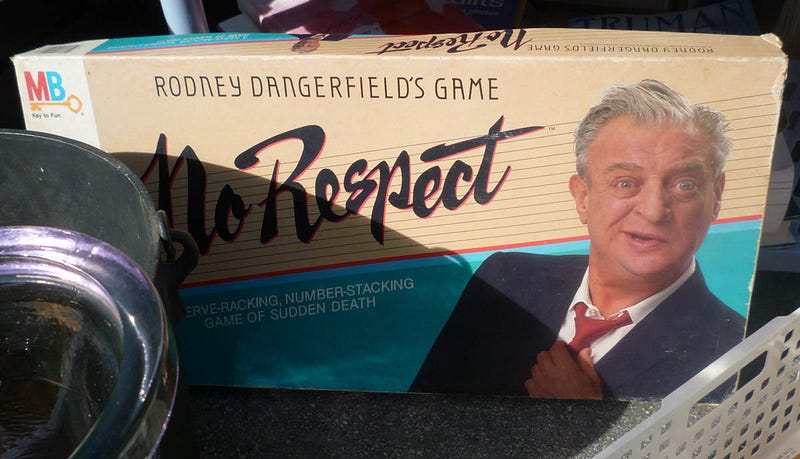
For the younger folks out there who have never heard of Rodney Dangerfield, let me introduce him. Dangerfield, born Jacob Rodney Cohen (no relation), was a Jewish standup comic whose heyday was in the 1960s. His celebrated catchphrase, spoken with requisite New York accent, was: “I can’t get no respect!”
At present, I think that Dangerfield’s line goes a long way toward explaining the fundamental grievance not only of Vladimir Putin but of modern Russia more generally. In 1972, the historian Theodore Von Laue wrote a book called Why Lenin, Why Stalin, revised in 1993 as Why Lenin, Why Stalin, Why Gorbachev. There, he laid out his view of Russia’s world historical kvetch: why can we get ‘no respect’ in the modern era?
Von Laue begins in the mid-19th century [full disclosure: many years ago, Von Laue was a college professor of mine]. The industrial and imperial powers of the West — Great Britain, France, Germany, and the United States — had formed an informal Great Power Club. Let’s call it the Cool Kids Table.
In order to be a member in good standing, one had to possess the economic and military prowess to compete with the others in the ongoing match for who would be the Greatest Power of Them All. That meant fulfilling the following requirements:
- the capacity to win wars
- the capacity to win and sustain a colonial empire
- the industrial capacity to support the first two endeavors
- the capacity to accomplish the above with the complete buy-in and cooperation of their own populations
While a feared land power in Europe with an enormous population, Russia was a perennial outsider to the Cool Kids Table. And, like an ungainly teenage boy desperately seeking a seat, it failed time and again to gain entry.
For one thing, Russia kept losing wars. In the Crimean War (1853–56), two cool kids, France and Great Britain, joined forces to prevent the would-be interloper from expanding his eastern empire to Crimea (which Putin, if you’ve been keeping score, annexed in 2014). In 1904–05, seeking colonial expansion in the Far East, Russia was humiliated by an entirely new kid at the now global table: Japan.
Russia became the first European power in the modern age to lose to a non-European nation — indeed, to a non-member of the club. Imagine the snickering at the Cool Kids Table! To make matters worse, Russia’s humiliation was overseen by one of the coolest kids of all, the American President Theodore Roosevelt, who brokered the peace.
Poor Russia. Ever a Great Power wannabe and ever a loser. Never able to keep pace with the West. Never able to get no respect. But why did this keep happening?
Here, Von Laue turns to the second two bullet points: industrial power and democratic participation. Both arenas found Russia — in Von Laue’s now verboten term — “backward.” I’ll substitute the word ‘lacking’.
Russia lacked a modern industrial base. In place of the busy, productive, entrepreneurial middle class that graced the western powers, its massive population was composed largely of uneducated, pre-industrial peasants.
Russia also lacked a modern political base. It was a lumbering czarist autocracy. Unlike the West, Russia possessed no cadre of patriotic citizens whose national loyalty had been secured through democratic freedoms and constitutional participation in their own government.
Von Laue emphasizes these two points — Russian’s lack of an industrial base and its lack of an industrious and nationalized citizenry — repeatedly. The populations of the West, he argues, were historically privileged and continue to take their privileges for granted.
The Secret Sauce: A Protestant Work Ethic
But where did those privileges come from? At the core of western power and productivity, Von Laue suggests, lies a largely invisible and unacknowledged advantage: the Protestant work ethic.
The originator of the term ‘the Protestant Ethic’ was the brilliant turn of the 20th century German social theorist, Max Weber. He posited that a formerly religious — specifically Calvinist — cast of mind had become secularized in the West by the 19th century and came thereafter to underlie modern industrial capitalism, not to say modern life more generally.
For Von Laue, the Protestant Ethic constitutes the secret sauce that rendered western freedoms, both economic and political, sustainable. It solved the modern riddle of the Sphinx: How might a state allow its people to do what they want without unleashing anarchy and violence? And better yet, how might such freedom generate an orderly and productive society?
The Protestant Ethic required its adherents to work hard and exercise a disciplined rationality. While originally meant to display one’s godliness, this habit of mind ultimately carried over into the business of day-to-day life.
The result was that social discipline, which had formerly required the authoritarian coercion of kings and governments, became internalized in the individual. In other words, the Protestant Ethic substituted individual self-compulsion for the external compulsion of the Powers that Be.
The modern, self-disciplined, self-regulating workaholic was born.
Western nations (members of the Cool Kids Table) could now liberate citizens to participate in politics and regulate their own economic activity without inviting social turbulence or violence. On the contrary, Von Laue suggests, such individual freedom, multiplied many times over, generated national productivity and power.
I should note that Max Weber was no fan of the Protestant Ethic, which he famously likened to an “iron cage.” Nor was he a fan of modernity, which he equated with what he called the ‘rationalization’ and ‘disenchantment’ of life in the developed world. (Weber was himself both a hyper-productive workaholic and the victim of major depression.)
I should also note that the work ethic, stripped entirely of its western religious origins, spread globally. By the early 20th century, a version had taken root in Japan and in western colonial empires, bearing with it the iron cage of modernity.
What if you Lack a Protestant Work Ethic?
But, returning to Von Laue’s account, while the Protestant Ethic emerged in the West by historical happenstance, it failed to penetrate Russia. The result would prove catastrophic.
It will be recalled that Russia wanted desperately to gain respect as a Great Power — to play big-boy games at the Cool Kids Table. It never renounced that ambition.
Absent a free, self-disciplined populace, however, it tried to catch up with the West in the only way it could: forcibly, from the top down. Initially, it failed. An early 20th century attempt at state-instigated industrialization went for naught, as did a halfhearted stab at parliamentary government.
Nevertheless, in 1914, Russia entered the bloody match over who would be the Greatest Power of Them All, otherwise known as World War I. But it did so without a sufficient industrial base or a disciplined and loyal populace.
The Czar sent what he had to the front: unschooled and ill-trained peasant-soldiers. The outcome, Von Laue argues, was no less tragic for being predictable. Consistently humiliated on the battlefield, the Russian army suffered enormous loss of life. Finally, as Lenin famously put it, Russian soldiers began to vote with their feet — that is, to desert en masse. The Czar fell from power.
Following the Bolshevik Revolution of 1917, Lenin made peace but at great cost. The Russian Empire was forced to cede the Baltic States to German control. And, of great significance at present, it also agreed to recognize Ukrainian independence.
Lenin, in other words, traded Russia’s status and respect as a Great Power for the survival of the newly declared Soviet Union. But Stalin would not forget Russia’s humiliations at the hands of the Cool Kids.
Von Laue interprets Stalin in a particularly novel way: not as a communist internationalist so much as a “Russian patriot[s] in Marxist disguise.” And Stalin continued to seek what Russia had always sought in the modern era: recognition and respect from the West as a Great Power.
In a 1931 speech, which Von Laue quotes at length, Stalin put the matter bluntly and in all too familiar terms. Russia had been “beaten by the French and British capitalists,” he lamented, and “by the Japanese barons.”
As for why that happened, his answer was equally familiar. “All beat her for backwardness, for military backwardness, for cultural backwardness, for political backwardness, for industrial backwardness.”
But Russia, he maintained, must continue to play at the Cool Kids Table— and now it has no choice but to win. While we are “fifty or a hundred years behind the advanced countries, [w]e must make up this lag in ten years. Either we accomplish this or we will be crushed.”
Stalin, in short, spun a nationalistic melodrama with Russia as the ever-victimized hero and the “advanced countries” as the ever-bullying villain. But he still had to confront what Russia chronically lacked: a modern industrial base and a citizenry possessing an ingrained work ethic.
So, he instigated a brutal, centralized, state-controlled program of forced industrialization. His notorious 5-year plans, begun in 1928, successfully modernized industry and retooled the Soviet military within a decade.
But again, the cost was immense. Peasants were forced from their lands into collective farms, and the Soviet state starved and murdered the millions who resisted.
By Von Laue’s lights, however, Stalin’s totalitarianism paid off. In World War II, the modernized Russian army valiantly stood its ground against Hitler’s onslaught. Russia survived and emerged victorious.
But once more, the Soviet Union sustained unfathomable losses. According to recent estimates, it suffered over 20 million military and civilian casualties — that is, much more than the newly crowned king of the postwar nuclear superpower Club, the United States. Russia has neither forgotten nor forgiven that disparity.
What about Mikhail Gorbachev?
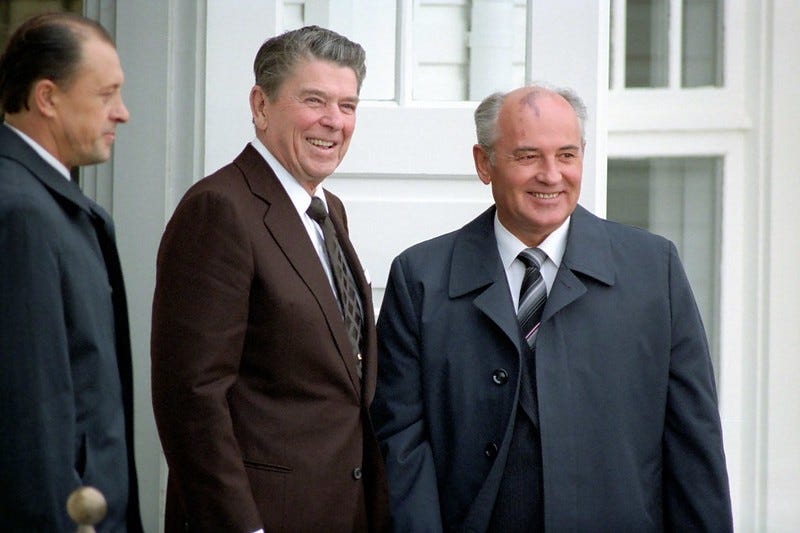
One might surmise that the last Soviet leader, Mikhail Gorbachev, was an exception to Von Laue’s rule. But he in fact epitomized it.
Now the junior member of the postwar nuclear-Superpower Club, the Soviet Union still lagged behind its rival economically. With Russian resources exhausted by the competition for global power, Gorbachev withdrew from the Cold War in the late 1980s.
He hoped to render the Soviet system more nimble and competitive by loosening the screws of Stalinism. So he initiated the domestic reforms of glasnost (openness) and perestroika (restructuring), which were meant to resuscitate the Soviet system by allowing the oxygen of economic and civic freedom into its bloodstream.
But Russia, Von Laue reiterates, still lacked a citizenry disciplined by an internalized work ethic. To withdraw state compulsion under such circumstances was to invite violence and chaos rather than order and productivity. The consequences, by Von Laue’s historical logic, were all but foreordained.
With its totalitarian state de-fanged, the Soviet Empire came apart at its seams. Absent the invisible glue of the Protestant Ethic, which guaranteed national loyalty and productivity in the West, enhanced individual freedom led to social disarray. Worse yet, the non-Russian ethnic nationalities that the Soviet Union had stitched onto its imperial corpus — the likes of Ukraine, Georgia, and Chechnya — forsook mother Russia and declared their independence.
Were Von Laue alive today, the most current version of his book would surely bear the title, Why Lenin, Why Stalin, Why Gorbachev, Why Putin. For Putin is nothing if not a latter-day Stalin. Following the geopolitical humiliations of the 1990s — a Cold War competition lost to the ever-reviled West and the demise of the Russian empire — he set about forcing the lid of the state back onto the boiling cauldron of Russian society.
Putin is currently offering the latest echo of Rodney Dangerfield’s perpetual whine: “I can’t get no respect.” But unlike Dangerfield or his courageous Ukrainian counterpart, Putin is no comedian. He is a brutal totalitarian nationalist seeking to recapture the global power and respect once held by the Soviet Empire regardless of the cost.
Is there an Antidote to the ‘Dangerfield Syndrome’?
So, what are we to make of Von Laue’s historical model? Is it true? Does it render the final verdict on Russia in the modern age?
Historians of modern Russia would surely object. Von Laue, I can hear them say, is an unapologetic historical determinist offering a variation on outmoded theories of “national character.”
However elegant his argument might be, they continue, it is too reductive. History is complex and contingent; it is never foreordained.
I agree. And that was how I argued against his views when he was my teacher. So let me offer an alternative that might retain his historical insights while discarding his determinism.
Suppose we liken a nation’s history to the history of a traumatized individual. And aren’t we all trauma cases of one sort or another?
Let’s say that in childhood, we have suffered severe abuse, deprivation, illness, or injury for which we were not prepared. In response to those events, we have developed the symptoms of post-traumatic stress syndrome.
Perhaps we are plagued by chronic insomnia and panic attacks. Or worse, by paranoia, psychosis, or major depression. We revisit the trauma unconsciously by telling ourselves the same story about it over and over.
That leads us periodically to reenact it in our relations with others. We seek, perhaps, to replay and resolve the trauma by gravitating toward the same kind of people who set it off. And we often end up getting burned yet again. Or, in situations that remind us of the trauma, we might become brutally aggressive.
Freud, of course, labelled such behavior as “repetition compulsion.” The key term here is “compulsion.” We feel compelled by outside forces, as if our free will has been overtaken by the puppet-master of our past. And tragically, our lives become more or less reduced to our trauma and the story we tell ourselves about it.
What if nations tell themselves such recurring and sometimes self-destructive stories? That seems more than likely given that most modern nations were conceived in traumatic upheaval — wars, revolutions, coups — and the tales that emerged from it.
Such, I think, is Russia’s “no respect” narrative. It does not reflect some innate national character. Rather, it has resulted, as Von Laue would have it, from a set of unlucky historical circumstances.
Above all, it emerged from Russia’s lack of a Protestant Ethic or its equivalent in an era of industrialization and imperial competition in the West. For that reason, traumatic losses and national humiliations have pock-marked its history since the 19th century. The result has been what I’m calling “The Dangerfield Syndrome.”
But neither that history nor Putin’s apparently compulsive aggression at present are foreordained. Like traumatized individuals, nations have been known to free themselves from self-destructive life-stories and rewrite their own destinies.
But that requires honest self-reflection. Since the past can never be erased, such national redemption can never be complete. Nor can it take place absent the suffering that attends authentic self-examination.
But it has happened. Witness South Africa’s Truth and Reconciliation Commission (1995–2002). Or Germany’s ultimate reclamation of its national narrative following World War II.
Obviously, my analogy between individual and national self-redemption remains entirely speculative. I offer no wide-ranging scholarly evidence for it, Nor do I plan to write no book about it.
But it does remind me of an old therapy joke. Question: how many therapists does it take to change a light bulb? Answer: only one. But it must want to change.


