
Ukraine
Russian Armed Forces Hardware: Ukraine Degradation
How seriously have the Russian Armed Forces hardware levels been degraded by the Ukraine conflict? I’ve tried to assemble some numbers to give me an idea, but inevitably the fog of war clouded the picture
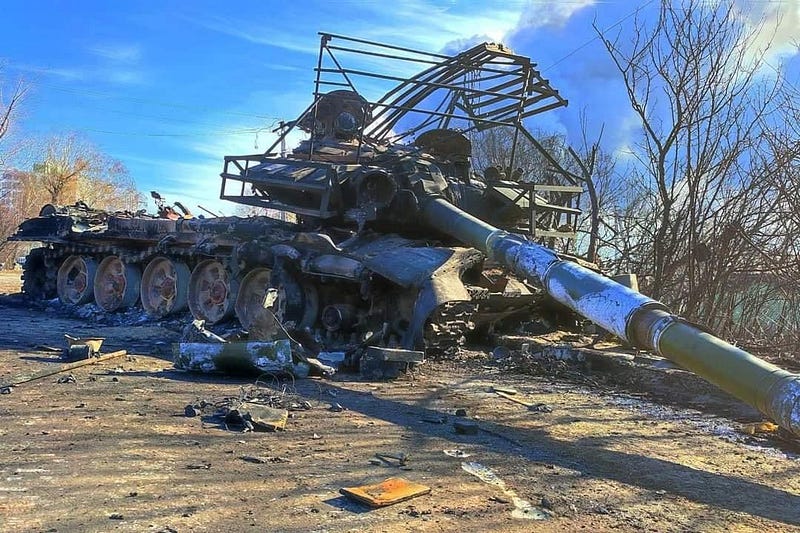
This article is about the estimated levels of armoured hardware and aircraft in Russia’s arsenal. I have then tried to estimate the degree to which the inventory has been degraded by the now 3 months old Ukraine war.
Methodology
To get the inventory numbers I looked at 4 main sites:
- Profolus
- Statista
- Global Firepower
- Wikipedia
I have no idea how these sites have collated their data, with the exception of Wikipedia which is by far the most comprehensive and with all inventory counts referenced, for better or for worse. It’s quite amazing what’s in there.
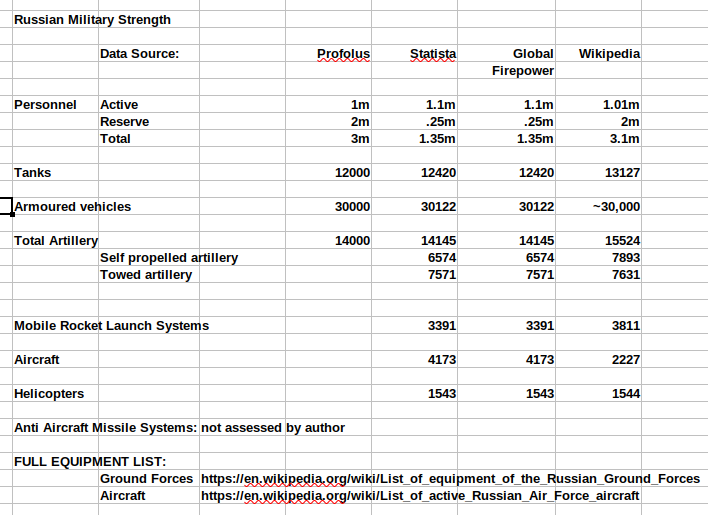
With respect to the sites other than Wikipedia, it appears that they are just quoting Statista numbers (for which I have not paid a subscription fee). You can see what I can see.
I then used Oryx, an open source intelligence site which tracks Russian (and Ukrainian) losses in detail, using geotagging, photos and other data validation methods.
I also included the latest Russian losses as claimed by Ukraine, which I would expect to be inflated as a matter of course.
This gave me a picture of the level of Russian equipment losses in comparison to their total inventory.
But it is war, and even Wikipedia data may be dubious.
Equipment losses — data concerns
When I looked closely at the numbers of losses there was such a huge disparity between the Oryx and Ukraine numbers that I began to doubt the currency of the Oryx data and whether their data was still being maintained (no small task).
If indeed the Oryx data is bang up to date and accurate then I would have to say that Russia would not have suffered all the reverses that we have seen reported in the last seven weeks or so since I first wrote about Russia’s battlefield losses on April 3rd.
Of course you can argue that this is whole exercise is like Swiss cheese anyway, but at least it’s something to think about.
It would be theoretically possible to trawl the Oryx data and find out what the last posted date was, but that’s a huge exercise well beyond my scope. And even then it wouldn’t guarantee any accuracy.
So, it’s a best endeavours exercise, warts and all.
Classification of hardware
You will see from my spreadsheet below the classifications of major hardware. I have not listed anything down to the level of mortars and small arms (little data) or the likes of staff cars.
I included personnel just as a matter of interest. Lives don’t seem to matter to Putin, but the UK Ministry of Defence calculates that the Russian military death toll now matches that of the ten year war in Afghanistan [paywall].
Generally, the classification of the hardware is straightforward, with a couple of exceptions:
- Armoured vehicles — these could include, for example, armoured mine clearance vehicles, armoured bridging equipment and so on, and I have no way of knowing what sites other than Wikipedia has included. There are so many flavours on Wikipedia that I gave up counting. Wikipedia does a really good job and I was amazed at their level of discrimination. So thanks to all the people out there (including some in Russia) who worked on those numbers and collated the data from multiple sources.
- Aircraft. This one stymied me. Wikipedia has about half the numbers that the other sites quote. I suspect that the other sites have included helicopters in aircraft as well as listing them separately, but maybe I’m misreading the data.
So, how much hardware does Russia have?
I doubt if they really know themselves. Here’s my data comparison between the sites:
Tanks
I’m writing a short paragraph about these in particular because they have played a central disastrous role so far for Russia.
Defenceblog.com wrote in 2020 that:
Citing an open-source intelligence report from military experts, Lenta.ru reported that the Russian Army has in total 2685 main battle tanks in their active inventory.
“The total number of combat units listed [in the publication] above is 2685 tanks. The total number of new and upgraded tanks (produced in 2000 and later) in combat units is about 1200 units or about 45 percent of the total, ”the report says.
Apparently Russia is sending in T-62 reserve tanks. These are very old technology and relatively poorly armoured. The video (unverified) is from the Ukraine Official Telegram channel.
Wikipedia does not list any T-62s in the Russian inventory, but Russia does apparently have 7,000 T-72s in reserve.
Pinch of salt? Or mis-identification? I’m no expert, but maybe you can tell which type of tank it is.
So, the number tanks in active service pre-invasion is open to question.
They might have huge numbers in reserve, but whether they have been properly mothballed (and are being properly re-activated) is another question. And how many tank crews do they have in reserve?
Update: 28 May 2022
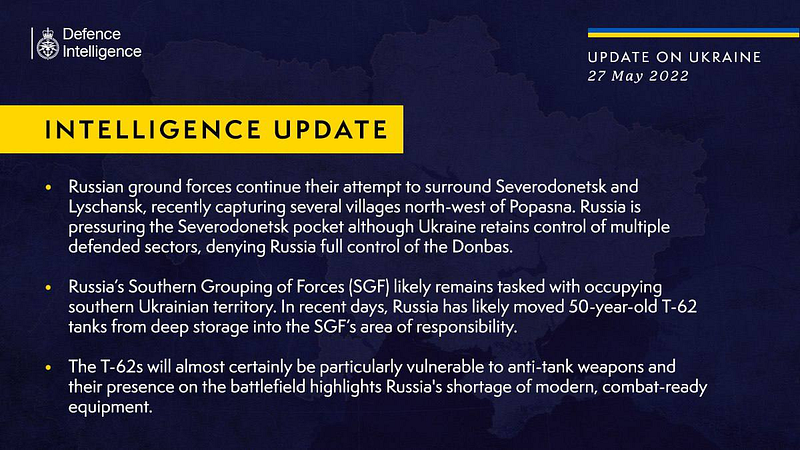
So there you have it. I don’t know why they were not listed in Wikipedia. Will they work properly, will they be just coffins for conscripts?
Surely a sign of desperation?
END OF UPDATE
Force degradation
To get back to the main thrust of this article I’ve gone with Wikipedia numbers from my spreadsheet above and compared the level of Oryx-reported losses as of 26 May 2022.
Here’s the picture:
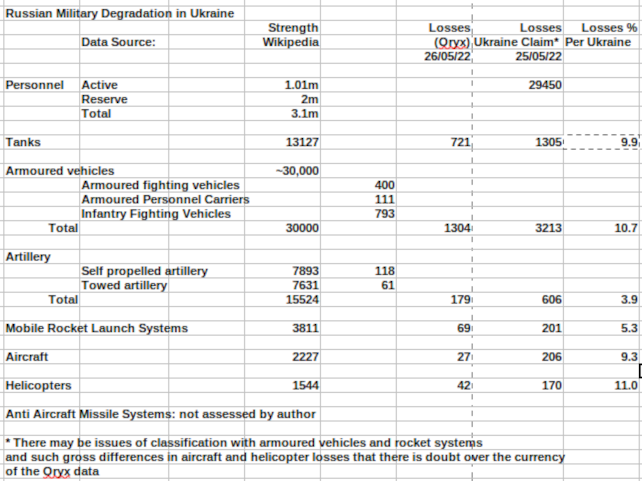
The range is wide, of the order of 4%-10% losses using the Ukrainian numbers.
And the Ukraine claims in full (25 May 2022):
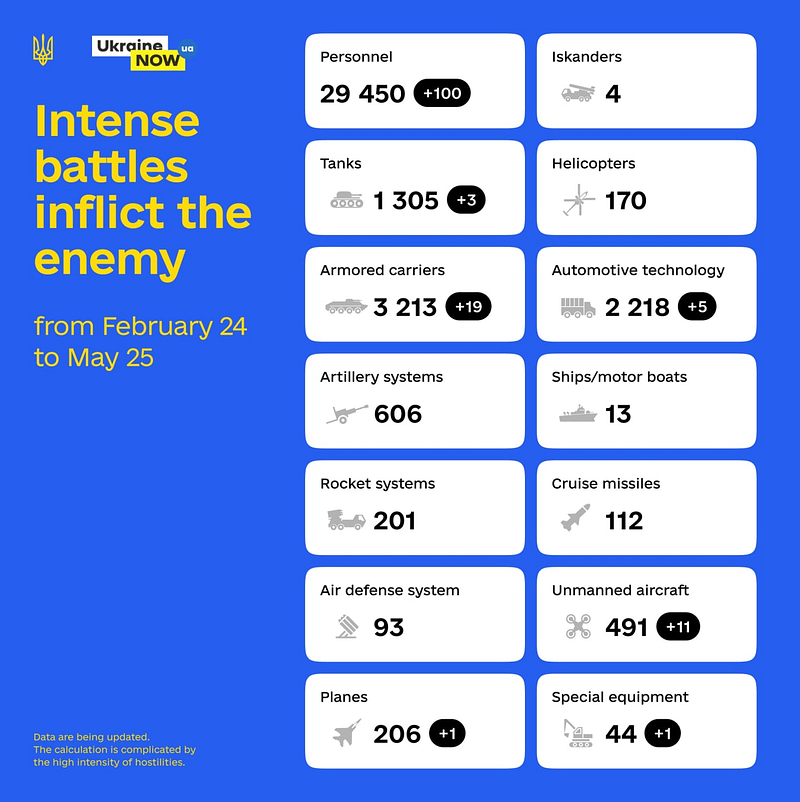
Conclusions
It’s very foggy out there.
The data is dubious and if indeed Oryx has stopped maintaining it then that’s a shame because it was a valuable exercise but recognisably costly.
As I wrote earlier, I doubt that Russia would have suffered such serious reverses if their losses were at the levels Oryx is currently showing, but I’m certainly no expert.
There are indications that the Russian military is getting its act together in the Donbas having learned many lessons from the early days of the war.
This is now a war of attrition, with Russia’s huge advantage of matériel offset by the poor morale of its forces and the determination, commitment and higher morale levels of the Ukraine forces.
Final note — desperation?
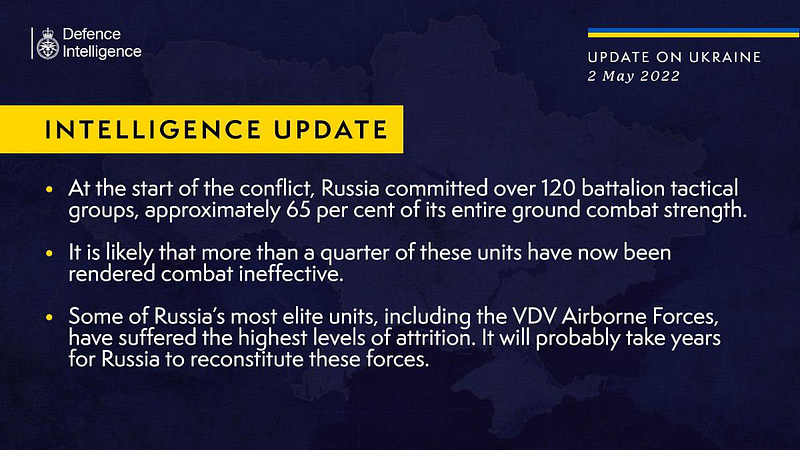
On 28 May 2022, Russia announced that it has scrapped its age limits on military recruitment of professional soldiers.
Putin has signed a law enabling people over 40 to enlist for the armed forces. They are expected to be people of normal working age.
Previously the army had age limits of 18–40 years for Russians and 18–30 for foreigners. — BBC
Sources: Profolus, Global Firepower, Statista, Wikipedia (ground forces), Wikipedia (aircraft)
About me: If you follow me I guarantee variety in your inbox! I write on a wide range of topics including humor, tech and travel, together with daily news events and the minutiae of my daily life living on a boat. I also write techno-thrillers…and about…
…the fog of war, murky data and doubtful claims
If you appreciate stories like these and want to support other writers and me, consider signing up to become a Medium member. It’s only $5 a month, giving you unlimited access to incredible stories on Medium. If you sign up using my link below, I’ll earn a small commission at no extra cost to you.
Or maybe just buy me a coffee?
