
Ukraine War
Russia Worries That Ukraine Might Get Australia’s F-18s
These aircraft may be better suited to Ukraine’s needs than the F-16s
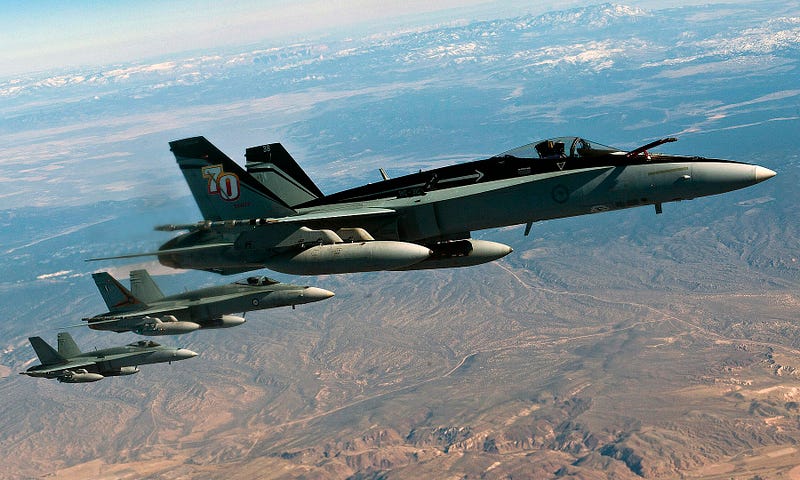
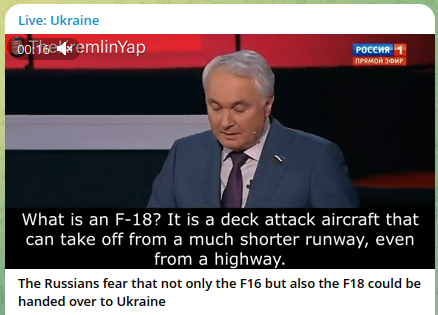
The Russian media has picked up on the benefits to Ukraine of these aircraft and appears to have some concerns!
The Hornet swarm
The F-18 (Hornet and Super Hornet) family are US Navy planes designed for carrier deployment, but also used by the US Marine Corps deployed from conventional runways. The Hornet was also sold to Australia for land deployment by the Royal Australian Air Force (RAAF). 75 aircraft in the A (57) and B (18) variants were supplied. Then the Australian Government ordered 24 F/A-18F Super Hornets in 2006. This design is significantly different from the original (or “classic”) Hornet. The RAAF’s first Super Hornets entered service in 2010 and deliveries were completed the next year.
The Russian media story is misleading (surprised?) because the F-18 actually needs a longer runway than an F16 except that on a carrier the F-18 is launched by catapult.
The terrestrial version of the ‘classic’ Hornet was used by the RAAF during the 2003 invasion of Iraq. They were retired in 2021 and may be transferred to Ukraine. 41 aircraft are believed to be available.
Comparisons
Because they were designed for carrier deployment, they have strong landing gear and robust airframe, features which would be beneficial to Ukraine’s needs. These features would allow Ukraine to fly off from damaged or less than perfect runways, and land. In contrast, the F-16 is relatively less robust and less tolerant of runway issues.
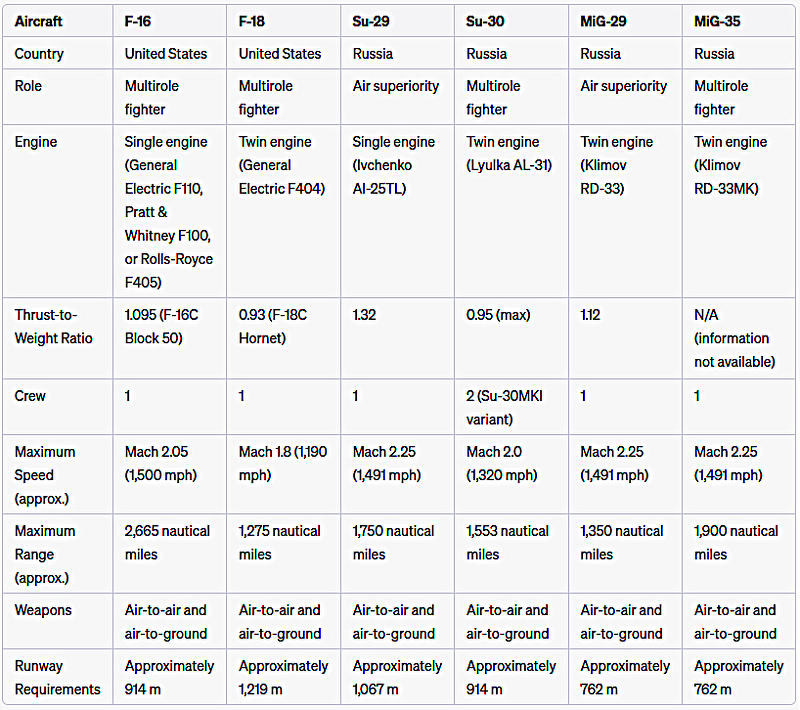
The F-18 Hornet and F-16 Fighting Falcon have different engine types and configurations, which contribute to the differences in their thrust-to-weight ratios. Although the F-18 Hornet has twin engines, they are generally less powerful than the single engine used in the F-16.
The F-16 is a lighter and more manouverable aircraft than the F-18.
Here’s a comparison, including the nearest Russian equivalents. The Mig-29 is also used by Ukraine:
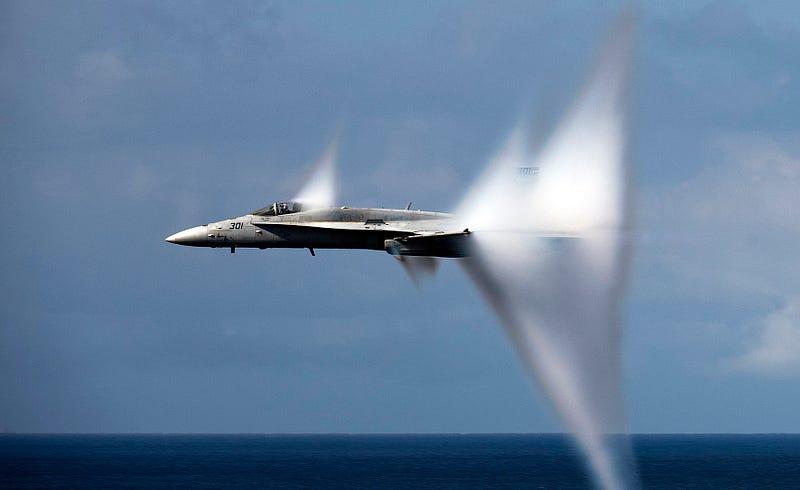
Radar and avionics
Radar is a critical component for Ukraine if they are to deter the Russian KA-52 helicopters that have been causing problems for armour in the counter offensive. However, the latest news is that Ukraine has downed four KA-52s in a couple of days (June 19), so they seem to have found a way to counter the threat.
Newer variants of the F-16, such as the F-16E/F Block 60 and F-16V, are equipped with more advanced radars like the AN/APG-80 or AN/APG-83 Scalable Agile Beam Radar (SABR), which offer enhanced detection ranges, improved target tracking, and greater resistance to electronic countermeasures. This is ‘non-mechanical’ and uses an electronic phased array for scanning.
The F/A-18 Hornet, specifically the earlier versions prior to the Super Hornet, was equipped with the mechanical scanning AN/APG-65 radar. The AN/APG-65 is a pulse-Doppler radar that operates in the X-band frequency range using a moving antenna to transmit and receive radar signals. The AN/APG-65 radar provides the F/A-18 Hornet with air-to-air and air-to-ground surveillance and targeting capabilities. It offers features such as target detection, tracking, and engagement in both beyond-visual-range and close-range scenarios.
Wikipedia: For air-to-air operations it offers a variety of search, track and track-while-scan modes to give the pilot a complete look-down/shoot-down capability. Air-to-surface modes include Doppler beam sharpened sector and patch mapping, medium range synthetic aperture radar, fixed and moving ground target track and sea surface search.
In the F/A-18, the radar is installed in a slide-out nose rack to facilitate maintenance. Obviously the mechanical radar had moving parts and therefore requires more maintenance than the F-16’s SABR.
During the RAAF Hornet Upgrade Program phase 2.1, the APG-65 radar was replaced with the improved AN/APG-73 (1992): more memory, faster throughput and simpler maintenance.
A bit of Australian spying?
[Thereafter] the RAAF’s Hornet fleet received few modifications until the late 1990s. During this period, the AN/AAS-38 “Nite Hawk” targeting pod was the only new system fitted to the aircraft. Australia also managed to break the codes which prevented modifications to the Hornet’s radar software after the US Government refused to share them. This enabled the software to be adjusted so that all of the aircraft operated by Australia’s neighbours could be designated as hostile. In his final address to Parliament, former Minister for Defence Kim Beazley stated that he had raised access to the radar system repeatedly with the US Government during the 1980s, and “in the end, we spied on them and we extracted the codes ourselves” (Wikipedia)
Weaponry
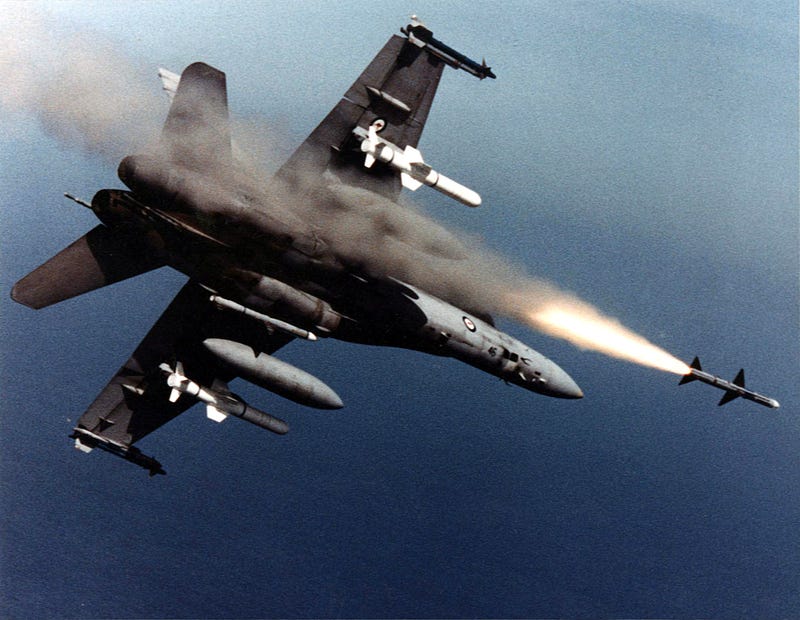
The Hornets are equipped with an internal M61A1 cannon for use against air and ground targets; 578 rounds can be carried for this weapon. The original aircraft were equipped with AIM-9M Sidewinder short-range air-to-air missiles and AIM-7M Sparrow medium-range air-to-air missiles. The Sparrows were replaced by the AIM-120 AMRAAM in 2002, and in 2004 the Sidewinders were replaced by ASRAAMs (Wikipedia ibid.)
Downsides
On the downside for the F-18 will be maintenance management, because none of Ukraine’s geographically close NATO neighbours has the facilities, skills and spare parts for support.
In an interview reported by Yahoo News, an aviation specialist named Romanenko said:
The expert said the closest country that could assist Ukraine in the maintenance of F/A-18 Hornets would be Spain, necessitating the transportation of the aircraft across Europe.
“They are also in service with Finland, but Ukraine does not have direct (overland) communications with that country, and no one will transport these aircraft there for repairs,” Romanenko added.
“Canada and Australia are also options, but they are even more distant possibilities,” Romanenko concluded.
The addition of the F18 would add another management and training complexity to the Ukraine aircraft fleet, although the weapons inventory would be similar to that of the F-16.
In the case of a very protracted ‘special military operation’, the F-16 is still in production, whereas the F-18 is not.
Other countries
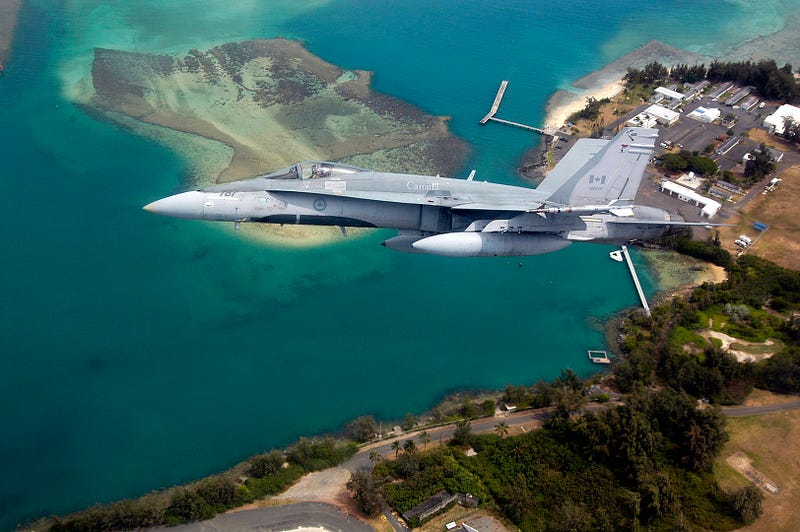
Other countries having the F18 in operation are Canada, Malaysia, Kuwait, Finland, Switzerland and Spain.
It’s interesting to note that Canada has false cockpits painted on the underside of the fuselage to help confuse enemy pilots during dogfights.
The Russian view
Follow me and I guarantee variety in your inbox with some unusual perspectives! I write on a wide range of topics that interest me including humour, tech, space, geopolitics and travel. I also write about…
…insects with a sting

My novels are available at my Gumroad bookstore. Also at Amazon and Apple
Author’s note: The concept, structure, style and creative content in this story are all my own and I hope that is obvious to a reader. I do not employ third party writers. However, I do occasionally use an AI assistant to research and present small sections of factual content and data. All facts are checked where possible and sources quoted.