
Russia to “Purge” Ukraine
And boom, just like that a country is invaded
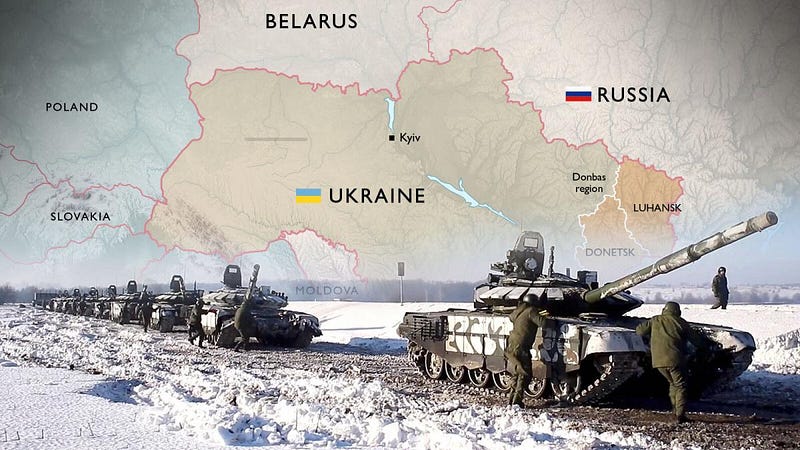
War to us might seem like such an ancient concept, but WW2 wasn’t even that long ago. While it might feel to us unconscionable to just simply invade another country (and let’s call offensive war what it is: state-sanctioned theft and murder), but to a realist like Putin, who sees the international system as being in a state of anarchy, might is right. — Although obviously, he is taking notice of the liberalist sensibilities of the Russian populace and as such has given his offensive a grand whitewashing suited particularly for the Russian taste. (And not anyone else apparently. Goebbels would be turning in his grave. A superior race and a historic destiny, now that’s a myth for war).
This notion of might-is-right has only been reinforced by the months-long lip-service paid by the EU and the US with who seem to think that ‘rules-based order’ can be maintained through sanctions and shaming. Liberals might want to rethink their strategy, as it doesn’t take much for people to start to realize that a rules-based order only works when the majority follows the rules. If such a system were to break down, the benefit would fall to the ones who were earliest in opting out; and no one wants to be left holding the bag. That tone does seem to be changing a little now especially in the UK with a Tory PM calling for a military response and in France with the French foreign minister reminding Russia that NATO too has nuclear weapons. But it’s too little too late. The West allowed this to happen — not only by their initial inaction but by years of pushing NATO eastward and isolating Russia — and it remains to their chagrin that the nations that Ukraine reached out to did not offer their support or that NATO has not stood up to Russia in demanding a halt to air raids that by their nature compound civilian casualties.
Unless of course, someone has made a deal with the Russians over Ukraine… Though more likely — like Transnistria, Crimea, and Georgia, and given that Ukraine was not quite in fold anyways — Ukraine might just not be seen as worth sinking the boat over. Putin has warned of “the greatest consequences in history” if anyone interferes — a reference likely to the use of nuclear weapons. Whether Putin is sadistic enough to use them is anyone’s guess, but what looks like sadism is often the potential consequence of out-of-control security dilemmas, be they military or economic (or, in the case of the US and Japan, as a result of callous calculations).
To make matters more tricky (and a possible reason why the EU was reluctant to draw a line in the sand with Russia) is that Russia is the biggest supplier of gas for the EU; in fact at 40%, with one of the 3 major pipelines going through Ukraine, the EU would likely be crippled in the short term if those supplies were shut off. — Not to mention wheat production, which is of concern to the rest of the world as well, especially at times of supply chain crisis, given that Russia and Ukraine together produce about 14% of the global supply.
And not to be totally Russian-shaming (although I am totally opposed to the Russian invasion), it’s clearly a rationalist move by Russia to widen their sphere of influence and forestall western encirclement. Ukraine was inching closer to joining NATO. If that were to happen, Russia would be encircled and be forced to share a large, open border with what they consider a hostile force. An invasion of Ukraine lies within the scope of Russia’s best interests. — And the West has not done it’s utmost to parlay some of those interests into ones that would better serve the cause of peace in the region.
Besides the military or balance of power threat posed by NATO, another likely influence on Putin’s decision to invade is that around 30% of Russian GDP comes from natural gas (accounting for around 50% of the government’s income). For a long while, the EU has been heavily reliant on Russian gas. Recently it was found that Ukraine is home to significant oil reserves, and with the help of western technology and investment, it wouldn’t take long for Ukraine to be a world-class supplier of gas and a direct competitor of Russia. If Ukraine was in NATO, the EU would be nearly completely self-reliant, and Russia would lose a vastly significant portion of its wealth, plunging it back into impoverishment.
This might give us some clues about what Putin’s endgame is. He might dream of a USSR 2.0, but for the time being, Russia is unlikely to be able to take over control of the whole of Ukraine — it would be a logistical nightmare. The most likely goal would be the annexing of a portion of Ukraine from the pro-Russian Donbas region, to the Kherson region which controls the water supply to Crimea, and to a land bridge linking Crimea with the pro-Russian Transnistria region of Moldova — effectively cutting off Ukraine from the Black Sea (and from significant oil deposits).
But, just like the US in the Middle East, this kind of barbaric manner of pursuing security interests is really so last century. This is the world realism gives us. That is not to say liberalism isn’t without its faults either, though it is much better at hiding it’s body count— there is a reason why Putin is leery of joining the fold. While there is very good moral reasons to choose the western model over the Russian (and Chinese) alternative, it doesn’t mean it has that much more moral high ground to stand on.
And speaking of China, this of course is quite concerning for Taiwan, given that China has long held aspirations of ‘reunification’, and Russia’s offensive is only likely to embolden them. Thankfully though — at least so far, even with the case of HK — blatant military force is not China’s style. China has a deeply rooted sense of saving-face, that Russia clear does not, so it packs more of a punch to garner the shame of the world. Let’s hope that still holds sway even as the world’s attention is on Ukraine.


