
Ukraine War
Russia: Pantsir Air Defence System Deployed In Moscow City
Moscow is beefing up its point defences with new Pantsir installations in the city itself — stoking up the public?
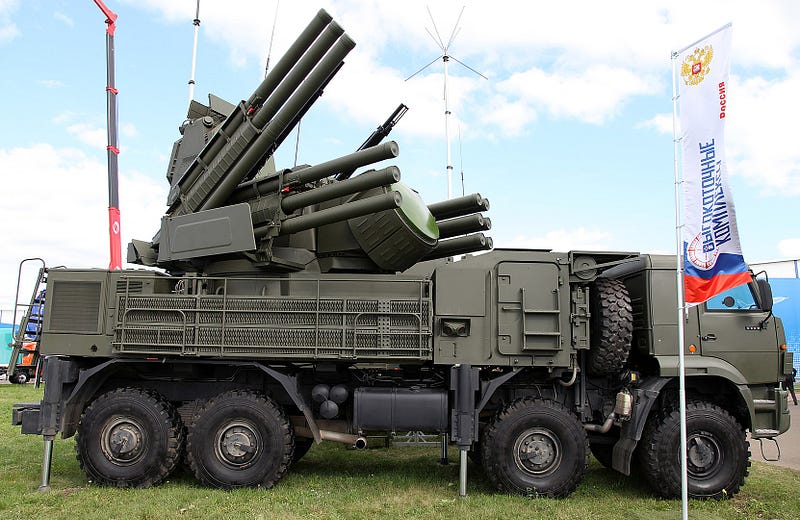
There are numerous press stories as well social media videos of Russian Pantsir air defence systems being deployed on rooftops in Moscow.
It’s a rather strange development given that Russia has a ring of S-300 and S-400 missile systems around the capital.
Why?
To answer that question we need to look at Moscow’s air defences.
The air defense systems surrounding the city of Moscow are, unsurprisingly, some of the most advanced and sophisticated in the world. They are designed to detect, track, and intercept any aircraft or missile that enters into the airspace around the city, and are a crucial component of Russia’s overall defense strategy.
The main component of the air defense systems around Moscow is the S-300 and S-400 missile systems. These systems are capable of detecting and tracking a wide range of aircraft and missiles, and can engage multiple targets simultaneously.
They can also engage targets at long ranges, making them extremely effective at preventing any potential enemy aircraft or missiles from getting close to the city.
In addition to the S-300 and S-400 missile systems, there are also a number of other air defense systems in place around Moscow. These include radar systems, anti-aircraft artillery, and the best of Russia’s fighter jets.
All of these systems work together to provide a comprehensive air defense network that can detect and intercept any incoming aircraft or missiles.
The air defense systems around Moscow are also integrated with other wide area defense systems, such as the Russian military’s early warning radar network. This network provides real-time information on the location and trajectory of any aircraft or missiles that are approaching Moscow, allowing the air defense systems to quickly and effectively respond to any potential threats.
In addition to its military capabilities, the air defense systems around Moscow also play an important role in protecting the city’s civilian population. They are designed to intercept and destroy any incoming missiles before they can reach the city, reducing the risk of civilian casualties and damage to infrastructure.
So, by increasing the number of Pantsir installations in Moscow, it could be possible to remove some of the S-300 and S-400 systems and redeploy them for use against Ukraine.
The S-300 systems have already been re-purposed for surface-to-surface use against targets in the Ukraine.
However by doing that it could indicate that Moscow sees no elevated threat from NATO.
But why not do this in St Petersburg?
Maybe they have already done it. There was report in September 2022 by a Finnish website that S-300 missiles from St Petersberg had been redeployed.
There may be other reasons too, such as bolstering public support for Putin’s bankrupt regime:
The Kremlin likely deployed the air defense systems in Moscow to generate inflammatory images that portray the war as more threatening to the Russian public. — Institute for the Study of War (Twitter)
Where’s the threat to Moscow?
I don’t believe that the threat to Moscow has changed. The main air defences have always been in place to defend against a NATO attack.
Ukraine has no missiles capable of reaching the Russian capital and is unlikely to acquire them or be able to build them. It would not be a good tactical move either.
It is remotely possible that kamikaze drones could be released near the capital by infiltrated Ukraine special forces. That might make headlines too, but bad from a publicity point of view. Much better to attack military targets which are actively engaged in the war.
What is the Pantsir?
The Pantsir-S1 was designed to provide point air defence of military, industrial and administrative installations against aircraft, helicopters, precision munitions, cruise missiles and UAVs; and to provide additional protection to air defence units against enemy air attacks employing precision munitions, especially at low to extremely low altitudes. (Wikipedia)
Interestingly, original Soviet strategic missile systems had been placed in fixed, hardened sites. Newer systems such as the S-300PS/PM (SA-10/20) were much more mobile which reduced vulnerabilities to attack. However, once the S-300 unit was found by enemy forces it was still very vulnerable to attack. One of the roles for the Pantsir-S is to provide air defence to the S-300 missile systems.
Modes of operation
There are four modes of operation. The launch platforms can operate independently or as part of a battery of up to six units with one of those being designated the master. They can also be individually controlled from a command post and also operate in automatic mode.
It’s also a very flexible system in targeting with:
- capability for anti-munitions missions
- targets on the waterline/above-water
- operation while in motion
Target engagement
A key feature of the Pantsir-S1 system is the combination of a multiple-band target acquisition and tracking system in conjunction with a combined missile and gun armament creating a continuous target engagement zone from 5 m (16 ft) height and 200 m (660 ft) range up to 15 km (9.3 mi) height and 18 km (11 mi) range, even without any external support. (Wikipedia ibid.)
As well as two-faced search radar, the fire control system has an electro-optic channel with a long-wave thermal imager and an infrared direction finder, including digital signal processing and automatic target tracking.
One Pantsir unit can handle up to four targets simultaneously.
Armament
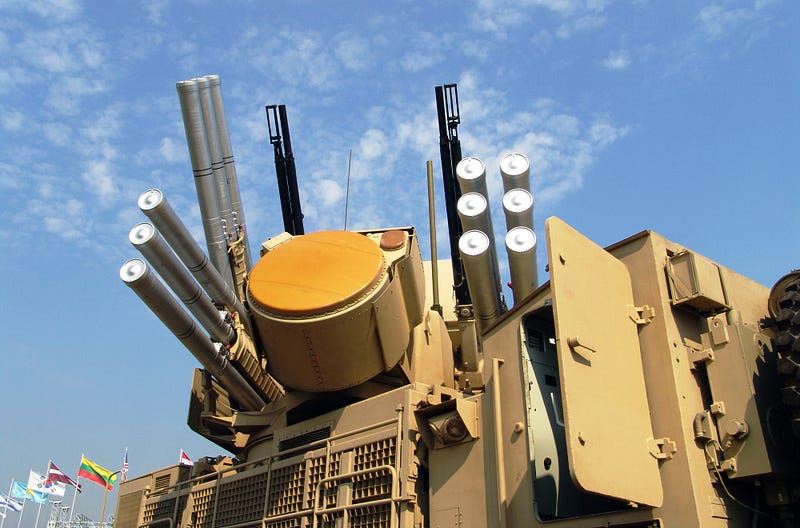
Besides 12 missile tubes (six on earlier versions), the unit has two 30mm autocannon.
A variety of missiles may be used, but typically warheads are about 20 kg in weight, 25% of which is explosive and the rest fragmentation or continuous rod.
The Pantsir-S2 has a range of up to 18 km (11nm) as compared with the S-400 range of 400 km (250nm).
The kill probability is about 70% and so two missiles are usually fired at one target, as the Pantsir is the last line of defence.
There’s a good video here (with a stilted AI voice) which examines the Pantsir’s strengths and weaknesses and explains why it doesn’t work against HIMARS GMLRS rockets.
The system has been widely exported.
Reliability
This is a hot topic for Russian weapons systems. Even the Pantsir’s effectiveness when it does work is open to question.
The US acquired a Pantsir-S1 during the Libyan civil war, and will have developed suitable ECM, but the Pantsir-S2 is a much upgraded version.
Putin’s very own Pantsir
In the Moscow region, near the village of Zarechye, another air defense system “Pantsir-S1” was installed.
It is just about 9–10 KM’s from Russian President Putin’s residence in Moscow.
— Source: Ukraine War Intel News on Telegram (20 January 2023)
This video has been circulating on Russian social media.
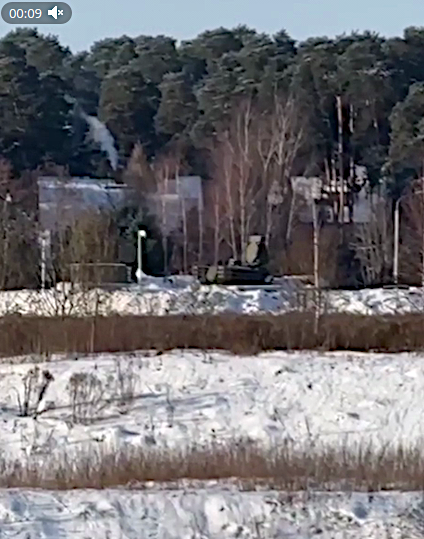
It’s hard to believe that someone could get that near (this is zoomed in with the camera, not my PC), and then post it on Telegram unless they have official support. More stoking of the Russian public?
And Moscow city’s very own
Here’s one fresh installation. There are several.

With more attempted.
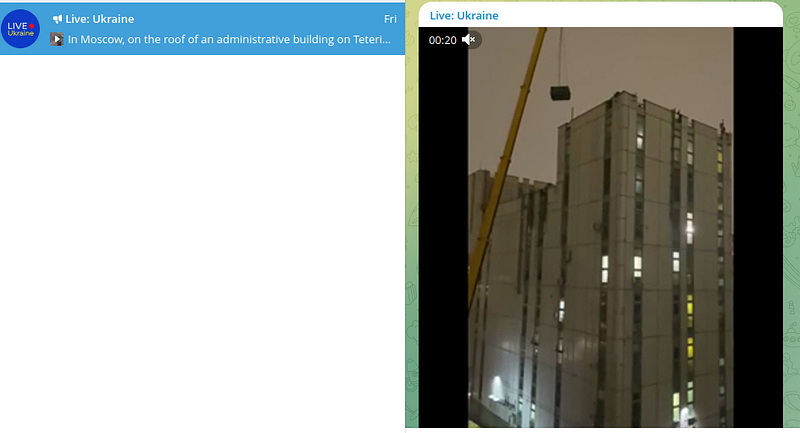
Whoever filmed that could be easily discovered — and taken away to prison. Unless it originated from the Russian government. I wonder?
Conclusions
I find it hard to arrive at any concrete conclusions about the Pantsir deployments, so choose from the following (or add your own):
- The Russians are re-deploying some of the S-300/400s
- They perceive an altered threat profile
- It’s a move to ‘bring the war home’ to the Russian population in readiness for the anticipated large scale mobilisation and below-the-radar conscription (altering the military service age band)
I suspect it’s a combination of 1 and 3. Unless you have a better idea.
About me: If you follow me I guarantee variety in your inbox with some unusual perspectives! I write on a wide range of topics including humor, tech, space, geopolitics and travel, together with daily news events and the minutiae of my daily life living on a boat. Yes, I really do live on a boat (some readers don’t believe that). I also write about…
… Putin’s Pantsoff
If you appreciate stories like these and want to support other writers and me, consider signing up to become a Medium member. It’s only $5 a month, giving you unlimited access to incredible stories on Medium. If you sign up using my link below, I’ll earn a small commission at no extra cost to you.
Or maybe just buy me a coffee? and tell me what you liked reading (or not)…


