
Ukraine War
Russia is Re-Writing its Warfare Manuals
A very bloody nose caused by Ukraine’s unexpected asymmetric tactics, new technology and a fully-engaged population should lead to Russia’s re-assessment of the use of BTGs (Battalion Tactical Groups) as a core operational unit
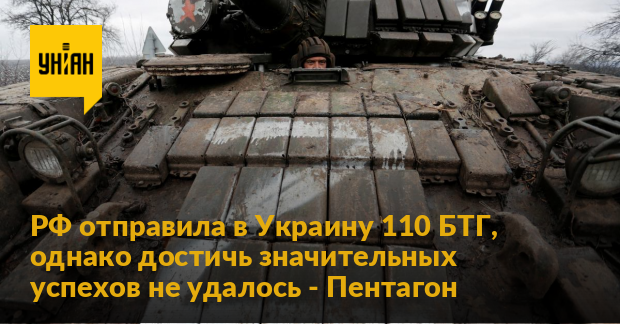

Battalion Tactical Groups are a core element in the operational structure and deployment of Russian armed forces, its ‘order of battle’.
However, following setbacks in Ukraine where Russia reportedly deployed 110 BTGs without success, it is believed that the doctrine may be re-assessed at the highest levels in the Stavka.
What are BTGs?
Battalion tactical groups are designed to be highly flexible and capable of conducting a wide range of military operations, including combat, peacekeeping, and counterinsurgency.
History
The structure has been used by the Russian Armed Forces for many years, although the specific structure and capabilities of BTGs have evolved over time. According to some sources, the concept of BTGs was first developed by the Soviet Armed Forces in the 1970s and 1980s, as a way to increase the flexibility and versatility of military units.
Since the collapse of the Soviet Union in 1991, BTGs have continued to be utilized by the Russian Armed Forces with some success.
Composition
The structure of BTGs varies depending on the specific mission and the resources available, but they are typically composed of a headquarters element, two to four companies of infantry and armor, and a range of support elements (such as artillery, air-defence, engineering, and medical units).
Formed from a garrisoned army brigade, the size of BTGs can also vary, but they are typically composed of around 500 to 800 personnel.
Command and control
The command and control of BTGs is typically organised around a central headquarters element, which is responsible for planning and coordinating the activities of the various subunits within the group.
The headquarters element is usually led by a high-ranking officer (such as a colonel or a general) and is supported by a staff of specialised personnel (such as intelligence officers, logistics officers, and communications specialists). Easily targeted.
Successful deployments
BTGs have been successfully used in a number of different contexts by the Russian Armed Forces. For example, they have been deployed to conflict zones, such as the wars in Chechnya and Georgia, where they have been used to conduct combat operations against enemy forces.
BTGs have also been used in peacekeeping missions, such as in Kosovo, where they have been responsible for maintaining order and stability in the region. Additionally, BTGs have been used in counterinsurgency operations, such as in the North Caucasus, where they have been tasked with combating terrorist and insurgent groups.
Combined ops
One of the key features of BTGs is their ability to conduct combined operations, which involves the integration and coordination of different types of military units (such as infantry, armour, and artillery) in order to achieve a common objective.
This is achieved through the use of advanced communications and command and control systems, which allow the various subunits within the BTG to coordinate their actions and share information in real-time.
The ability to conduct combined operations is particularly important for BTGs, as it allows them to effectively respond to a wide range of different threats and challenges.
Advanced technology
In order to facilitate combined operations, BTGs are typically equipped with a range of specialised equipment and technologies, including advanced communications systems, unmanned aerial vehicles (UAVs), and sensors. These technologies allow the BTG to gather and analyze real-time intelligence, which is essential for making informed decisions on the battlefield.
Additionally, BTGs are typically trained in a variety of different tactics and techniques, which allow them to adapt to changing circumstances and achieve their objectives in a variety of different environments.
Theory v practice
Overall, the ability of BTGs to conduct combined operations should be one of their key strengths — and has been in several conflicts.
But the reality on the ground in Ukraine has been very different. Russia deployed 110 BTGs to Ukraine, with no measurable success. Reasons (from my amateur perspective) included:
- poor force coordination
- HQs heavily targeted by Ukraine forces
- serious failures in communications infrastructure
- a patent lack of adequate security procedures
- poorly trained troops
- ill-maintained and poorly functioning equipment
Who can forget the images of Russian armoured columns on the road into Kyiv — sitting ducks with no dispersion or camouflage?
For example, on the 1 January 2023 Ukraine hit a Russian troop concentration sited next to an ammunition dump. Hundreds were killed. Command incompetence or lack of security? This is what the Russian Defence Ministry said:
A commission is investigating the circumstances of the incident, the statement.
But it is “already obvious” that the main cause of the attack was the presence and “mass use” of mobile phones by troops in range of Ukrainian weapons, despite this being banned, a spokesman said.- BBC
You can’t fix stupid.
Historically, the use of BTGs has proven to be effective for the Russian Armed Forces. But now?
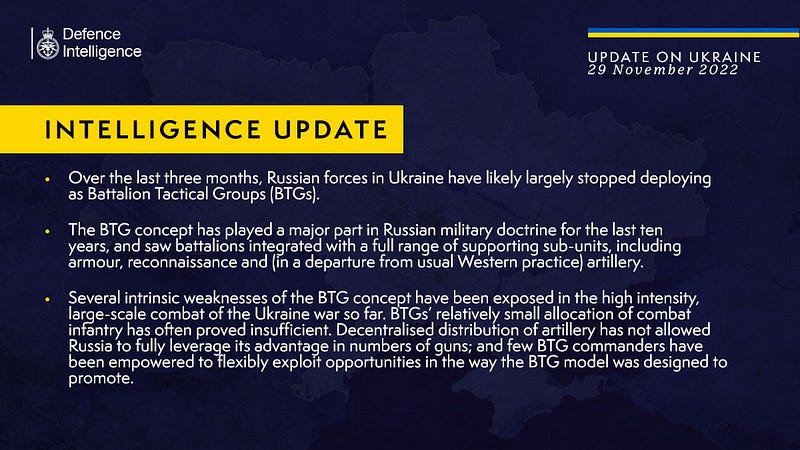
This is what the British MOD has said were the weaknesses of Russia’s use of BTGs in Ukraine (I have paraphrased):
- an insufficient allocation of combat infantry to achieve individual BTG objectives
- decentralized artillery deployment has diluted the effectiveness of Russia’s artillery superiority in numbers
- lack of the initiative required from field commanders to exploit immediate battlefield opportunities — this is a structural and training issue within the Russian forces and not easily resolvable.
Western equivalent of the Russian BTG
Note that the integration of artillery into BTGs is different to the practice of Western forces. The term ‘Combat Team’ is the nearest Western structure to BTG but the terminology and composition of BCTs varies between country.
In British commonwealth nations a combat team is a temporary combined-arms grouping of based on a combat sub-unit (an infantry or armoured sub-unit) with attached supporting arms. Canada differs.
In US Armed Forces usage, “combat team” is not defined as a term by itself but it is found in inside larger labels for combined arms formations such as regimental combat team and brigade combat team. US Army doctrine has at least once referenced an armoured battalion combat team — Wikipedia
An eye-opener
That Western model was an eye-opener for me as I’d assumed, as an ignorant armchair amateur, that all NATO forces had adopted similar structures. How in hell could they fight a joint land war in Europe as a unified functioning army?
I hope we don’t find out the hard way.
It’s pretty clear (I’ll not quote sources, but there are many) that the Russian invasion has so far failed.
But they may be learning as they lick their wounds, re-boot, regroup, and train up new troops.
And get more weapons from Iran.
How will 2023 look?
There have been suggestions that Putin is digging in and slowing down the pace (apart from missile strikes) to enable his military-industrial complex to ramp up weapons production - and for the Stavka to re-work its order of battle.
Certainly, the Russian forces seem to be better coordinated now under Sergei Surovikin, with a well-executed withdrawal from the indefensible west bank of the Dnieper in Kherson his first success, but the deeply ingrained nature of Russian commanders fear of initiative/failure will take a long time to change.
Even the use of BTGs, which has been drilled in to them, cannot be changed overnight. Changing military doctrine takes forever in Russia.
Will they learn any lessons and re-shape their BTGs?
Do they even compile a list of ‘lessons learned’?
Sources:
- “Battalion Tactical Groups: A New Approach to Warfare?” by Samuel Bendett, Jamestown Foundation, April 26, 2017.
- “Russia’s Military Reforms: Implications for the United States” by Stephen J. Blank, Congressional Research Service, July 29, 2016.
- https://thehill.com/opinion/national-security/3795467-ukraine-wars-outlook-in-2023-harder-fighting-against-a-tougher-russian-army/
Author’s note: The concept, structure, style and creative content in this story are all my own and I hope that is obvious to a reader. I do not employ third party writers. However, I do occasionally use an AI assistant to research and present small sections of factual content and data. All facts are checked where possible and sources quoted.