Russia and Ukraine: A Backstory View of the Conflict
Hello, I’m an analyst and consultant for legal and international affairs. Thanks for taking the time to view my writing. I’m not for war — as I stand for peace. But as a student and professional of international conflict I understand that every war has a backstory that is relevant to all parties to any conflict. Thus, every side of the story has its own backstory, and understanding the backstory to a conflict is one way to strive for world peace.
Fundamental Problem of the Russia-Ukraine Conflict
One of the fundamental problems between Russia and Ukraine is about NATO enlargement in Eastern Europe. Russia fears this would bring Ukraine into a Western security alliance that deters Russian influence in what is referred to as its “sphere of influence.” Russia demonstrated how far it was willing to go to protect its sphere of influence when Georgia fought a war against separatist territories, South Ossetia and Abkhazia, in 2008. After convincingly pushing Georgia’s military out, Russia recognized the separatists territories’ right to self-determination.
This fundamental problem of NATO enlargement has become more of a European-centric issue in recent years, as ideals for European strategic autonomy, security responsibilities and national sovereignty are being defined under the leadership of France and Germany in the European Union (EU). Since the United Kingdom left the EU, it’s likely that Russia is calculating whether the EU’s current defense posture can obstruct Russia’s advancements on Ukraine — for instance, the takeover of Crimea in 2014 left Russian forces unscathed, along with a new territory captured by Russia on the strategic area of the Black Sea.
United States Diplomacy
Here is a list of critical events I compiled from H1 2021:
2. US ensures EU it won’t be affected by energy crisis
3. Russia halts gas exports to Europe via Yamal pipeline
4. Russia performs anti-Satellite test in outer space
5. USA sends extra weapons to Ukraine
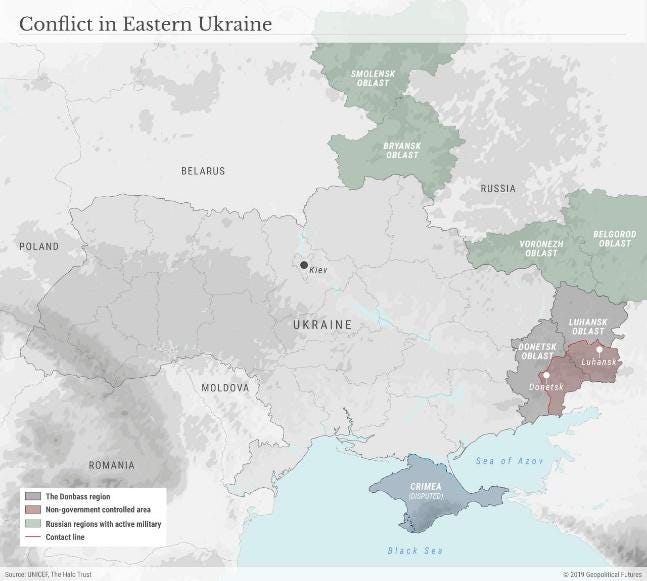
These events serve as a backdrop to when the USA and NATO held talks with Russia in early January 2022 to discuss the situation in Ukraine. During these negotiations, it was reported that Russia initiated military exercises in the western regions of Voronezh, Belgorod, Bryansk and Smolensk, with about 3,000 troops participating in the exercises near the Russia-Ukraine border.
When talks between the USA and Russia failed, NATO countries prepared themselves for renewed Russian aggression toward Eastern Ukraine and possibly more. One of Europe’s biggest concerns leading up to these talks was the stability and flow of Russian natural gas. With dashed hopes of a diplomatic solution to Ukraine, the USA publicly announced that it would export its abundance of Liquified Natural Gas (LNG) to European countries, in light of its import dependency on Russian energy.
Europe’s Dependency on Russian Natural Gas Transiting Ukraine
Experts believe that the energy aspects of the Russia-Ukraine conflict are indisputable. According to Niall Ferguson of the Hoover Institution, “the consequence of Europe’s allowing itself to become so reliant on Russian natural gas and oil…that Vladimir Putin has been able to build up and modernize Russia’s military.” The problems surrounding transit fees from Russia to Europe through Ukraine’s territory has been a contentious issue since 2006, with the most notable dispute over gas transit fees occurring in 2009, when Russia’s Gazprom cut off gas supplies for Europe due to Ukraine’s failure to pay off debts.
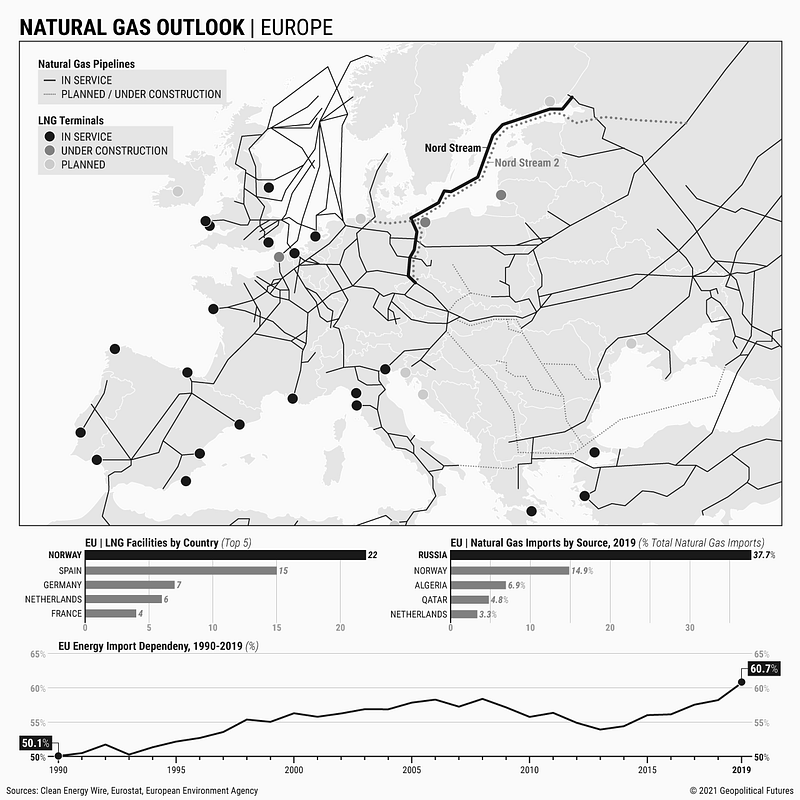
This prompted the EU to launch an anti-monopoly investigation against Russia’s largest gas pipeline company, Gazprom, in September 2011. This was a significant setback to Russia’s economy, as Bruegel’s Georg Zachmann points out: “Russia has built its entire economy on the export of hydrocarbons, and Russia is not really able to sell natural gas anywhere else than to the European Union.”
In addition, Russia’s top LNG exporter, Novatek, was put on the US sanctions list in 2014, for what former US President Obama called Russia’s “continued provocations in Ukraine.” The remaining pipelines that Russia has the most influence over are the Caspian Pipeline Consortium (CPC) transiting Kazakhstan and the Nord Stream Pipeline and newly built Nord Stream 2 Pipeline transiting the Baltic Sea.
Some Important Questions
- What Do US Security Pacts and Military Assistance Entail for the Russia-Ukraine Conflict?
On October 18, 2021, a security pact was signed between U.S. Defense Secretary Lloyd Austin and Georgia’s Defense Minister Juansher Burchladze, in response to Russia’s expansion in the Black Sea. The meeting came after the Biden Administration approved foreign military sales (FMS) to Georgia worth $30 million, including Javelin anti-tank missiles and launchers. As the US had already been providing military assistance to Ukraine, the FMS to these countries proves that the United States is taking the Russian threat to these countries very seriously.
Speaking on the security pact with Georgia, Donald Jensen of the United States Institute for Peace (USIP) asserts that “even though the military situation is relatively at a standoff [in 2021] Russia tries to undermine Ukraine in other ways.” This implies that more military assistance might not be enough to deter Russia’s actions in the future. That’s why it has been the Biden Administration’s strategy to compel Russia by both military and economic means — a combination of military assistance to Russia’s neighbors, as well as forcefully applying economic sanctions on Russian individuals, entities and business sectors.
- Towards Peace or Proxy War in Ukraine?
On March 29, 2022, peace talks were held in Istanbul, Turkey, whereby Ukraine President Volodymyr Zelenskyy acknowledged that, because Ukraine could not be allowed to join NATO, then a viable option would be for Ukraine to accept neutrality — under the condition that security guarantees would be provided by the United States, France and United Kingdom. However, in order to appease Russia, the Ukrainians offered not to apply such security guarantees to the Donbass region. The Donbass region of Ukraine, according to George Friedman of Geopolitical Futures, “was always a pro-Russian region, where the Russians have special forces there.” Due to Russia’s lack of progress with fighting in Donbass, Friedman claims that Russia’s overall invasion has weakened morale, and thus Russia intends to launch an offensive during this “window of opportunity” before USA’ military assistance arrives in Ukraine.
EU officials have called Russia’s demands for Ukraine to “demilitarize” unreasonable and that Ukraine needed more military assistance to stop the Russian invasion. At the same time, analysts have argued that a “proxy way” is being initiated by countries outside of Ukraine in response to Russia’s so-called “special military operation.” Proxy wars have been defined as a way to de-escalate conflict and increase leverage over the disadvantaged country in a conflict. In this case, Ukraine is the country seeking leverage at the negotiating table with Russia. In fact, former CIA director Leon Panetta is confident that the proxy war between USA and Russia has already begun, “[USA] are engaged in a conflict here. It’s a proxy war with Russia.”


