
Running My First Marathon
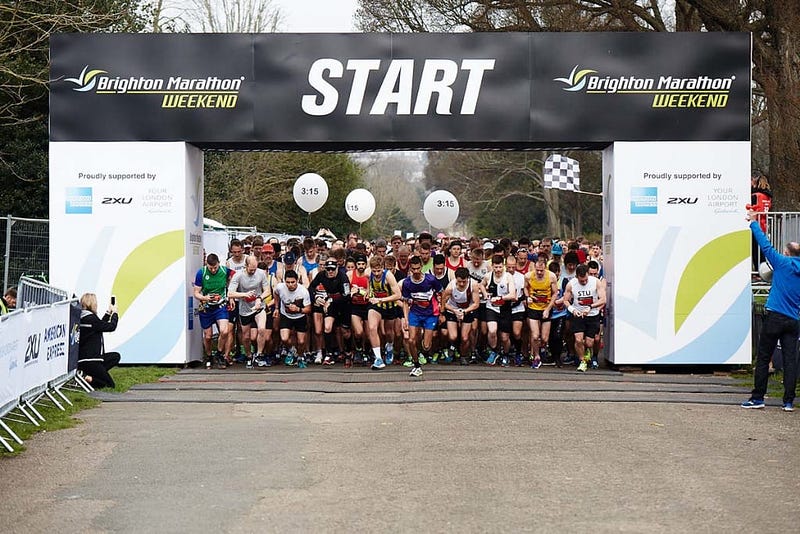
At no point in my life have I ever wanted to run a marathon.
Ever.
I hated running. I didn’t understand the point of running “for fun” (fun?!).
I’d read that long-distance running was dangerous, a point that was regularly reinforced when a runner collapsed and occasionally died during a marathon.
And what about shin splints and the repeated trauma to our joints as a result of the impact as our feet land on the ground?
No, thank you. Running is not for me.
Except…
Part of me wanted to be able to run. I recognised the physical ability and fitness required, and I lacked it. I could physically run — to catch a bus or escape danger — but I’d be huffing and catching my breath afterward.
No doubt, part of the disdain I had towards running and runners was a pang of jealousy that I wished I could do it, too.
Then in 2018, my wife said she’d signed up for a 5k to raise money for charity, and get herself into better shape. To achieve it, she would follow the Couch to 5k programme.
I decided there and then I should do it too. We would both be complete beginners, following a programme for complete beginners.
I’ll spare all the details for now, but week 1 was tough, and I had to repeat week 3 because I wasn’t capable of running 3 minutes without stopping.
Fast forward 9 weeks, though, and I completed it. My wife ran her race, and although I didn’t put my feet forward competitively, I finished the programme and ran 5k around my neighbourhood.
“Great, that’s finished,” I thought.
And promptly stopped running.
Between 2018 and writing this at the end of 2020, I’d go for the occasional jog, but that’s about it. I still certainly didn’t want to run a marathon.
During October 2020, while I was partaking in the 75 Hard challenge, I read two books that were instantly pivotal moments:
“Can’t Hurt Me” by David Goggins, and “Living With A SEAL for 30 days” by Jesse Itzler.
The SEAL in Jesse’s book is also Goggins, and if you don’t know who he is, a Google search would be more informative than I could be. Suffice it to say that he’s on a one-man mission to defy limits and conquer the mind.
“Can’t Hurt Me” is Goggins's autobiography, and he shows the reader that winners aren’t born that way; that through ruthless accountability and dedication to keep going, we are all consistent decisions away from being who we’re capable of.
Jesse Itzler first saw Goggins at the San Diego One Day — a 24-hour non-stop race. Deciding that he had to get to know this guy, he cold-called him after the event and asked Goggins to live with him for a month to train him.
And he did.
In some ways, Itzler’s book is more impactful.
Why?
Because Itzler is a normal guy. Okay, he’s extremely wealthy, lives in the same building as Sting, and already had distance running under his belt.
But he’s physically normal, not a professional athlete, and his daily activities are not uncommon.
Enter Goggins.
Over those 30 days, Itzler is pushed to his limits and then some. He details the feelings of reaching your physical limit, which we can all relate to, and then the feeling of having to go past it — which we can’t all relate to.
He details the exhaustion, the aches, the struggle, the determinations, the wondering why he’s putting himself through this — all the thought processes regular folk can relate to.
And over the course of a hilarious and page-turning book, we see his transformation. By the end, he’s able to do 1,000 push-ups in a day.
It’s hard to not be inspired by Itzler, and to think, “Hey, if he can do it, I can give it a try, too.”
After reading both books, they inspired me. As I stare into my mid-30s, I’ve never truly pushed myself physically. We all like to think we’ll rise to the occasion when the situation demands it, but the reality is we seldom do — how can we when we’ve never prepared? It’s like expecting to pass a complex math test without attending any classes or studying.
Goggins and Itzler ran — a lot. Over the 700 or so pages from both books, marathons no longer seem like a long way. When you’re reading about Goggins completing one in 3 hours on broken feet, not to mention ultra-marathons in Death Valley and 100-mile races, suddenly 26.2 miles feels like nothing.
“A marathon? Pah, I’ll do that before breakfast. Won’t even need shoes.”
And last month I saw Itzler’s Instagram story of a recent virtual Ironman he undertook — a swim, bike ride, then marathon. Watching it in real time was amazing, and there was a point during the marathon when he was done. He sat in the van feeling nauseous and physically depleted, eating honey to try to restore some energy, and then continuing by literally shuffling around the course until it ended.
In that moment, he demonstrated what commitment really means.
Commitment perhaps only means something when it’s hard, when you push yourself to keep going and complete what you signed up for. Anyone can quit, and anyone can complete an easy task.
I knew what that felt like, though. Not to the same extent, I’m sure, but we’ve all experienced that complete exhaustion and feeling like if we go one step further, we’ll be sick.
It hammered the point home that the big victories aren’t achieved by those who find them easy, but by those who feel the same things I’ve felt, and don’t give up.
And so it came to pass that I signed up for my first marathon, fittingly enough taking place on my 35th birthday in 2021.
Now that my name is on the list, the enormity of it no longer eludes me. I realise — but can’t yet comprehend — that it’s going to be hard, that my body will hurt, and I’ll want to quit.
The question is, will I relent to those moments?