
Running and Menopause: The 9 Ways I Made It Through the Roughest Running Year to Date
Learn from my experience and avoid the setbacks menopause can bring to your runs
In August of 2022, I had to take some time off running. I wasn’t injured, but I needed to focus on a move to a new town and a new job. I needed a month to get unpacked, settled, and get into a routine with the new school year (I’m a teacher.) However, coming back to running after my self-imposed break was unlike any other time before. It took me about 9 months to get it together, and by “it,” I mean the whole running mojo, from consistency to building miles. What was going on?
In a word: menopause.
In the past, I’d managed to come back strong from three pregnancies, plenty of colds and illnesses, and what felt like every injury in the book.
I had navigated all the craziness of a half-century of life with running as my constant therapist. Was menopause going to be what made me hang up my shoes?
Here I was 53 years old, I’d raced every distance from the 800 to the marathon. I still had planned to run at least one ultramarathon, but I could barely get 4 miles in consistently.
Physically, my legs felt heavy during runs, my knees ached every time I got up from a seat, my joints hurt, and I was always tired. I felt — and hobbled about — like a 90-year-old woman.
Emotionally, I was “meh.”
I couldn’t say I was fully depressed, but I definitely wasn’t enthusiastic about life, or more directly, about running. If I didn’t get a run in and sat on the couch, meh. If I didn’t get my strength workout in, meh. I wasn’t thriving, by any means, I was joylessly pushing myself through the motions.
The biggest problem at this time, without a doubt, was poor sleep.
No matter how perfect my nightly sleep routine — from turning off electronics, to eliminating alcohol, to keeping a sleep schedule — sleep was impossible. It was disrupted by hot flashes, racing thoughts, or most frustratingly, nothing at all.
However, as much as I knew lack of sleep was affecting my days and my running, this wasn’t the first time in my life I had dealt with poor sleep. As a single mother, I had worked three jobs for years, still ran, and survived on about 5 hours of sleep. Did I feel great, of course not, but I was still running strong. No, this time was definitely different.
Menopause was proving to be my biggest running obstacle to date.
What exactly is menopause?
All over the internet and beyond, menopause is having a moment. In fact, it’s a long-overdue moment. Women are talking about it, and more importantly, normalizing talking about it.
Menopause is only one of three phases: perimenopause, menopause, and post-menopause.
Menopause is the shortest phase (one year) and most distinct. It is defined by 12 months of no period. That’s it. This short definition is extensive compared to what I was taught in school and by my family, which was simply, “It’s when a woman stops having periods.” At least the above definition puts a timeline on it.
“In the U.S., an estimated 6,000 women daily and more than 2 million women yearly reach menopause. With an average life expectancy of 81, women are spending greater than one-third of their lives in menopause.” (Mayo)
Perimenopause
In truth, menopause begins several years before your last period when estrogen begins to drop.
This first phase is perimenopause, and it is subdivided into two more phases. In the early stage of perimenopause, periods are mostly normal with a few interruptions, but symptoms are beginning, such as hot flashes. In the second stage of perimenopause, periods stop for longer days (around 60 days) to the final period. Most women take 7–10 years to reach menopause, and these perimenopause years can be incredibly frustrating.
My doctors didn’t discuss perimenopause with me until the second phase when my periods became irregular, but the symptoms had long been present, only I didn’t recognize them at the time.
Before my periods became irregular, I experienced poor sleep, low moods, weight gain, hair thinning, and hot flashes. With the exception of hot flashes — and maybe even those — all these symptoms can be “written off” as something else.
After all, how many of us not going through perimenopause stay awake with racing thoughts, notice weight gain, and commonly have days when we’re in a funk?
I went to the doctor for my thinning hair, and I was told it was all due to stress.
While I don’t dismiss stress (I had a lot of it) or aging, not one doctor asked about or mentioned perimenopause. When my periods became irregular, all these symptoms continued and worsened, but now I was starting to figure out the beast that menopause could be.
The hot flashes, thankfully, only occurred at night. During the first stage of perimenopause, I would wake up drenched in sweat, but at least I had slept. As I got closer to menopause, the hot flashes would wake me, and it was nearly impossible to get back to sleep.
I came to learn later, thanks to Dovile Kalvinskaite MD in The Ultimate Guide to Sleep in Menopause that it’s not only low estrogen disrupting our bodies, but also low progesterone. Progesterone is another hormone — one that helps us sleep — that also begins to decline during our perimenopause years.
Yet, during perimenopause, my runs were still fulfilling.
Sure, I was never going to run as fast as I did in my 20s and 30s, but I still was placing in my age group, feeling as though I’d be running for decades. I was in my late 40s, and I was running half-marathons and averaging an 8- minute-mile pace. I felt strong while weight training as well, and the only time I felt like I was aging was in the morning or after long bouts of sitting. It was taking a bit longer to loosen up and get going.
Of course, I was tired from poor sleep, especially in the afternoons, but who isn’t? It’s the American way, and it wasn’t affecting my runs.
In short, while perimenopause was full of miserable symptoms, I was still running strong, so I could carry on. One study credited exercise as effective in reducing hot flashes, and I also credited running for keeping my perimenopause symptoms from being worse than they could be.
That all changed in 2022.
Menopause
In October 2022, I began the menopause stage, only I didn’t know it at the time because I can’t see into the future. Without testing for hormone levels of estrogen, progesterone, and testosterone, you’re never certain if you’re in menopause until you reach the “12 months of no periods” mark, at which point, you are then post-menopausal.
For instance, once, I thought I was surely in menopause, but I had a period after 7 months of no periods and the “menopause clock” started over. Twice, a plane flight (I’m convinced, although it could be coincidence) triggered a period. Therefore, much of the frustration with menopause is the unknowns and uncertainties.
In hindsight, I wish someone had told me about hormone testing. It’s one of those moments of “you don’t know what you don’t know,” and I’m certain I’m not alone. Just another reason why it’s so important to talk about menopause.
Nevertheless, unlike perimenopause where you begin suspecting that your body is changing, in the menopause year, you are certain.
It was during this time that my running took a nosedive.
Physically, my strength had vanished, seemingly overnight. A daily four-mile run felt like drudgery, and I counted the minutes and miles until I was done.
Joint pain escalated. I could plank for two minutes on my elbows, but only 30 seconds up on my hands because of the pain in my wrists.
I hobbled about each morning and after runs from the knee pain as well. Sleep was worse, so I was always tired.
What happens to the body during menopause and how does that affect running?
Muscles, Tendons, and Ligaments
Bad news: Due to low estrogen production, menopausal women will lose both muscle mass and muscle strength. This explains the heavy legs and plowing through runs.
Good news: While you may find, like me, that you are slower and weaker, your daily runs are combating this inevitable change to your muscles and helping you to maintain strength and mass. Be sure to keep including exercises to target your fast-twitch muscles, such as interval runs and plyometrics. Also, because running targets your lower body, you still need to make time for the gym workouts. Not only will you strengthen muscles and improve muscle mass in your legs, in the gym, you will also take care of your arms and back muscles.
Bad news: You are more susceptible to injuries because estrogen is used to protect your muscles from the wear and tear you are putting them through. Similarly, estrogen is instrumental in collagen synthesis and turnover needed to keep your tendons and ligaments strong, so injuries related to tendons and ligaments may increase.
Good news: This doesn’t mean an end to running. However, it does mean more strategically located rest days. For instance, you may need two rest days after a hard workout instead of one, or you may need a rest day and active recovery day.
You may also need to customize training plans, which usually are set up on a weekly cycle. A 10-day cycle allows for more recovery days.
I’ve suffered two tendon/ligament injuries during perimenopause and menopause. One was in my hip/glute area: gluteal tendinopathy. This pain developed as a result of a new sleeping position and, of course, the repetitive nature of running. I healed it with some time off, strength training exercises prescribed by my sports doctor, and sleeping with a pillow between my legs.
The second injury occurred in my left ankle and heel, and I’m still in rehab from this one, but it is getting better. This one occurred when I switched suddenly from running always on flat terrain to a week of intense hill running.
I should have known better, but it was never an issue in my younger days. (A phrase I find myself thinking too often these days.) This time, I irritated the tendons and ligaments in my ankle, and they are still quite angry with me. The doctor has prescribed time off from running to allow the tendons to heal, avoiding compression and stretching, and adding gentle loading exercises. He also suggested I increase my protein intake. I’m healing faster than he expected.
I’m learning, (and I hope my readers will learn through me) that menopause does not mean an end to running. It does, however, mean we must add rest and recovery days and increase the weekly/daily strength and mobility exercises.
I’m guilty of skipping the gym because I want to run, run, run, but menopause has taught me–once again–the importance of strength training to support my running lifestyle.
Bone density
Bad news: Perhaps one of the most well-known problems with menopause, besides hot flashes, is loss of bone density. Estrogen is key to bone health; it is necessary for our bones to generate new bone cells. As a result of low estrogen due to menopause, bones can become brittle and less dense, making women more susceptible to fractures and osteoporosis.
Good news: The methods for preventing osteoporosis include much of what runners are already doing. Experts recommend load-bearing exercises, such as running, as key. Secondly, they recommend calcium and vitamin D, so unless you are running inside or at night, you are probably getting some good vitamin D.
If you regularly get your blood work done, then ask your doctor to test for vitamin D levels. Also, ask if you are a candidate for bone density screening. According to my doctor, bone density screening begins at age 65 unless there’s a history of osteoporosis in your family. Then, you should be screened younger. My doctor said I could have a screening if I wanted it, but because I was a runner, he wasn’t concerned. Running, he said, is the best exercise I could be doing for my bones.
Depression
Bad news: According to Ben Jones MD PhD, “Half of all women experience depression around menopause.” Depression or depression-like symptoms are as common as hot flashes and brain fog during menopause. Couple depression with the stresses of mid-life (raising teenagers, aging parents, work, etc.) and it is no wonder menopause can feel overwhelming.
My own depression-like symptoms were present, but mild. Again, I attribute this luck to running outside, but I definitely noticed an increase in sad days as a result of menopause. Because my symptoms were mild, I’ve mitigated depression-like symptoms with meditation, eliminating alcohol entirely, and exercise.
Good news: Running, especially outside absorbing Nature’s healing power, has proven benefits for combating depression. If running is not enough, however, to mitigate the feelings that come with depression during menopause, then there are more methods to explore, such as cognitive behavioral therapy (CBT), social support, antidepressants, and hormone replacement therapy. Seek treatment for depression just as you would for a running injury.
How did I get my running mojo back?
At the beginning of this article, I noted that it took a good 9 months to get my running mojo back. Here are the steps I took that made a difference for me:
- Committed to a running partner. I had been running alone, but I found a running partner who was my age and faster than me. We committed to running together almost every weekend. Just knowing that I had someone to keep up with that Saturday helped me show up for my own weekly runs. Socially and emotionally, she and I shared similar “menopause and running” stories. It was hugely comforting to add this layer of camaraderie. Do not discount the emotional support you gain as well as the physical challenges you gain from running with others.
- Committed to a challenging race. I had deferred my entry to my first 50k because of the house move, but it turned out to be just the incentive I needed. I didn’t need to train for another 5k. Nothing against the 5k, but I needed to really challenge myself, prove to myself I could still run far. I hadn’t run a marathon since 2007, so training for an ultramarathon was the equivalent of running menopause into submission.
- Increased strength training. I re-committed to my 3 days in the gym, and I added another day on the weekends. This was pivotal. It was not long before the knee pains diminished, and my runs felt stronger.
- Stopped worrying about speed. My goal was to finish my first ultramarathon. I didn’t care how fast I ran, so I reduced my speed workouts to one day of Fartleks a week.
- Cut back on alcohol. During my training, I reduced my alcohol intake to two drinks per week. During the 5 weeks before the ultramarathon, I eliminated alcohol entirely.
- Increased my iron and protein intake. I eat a pescatarian diet. It’s plant-forward, and I get my protein from fish, but during the 8 weeks prior to the race, when I was running my longest runs, I found the added protein and iron from organic chicken and iron supplements combated any fatigue.
- Focused on sleep. I began Hormone Replacement Therapy only 2 months before the race, and according to the doctor and the prescription label, it takes about 3 months for the effects to kick in, just short of the race. Nevertheless, about 2 weeks before the race, I finally began sleeping better. This, I’m certain, was instrumental during my tapering phase to allow me to be ready to run. Read about the benefits and safety of HRT in the work of Dovile Kalvinskaite MD and Rebecca Levy-Gantt.
- Re-calibrated my mindset. I read everything I could about strong master runners. Jeannie Rice and Jenny Hitching were shattering records and reminding me that age is just a number. I simply made the decision that I might have to build more slowly, do more strength exercises, include more rest days, and most importantly, stop comparing my new self to my 30-year-old self, but I certainly didn’t have to quit my beloved sport.
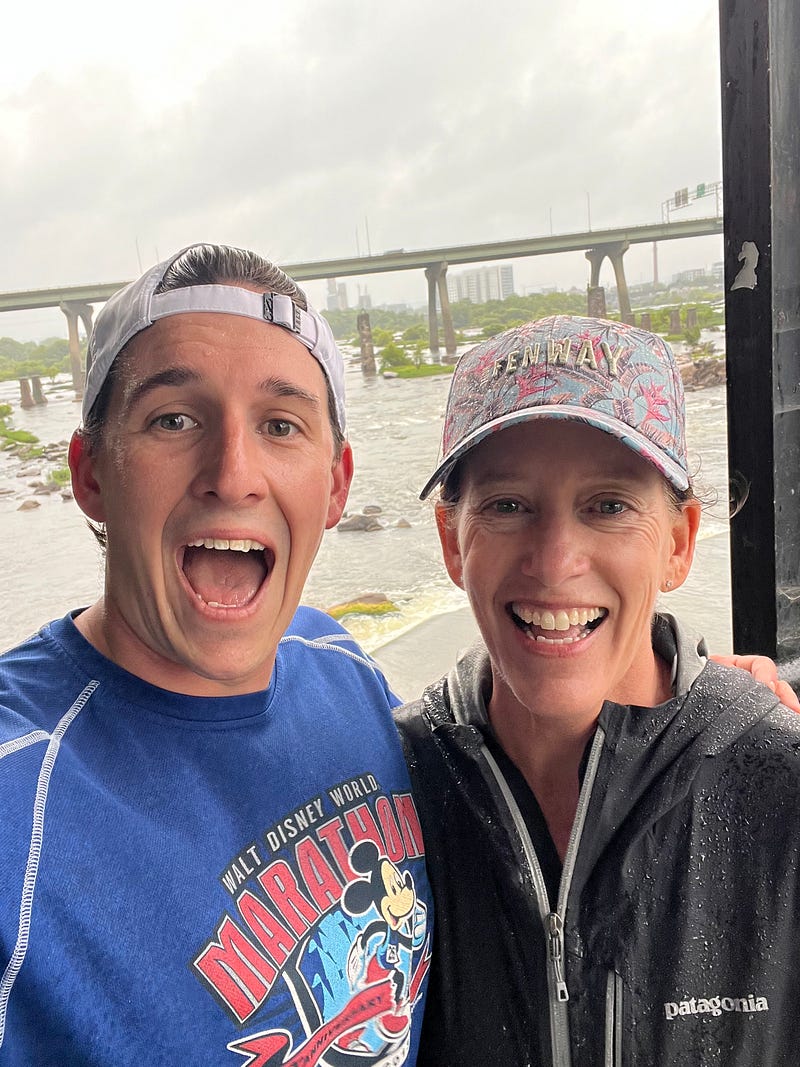
- Consciously injected joy into my runs. After 40 years of running and racing, this sport is a habit and addiction, so it can be easy to forget that it’s also fun. During the menopause months and since, I scoped out new places to run and explore, and I ran with people I love (see picture above). I woke early to catch sunrises, ran in the rain, listened to my favorite music and devotionals, and did a lot more smiling. I also treated myself to ice cream.
Post menopause
TBD. At the time of this writing, I’ve just begun the post-menopausal stage, so expect a running and post-menopause report in the future. Until then,
Training for your first race? Enjoy my free five-day educational email course.


