
Rule Number 42 — Studying The “Answer To The Ultimate Question Of Life, The Universe, And Everything”
No One Shall Speak To The Man At The Helm, And The Man At The Helm Shall Speak To No One.
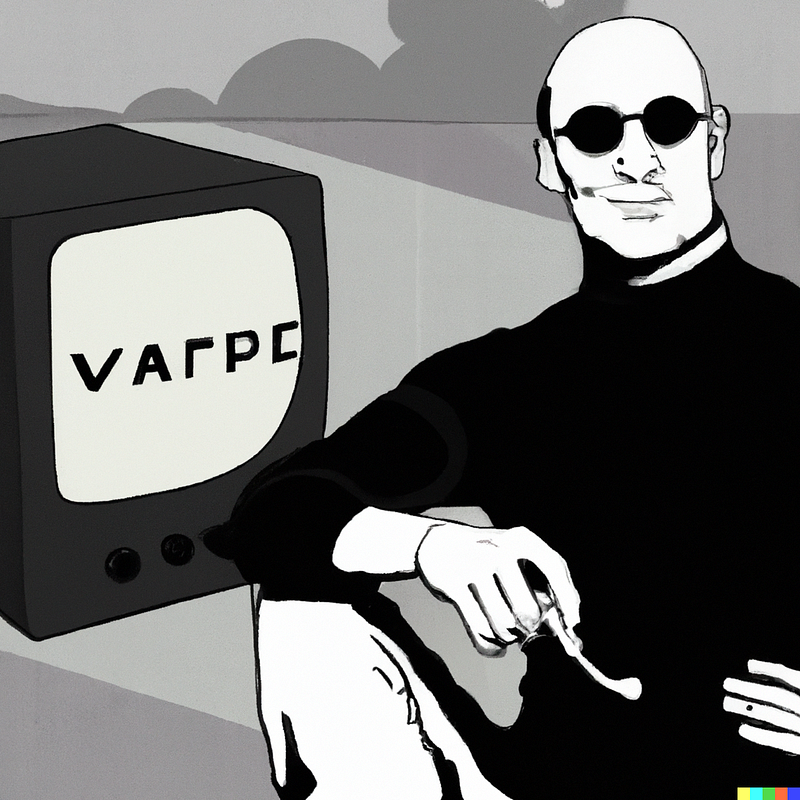
In The Hitchhiker’s Guide To The Galaxy, the late science fiction writer Douglas Adams inadvertently created the “Cult of 42” which has since then spawned a massive circle of influence, spanning across fan-theories, tributes (in the form of brand names, business names, books, etc) and more than anything else — attempts to decode the hidden meaning, and/or symbolism behind Adams’ choice of the number 42.

For those unfamiliar with the story, the Hitchhiker franchise kicks off with a narrative about the planned destruction of planet earth, executed by “friendly” intergalactic forces. The last remaining (surviving) human being, i.e. ‘Arthur Dent’ is then projected into an adventure of epic proportions, journeying through cosmic constellations and fantastically improbable destinations on spaceships, on a mission to decipher the answer to the ultimate question of life, the universe, and everything.
When Arthur and his comrades arrive at their final destination to seek this answer, they land on a supercomputer that’s the same size as a planet, which has been calculating the answer to this question for millions of years at a stretch. The answer is then revealed to the explorers, as just the number 42. No explanation is provided as to why 42 is the ultimate answer. The computer, titled Deep Thought then tells the onlookers, that it was only assigned the task to find the ultimate answer, and not the question that precedes it.
Adding misery to the travelers’ woes, the supercomputer also reveals that Planet Earth, destroyed moments back (in the storyline), was actually another supercomputer which was designed to find the ultimate question. The question, it is naturally assumed, has been lost forever. But the computer insists that the answer is “certainly 42”.
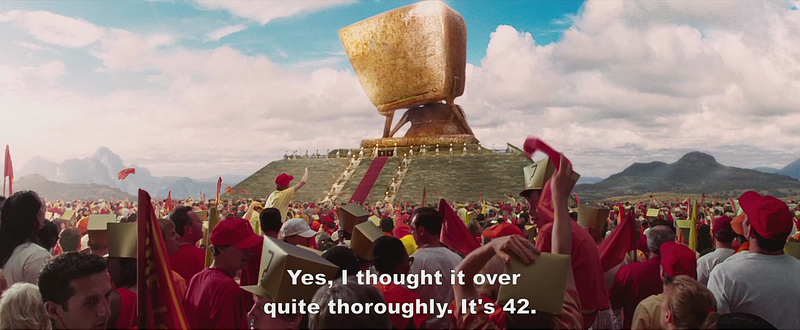
The rest is history.
Owing largely to Adams’ association with (and corresponding influence from) the philosophical schools of thought of Buddhism, Tao, and Zen, and fueled by curiosity surrounding his meteoric success as a nonconformist creator who found mainstream success, people kept asking him questions, trying to understand his motivations behind choosing the number 42.
The Only Person Who Knew For Sure — Stephen Fry
Douglas Adams never publicly confessed or revealed his intentions. Rather, he kept deflecting all the wrong questions with witty responses. Once, a math enthusiast asked Adams if 42 was just the number 10 in base 13 (based on logarithmic values). Adams responded, “I don’t do jokes in base thirteen”.
And even with that exchange cast aside as an isolated incident, as per available records there is just one record of Adams having explained his real reasons to a fellow human being. This ‘fellow human being’ was Adams’ close friend and veteran British actor and comedian, Stephen Fry.

After Adams’ sudden demise in 2001 (aged 49), Stephen Fry publicly confirmed that Adams had told him “exactly” why 42 had been selected. Without revealing the exact reason, Fry went on to claim that the reason is “fascinating, extraordinary and, when you think hard about it, completely obvious.”
However, Fry has maintained that he took a vow to never reveal this secret to anybody, and that it “must go with him to the grave.”
The Ultimate Question To Life, The Universe, and Everything
Let me ask you a question. I am operating under the limits of safe assumption that you too, like me, are in pursuit of your life’s greater mysteries, and that like me, your dreams and aspirations and (the proverbial) fulfillment too, lie ahead of you.
Given the present circumstances of your life, if you had access to an all-knowing, all encompassing, all-wise form of superior intelligence, what questions are you most likely to ask it? In other words, if you were given the power and the responsibility to ask just one question to such a creature, what would you end up asking?
I know what I would ask.
My question would be fueled by some underlying assumptions about reality, though. For starters — if I must accept that such an “ultimate question” and such an “ultimate answer” are really in existence as valid constructs of reality, then reality must, without a shred of doubt, be predetermined — and therefore by definition, a controlled simulation.
If you leave pre-determinism and simulation theory out of the equation, then you might as well stop looking for the question or the answer. If this is really not a simulation, then all events are pretty much random, chaotic, and there is no point to do anything. Purpose, ethics, and societal standards would become increasingly malleable, because no “end goal” is defined.
But fortunately, I happen to be a personal believer in the simulation hypothesis. And to me, it doesn’t really matter if you accept this truth through spirituality (and address the creator of the simulation by a name like god or godhead or atman or brahman or the primordial AUM), or whether you follow the logic of the Matrix movie franchise or that of modern technocrats like Elon Musk, to assign a different name to this simulation-owner (such as a hyper-intelligent and sentient form of artificial intelligence, or some future version of humans, or an advanced civilization )— the results for you (as a part of this simulation) are pretty much the same.

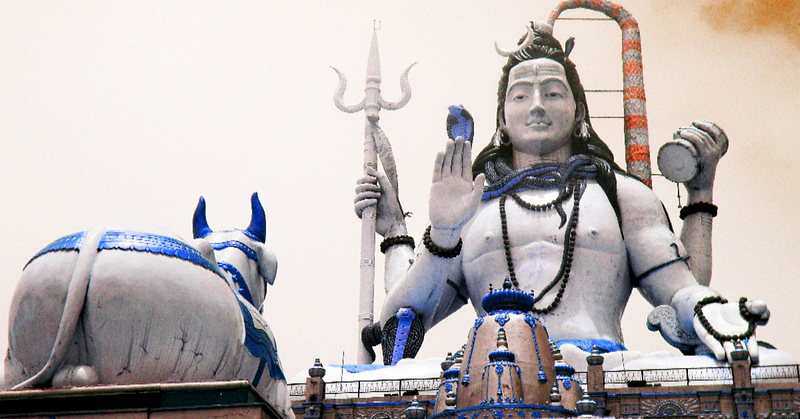
My question for this ultimate “being”, then, would be very simple and very concise. It would arise from my inherent need to be able to “break out” of this simulation and get “in control”.
Breaking out of the simulation would enable one (at least in theory) to bend the rules of space-time, influence or motivate free will in people other than themselves, and these “abilities” by definition, would allow such a person to create, make, or break realities in every sphere of their lives — wealth, abundance, love, professional success, social interactions, and yes, even happiness.

Breaking out of the rules of the simulation would essentially give someone the same level of influence and power that Thomas Anderson (Neo) enjoys in the fictional Matrix movies (as “the chosen one”).
Think about it. If reality is indeed a controlled simulation sequence (and once again — I implore you to ask yourself why not, especially if you’ve been able to wrap your head around religious and/or spiritual constructs), then anyone who breaks out of it will be able to achieve seemingly impossible feats, such as bending spoons. But that’s just an exaggerated imagination at play, curious enough to tease the laws of nature. Other than the physical manipulation of matter, the possibilities extend to other, socially acceptable “impossible” feats— such as building a trillion dollar empire out of an idea that everyone else on the planet is busy ridiculing.
In other words, anyone who breaks out of the simulation, becomes an Übermensch (as described by the German philosopher Friedrich Nietzsche) — the same concept of the “Overman” which served as the original inspiration behind the Superman range of comic-books. In fact, the word “Superman” is nothing but a loose translation of the word “Übermensch”.
The ultimate question to life, the universe, and everything, is then perfectly clear — “How to break out of the simulation?”

42 As An Answer To The “How To Break Out Of The Simulation?” Question
Among the listed and most noted influences of Douglas Adams, is the British author Charles Lutwidge Dodgson, more commonly known by his pen-name Lewis Carroll, who is credited for a seminal piece of children’s literature called Alice’s Adventures In Wonderland.
But other than the Alice series of stories, Dodgson was also a prolific poet, dedicated to the task of writing seemingly nonsensical poems, that resembled the structure of classic epic poems (such as Iliad, and the Mahabharata).
Nonsensical works of poetry are in nature, very similar to fantasy novels or science fiction novels. In fact, they were one of the earliest known literary devices of creation, which allowed the embedding of spiritual symbolism into words that everyone could read and appreciate, but not necessarily understand. Nonsensical poems are in fact, the easiest places to hide very important secrets in plain sight.
The Hunting Of The Snark (And Rule Number 42)
“The Hunting of the Snark (An Agony in 8 Fits)” is a nonsensical poem written by Lewis Carroll, between the years 1874 and 1876. It is available for free online reading at Project Gutenberg.
The poem is divided into eight sub-sections, and follows the story of an unusual crew at sea, with a mission to hunt a “snark”. Snarks do not exist in our reality — it was a made-up word in an endless list of made-up words, but if you happen to possess some knowledge of ego-dissociation and ego-death, it is not hard to notice that the word snark is an indirect reference to the concept of the ego (your perceived identity).
The ego or the “perceived identity” of being you, has the following attributes:
- It answers to your “name”.
- It’s what people identify you as.
- It carries all your perceived strengths and weaknesses (and by definition therefore, all your perceived strengths and weaknesses are linked to this ‘ego’ identity).
- It is bound by the rules of your simulated “reality” (since the ego itself is the viewpoint through which you observe this simulation).
- It is responsible for both your pleasure, and your misery.
- It can experience everything, but it cannot control anything. It often chooses to lament the experiences you have, and lament the aforementioned lack of control.
Adding pointers one through six, I am able to arrive at an easy conclusion. The easiest and fastest way to “break out of the simulation” and “get in control” is to break out of the clutches of the ego.
Whatever is outside the ego:
- Does not answer to your “name”.
- Is not how people identify you.
- Has unlimited strength (control) and no weaknesses.
- Is not bound by the rules of your simulated “reality” (since it is controlling and projecting the simulation in the first place).
- Is responsible for ultimate happiness and ultimate control.
- Can control everything, and is controlled by nothing — hence by definition, treats all experiences as passive.
The ego is Clark Kent. But Clark Kent is Superman.
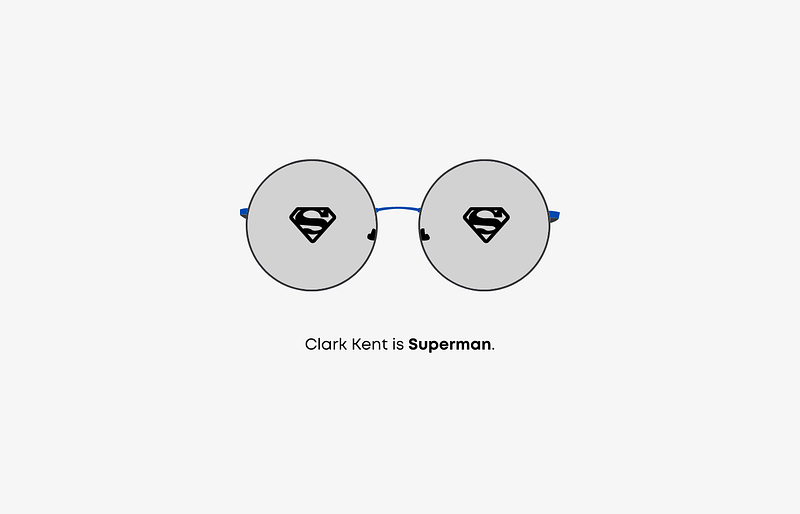
The trickiest (and arguably, the easiest) thing to understand about this theory, is that once you have “hunted the snark down”, there is really not much left to happen, other than the “other side of you” to take over.
Rule Number 42 — An Introduction
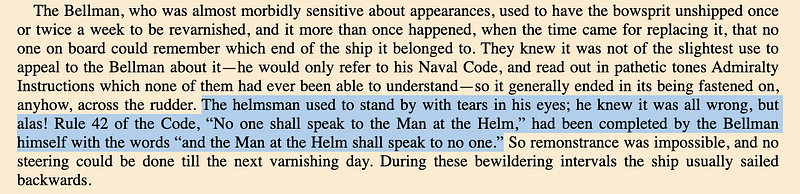
In the poem, Carroll has created a sort of preface to the eight “fits”, where an interesting but strange rule is mentioned — for the effective navigation of the ship, no one is allowed to ‘speak’ to the ‘man at the helm’ and the ‘man at the helm’ is not allowed to ‘speak’ to anyone.
For you to accept Rule Number 42 as the guiding principle behind getting out of the simulation, you must understand that at its core, this is a rule that maintains balance and harmony in the universe.
Yes, there is a simulation. Yes, there is an ego, and yes, it is derived from a sense of false perception. Yes, it is possible to strike the ego out of the equation and get in control of your reality. But to continue doing so without massively impacting the general peace and harmony in your simulated “reality”, you must not speak to any other living soul in your capacity/mindset as the “Overman”.
The Last Word On Rule Number 42 (And Suggestions On How To Proceed With Caution)
It is in fact, Rule Number 42, which prohibits the absolute and full disclosure of both intent and procedure, when it comes to breaking out of the simulation. I understand that this is sad for you to read, but that’s the beauty of it. You cannot continue to understand and apply Rule Number 42 effectively if you disclose it completely. Disclosing it completely is the same as telling your friends, family, and loved ones (or strangers, or readers on the Internet) about the exact nature of your game. And if you do this, people will either think you’re crazy, or if they see your ideas in practice, they will get very scared of you, or ostracize you. Worse still, they may end up harming themselves without fully realizing the consequences of their actions.
The adherence of Rule 42 is not easy. About half the number of people that form a majority of all your public interactions, including personal acquaintances and strangers, will end up criticizing you, your thoughts, your approach. But the rewards of following it are equally fantastic — the other half of the world will resonate to your tune. Things will happen the way you want them to happen. Your deepest sense of purpose will materialize. You will be able to control the “flow” of destiny as you see fit, without harming yourself or anyone else.
By gaining access to the secret, you are by default “sworn into secrecy”.
But if your quest has led you so far, I think it’s fair to make a few suggestions that will lead you towards finding everything else that needs to be found.
- Just like Deep Thought’s revelation of “42” as the answer mandates the existence of a question and the validity of both the question and the answer, the identification of “Rule Number 42” postulates, that the way to breaking out of the simulation really does exist.
- Transcendental Meditation is a very important tool towards absolute self-realization. This is probably the biggest hint that I can drop.
- (Re)-watch the movie “Birdman (or The Unexpected Virtue of Ignorance)” and the web-series Dirk Gently’s Holistic Detective Agency. The latter is where it all started for me.
Dedicated to Dirk, Douglas, and Dev.
- *Update on November 16, 2022** — Popular columnist & content creator Sahil Bloom says he believes in the simulation now — https://twitter.com/SahilBloom/status/1592625964248633347?s=20&t=WmJoXFVX-642MdJrhU22Qg


