
Rubik’s Cube and the Power of Checklist
Smash the impossible into a million pieces, and knock them down like dominoes
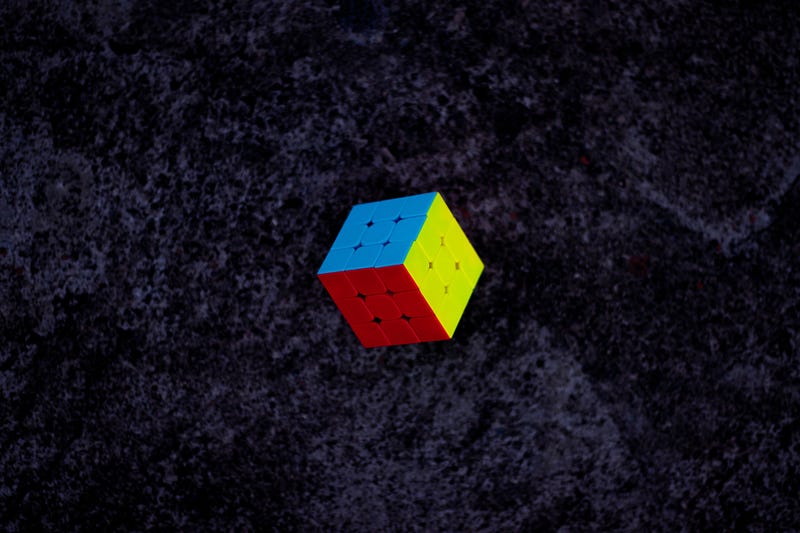
I’ve wanted to solve the cube since I was eleven. My step-father could do it, but only with his eyes closed. To this day, I still don’t know if he was messing with me.
The Rubik’s Cube has become a symbol of intellectual prowess the world over. It’s the most popular toy of all time, with hundreds of millions sold.
It’s an obsession for mathematicians, who call the lowest possible number of moves to solve it — God’s Number. We even use it to train artificial intelligence.
Perhaps because of this, I avoided it like the plague.
The Rubik’s Cube
There are 43 quintillion possible permutations to the Rubik’s Cube. Solving it seemed impossible to me. I couldn’t face the possibility of not being able to do it. That I just was not capable, didn’t have the right stuff, and never would.
Stuck in a fixed mindset at the time, I avoided challenges that threatened my potential.
Flash forward 25 years, and my 11-year-old nephew solves it before my eyes in seconds and drops it like a hot mike. Cue the smuggest little smile in the universe. Then his sister, younger brother, and his mother all solve it too.
My mind imploded.
Here was something I’d secretly kept on my “Am I a Genius?”-bucket list for decades being solved before my eyes by kids and moms alike. From that moment, I promised myself that I would solve the plastic brain basher once and for all.
I borrowed my nephew’s cube and struggled with it the whole night into the early hours of the next morning. I managed the first few levels, the intuitive steps, the ones we can all work out.
Then I got stuck.
The Power of Checklist
In Harvard surgeon Atul Gawande’s book, The Checklist Manifesto, he relates a story from every parent’s worst nightmare.
A child traveling with her parents outside a small Austrian town in the Alps fell through broken ice and sank to the bottom of a murky pond. She remained in a near-death state for two hours before her body temperature rose again.
Two weeks later, she walked out of the ICU, having made a full recovery.
A thousand different things had to happen in just the right sequence for that happy ending.
➰Her parents kept searching and diving for 30 mins. ➰EMT arrived within 10 minutes ➰They did CPR continuously for 90 minutes. ➰The first surgical team completed a complicated heart bypass using her femoral arteries without complication. ➰The second surgical team cracked opened her chest to get her on a special ECMO ventilator when the standard method failed. ➰Her organs then came back to life, one by one, during her ICU stay.
This miraculous situation hints at the power of checklists because any one of those skilled, intelligent professionals could have made a fatal mistake. The miracle is that they didn’t.
What checklists do is help us replicate miracles. Every day. It reduces the errors we make, the steps we skip while operating in stressful life or death situations.

The Seemingly Impossible Is a Series of Simple Steps
I struggled with the cube until I sought help from my sister-in-law and countless websites and rambling YouTube videos.
But the real breakthrough came for me when I scribbled all the steps down onto a piece of paper.
That’s when the whole process clicked. Seeing it before me, a concise and straightforward list. The magic proved to be getting it out of my head and seeing the handful of steps needed to do it.
My impossible task was now doable. I had a checklist that I could follow and double back on if I got lost. And it worked, over and over again.
The Rubik’s Cube is just a tangible object that represents a seemingly impossible task. People may cry foul and say we didn’t work it out on our own — but that’s not the point. The real point here is to use checklists.
Use checklists to break down complicated tasks or processes into small manageable blocks and to facilitate learning and growth by seeing a looming mountain as just a series of steps — or to eat that elephant one bite at a time.
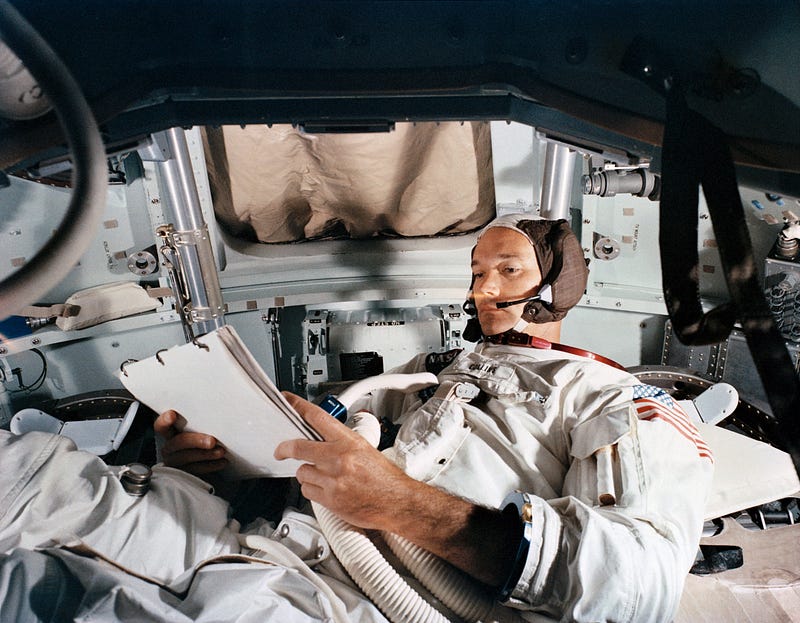
One Small Step for Man, One Giant Tick for Mankind
Checklists — at least three of them — put two men on the moon and brought all three astronauts back safely down to earth.
They broke down incredibly complex tasks into tiny pieces so that smart people in stressful situations could go through the problem one piece at a time.
Matthew Hersch referred to checklists as Apollo’s Fourth Crewmember.
David Oberhettinger, the Chief Knowledge Officer of the Jet Propulsion Lab at NASA, says — why I love checklists? Because rather than letting my imagination run amok to my detriment, effective use of checklists allows me to direct my imagination to more productive purposes.
Dr. Checklist
Nicknamed ‘Dr. Checklist’, Peter Pronovost, in a 2006 pioneering study, proved the value of checklists for patient safety.
He devised medicine’s first checklist, what Gawande calls “an absurdly simple tool” for safely inserting a central line into a patient’s chest. A lifeline for delivering medication that gets infected in 4 percent of cases.
Studying a hundred Michigan hospitals, Pronovost found the cause. Thirty percent of the time, surgical teams skipped one of five essential steps:
(1) Wash hands (2) Clean site (3) Drape the patient (4) Don surgical hat, gloves, and gown (5) Apply a sterile dressing
Fifteen months after using Pronovost’s checklist, these hospitals cut their infection rate from 4 percent to zero. Saving 1500 lives and nearly 200 million dollars.
As in the first story, we can’t rely on miracles to save our loved ones, but as Hale and Pronovost proved, we can rely on checklists.

How Checklists Can Solve Your Impossible Problems
The volume and complexity of what we now know in our professions have exceeded our ability to deliver on its value. Either reliably or consistently.
Checklists work because they reduce our reliance, especially when stressed or tired, on our memory and decision-making abilities. This frees up our minds for better judgment and creativity.
How to make a useful checklist
✔️Write it down. Keep it concise, focused, and actionable.
- Keep it to 5–9 practical items.
- Ideally, on one page — to get an overview of the whole process and keep it a manageable size.
- If it gets too long, break your checklist down into a group of checklists — one for each stage of your task.
- That way, you can focus on one particular area at a time.
✔️Get to study your process first, then learn from masters.
- Practice it and get to know its weak points by learning through doing.
- Go through it step by step, so make sure nothing is missing and that you get similar results every time. Can you still improve it?
- Only then look to mentors for help when you can’t improve it — otherwise, researching perfect processes fuels procrastination.
Don’t skip steps; skipping steps only creates the illusion of speed. The impossible often only seems so because it is a long, unforgiving chain of small and simple steps.
So you hung around to the end, and you still want to know how to solve the damn cube?
Steps of the Beginner’s Rubik’s Cube Solution:
1. White Edges 2. White Corners 3. Second Layer 4. Yellow Cross 5. Swap Yellow Edges 6. Position Yellow Corners 7. Orient Yellow Corners
Write the steps down on paper and give it a go.
Thank you for reading.
If you are interested to know about me, you may read the following post.


