
Round-up of key green trends in Singapore 2021 (Energy & Carbon Edition)
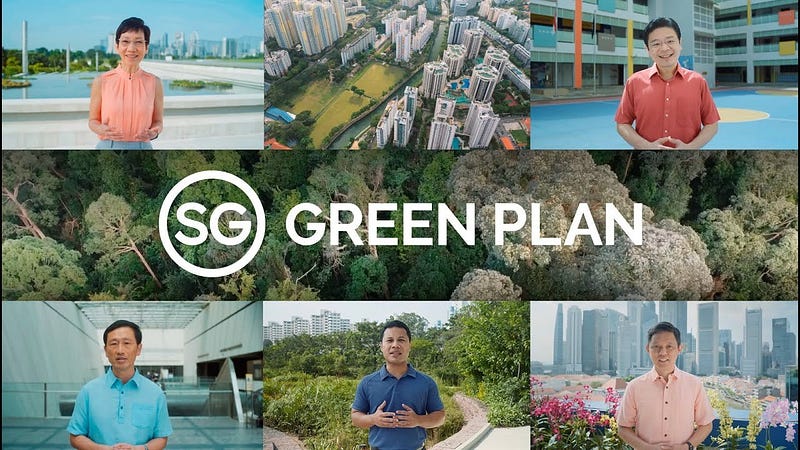
2021 has paved the way for major green initiatives in Singapore. As we enter 2022 in full force with Budget 2022, here is a round-up of key trend-setting events that positively disrupt Singapore’s decade to come. Starting with Singapore Green Plan 2030, I will discuss Budget 2021, Singapore International Energy Week, COP26 and BCA’s new Green Mark Certification that have a bearing on Singapore’s energy supply, efficiency and city infrastructure, that ultimately shapes the space that we occupy, our standard of living and the shared responsibility and sustainable impact we make on our planet Earth.
- Singapore Green Plan 2030 and Budget 2021 (February 2021)
A year ago in Feb 2021, Singapore unveiled the Singapore Green Plan 2030 (SGP30), a nationwide movement to advance Singapore’s national agenda on sustainable development and tackle climate change — underpinned by 5 pillars: City in Nature, Sustainable Living, Energy Reset, Green Economy and Resilient Future. This is to reinforce the efforts under the UN 2030 Agenda for Sustainable Development and the Paris Agreement, and collectively governed by 5 Singapore ministries: Ministry of Sustainability and the Environment (MSE), Ministry of Transport (MOT), Ministry of Education (MOE), Ministry of Trade and Industry (MTI) and Ministry of National Development (MND).
SGP30 is meant to be a living masterplan that evolves as the agencies stay grounded with collaboration with Singaporeans and partners from various sectors, charting Singapore’s roadmap for Singapore’s green targets over the next 10 years.
An “ Energy Reset”: One of the key initiatives as part of Singapore’s “energy reset” is to phase out internal combustion engines (ICE) to have all vehicles run on cleaner energy models by 2040. So with this electro mobility transformation, what does it entail on the impact of our carbon footprint? Allow me to break it down for you.
In Singapore, 95% of our energy supply is generated from natural gas and we have nearly a million cars on Singapore’s roads. While natural gas is the cleanest fossil fuel, driving your car in Singapore produces carbon emissions and vehicles on aggregate are responsible for over 6.4 million tonnes of carbon dioxide (CO2) equivalent each year, which translates to over a tenth of Singapore’s total emissions. On this end, this is what the Minister for Transport, Mr Ong Ye Kung shared at the Committee of Supply Debate 2021, “The net carbon abatement by switching from ICEs to EVs is about 50%. If the subset of light vehicles all ran on electricity, the total net carbon abatement would be about 1.5 to two million tonnes of CO2-equivalent per year. This abatement is about 4% of our total annual emissions — not insignificant.”
And of course to drive this mobility shift, the supporting infrastructure needs to accompany the transformation. As part of SGP30, the ambition to more than double the targeted number of electric vehicle charging points from 28,000 to 60,000 charging points by 2030 (comprising of 40,000 points in public carparks and 20,000 in private premises) is also laid out.
This is where Budget 2021 comes in — to catalyse partnership between the public and private sectors, the Government will also put aside S$30 million over the next five years for electric vehicle-related initiatives. Tax incentives were also introduced to incentivise the adoption of electric cars, which was announced during Budget 2021. These measures include reduction of Additional Registration Fee (ARF) floor, revision of road tax framework for EVs, EV Early Adoption Incentive (EEAI) and the enhanced Vehicular Emissions Scheme (VES) — more on that in my next article on everything you need to know about total cost of EV ownership in Singapore (stay tuned!).
Other initiatives to highlight include greening 80% GFA of Singapore’s buildings and 80% of new buildings to be Super Low Energy Buildings by 2030. On energy front, quadrupling solar energy deployment to 1.5GW by 2025, leveraging on cleaner electricity imports from the region and exploring of emerging low-carbon technologies — further elaborated under Singapore’s Energy Story.
2. Singapore International Energy Week (24–29 October 2021)
Singapore International Energy Week (SIEW) is an annual flagship week-long energy event organised by the Singapore Energy Market Authority (EMA), featuring industry leaders in global energy sector, policymakers and thought leaders to discuss energy insights across oil & gas, clean and renewable energy, smart grids, carbon abatement and energy trading industries.
For SIEW 2021, my company Envision Digital had the opportunity to sponsor EMA in its journey to advance Asia’s energy transition and jointly partnered with EMA to launch the Net Zero Startup Challenge — an exciting 4 million partnership to develop local energy startup and SMEs on renewable energy, urban energy efficiency and low-carbon solutions to accelerate Singapore’s net zero ambitions. Having the privilege to follow the proceedings of the week-long event upclose and personal, some highlights of this year’s event is centred around the need to balance the electrified economy transformation with the three pillars of the energy trilemma-economic growth, environmental sustainability and energy security, to cite the EMA Chairman Richard Lim.
The timing could not be more apt given that the event happened in the backdrop of global energy crunch that led to extreme price volatility in energy prices — which eventually forced the hands of a couple of our electricity retailers, iSwitch, Ohm Energy, Best Electricity and SilverCloud Energy to exit the retail side of the electricity market. In fact, the monthly average for the uniform Singapore energy price (USEP) has more than doubled within the last year, from S$67 per megawatt hour (MWh) in October 2020 to S$156/MWh in September 2021. Between Oct 1 to 14, the average USEP was closer to S$400/MWh, just on the electricity cost alone. In Singapore, the energy market was liberalised in 2018 and operate as the open electricity market to provide customers with more options, however this also makes the market very susceptible to external forces which is very much evident in this case. On the other hand, rising fossil fuel prices might just be the rude or necessary awakening or perhaps even serve as a justification for a business case for transitioning to renewable energy — where the obvious and biggest barrier to the switch was and has always been the initial high CAPEX cost.
Singapore’s Energy Story presents us with the “4 switches” to Singapore’s energy future, as part of the whole-of-nation movement towards sustainability. Given our geographic constraints, Solar is our most viable renewable energy source, while energy storage systems (ESS) come in to supplement the intermittency of the renewable energy. Adding to the resilience of the grid, we are connecting to regional power grids to access low-carbon electricity beyond our borders, with plans to import 4 gigawatts (GW) of electricity by 2035. This will account for about 30% of our electricity demand then. Emerging technologies such as low carbon alternatives such as hydrogen and carbon capture, utilisation & storage will be explored.
3. COP26 (31 October — 12 November 2021)
The United Nations climate change conference, COP26, to the United Nations Framework Convention on Climate Change (UNFCCC) concluded in November 2021 — which earmarked an important one since the adoption of the Paris Agreement in 2015.
Why was COP26 (26th Conference of the Parties) so important?
Around 200 countries adopted the Paris Agreement in 2015 setting forth the global aims, without elaborating how they can be achieved. Fast forward 3 years of negotiations in COP 24 in Poland, consensus was made to adopt the Paris Rulebook (the “how to”) — guiding how the initial agreement can be implemented. With Covid-19 pandemic disruption, COP26 was also postponed by a year, building up a lot of anticipation and call for action as the urgency and need for climate change looms. This was also a journey of twenty-six years of climate diplomacy coming to a head, with the first meeting COP1 that began in Berlin in 1995, and yet the progress we have seen thus far have been slow while climate change is intensifying, rapid and widespread by the day. In fact, it was regarded by the UN as the last saving grace to avoid a climate catastrophe.
Outcomes
The front and centre of COP26 is all about limiting global warming within 1.5 degree celsius and therefore ambitious emission reductions need to be pledged. According to Climate Action Tracker, 2030 targets would lead us to 2.4 degree celsius by the end of this century, which prompted for a revisit and strengthening of 2030 climate pledges or Nationally Determined Contributions (NDCs). This bring us to the signing of the Glasgow Climate Pact, the first ever explicit plan to phase down coal — which by and large is still an under-delivering act considering that there was an earlier commitment to phase out coal in the negotiation drafts that met with dramatic opposition from India and China.
One issue that stood out to me is that need for climate reparations by rich countries. Climate burden is faced by all nations alike: rich or poor, yet the poorer countries who are least responsible for the decades of damage to our planet and environment are having to bear the greater brunt of climate change. From flood to fire, 2021 has already seen unprecedented extreme events, and even more so dire for the most climate-vulnerable countries like the Maldives that is low-lying. With sea-level rises, experts from the World Bank and other institutions have claimed that we could witness the disappearance of some of the most beautiful islands in the world, including Maldives and Fiji, by the end of the 21st century. At the moment, developed countries have not made good on the promise to channel US$100 billion (S$135 billion) a year in climate finance to poorer countries, which is now a commitment to be done by 2023 — for us to wait and watch.
On the global decarbonisation efforts, where the previous conferences COP 24 and 25 failed to reach consensus on Article 6 of the Paris Agreement, COP 26 has seen progress on a few fronts. 1) No double counting of carbon credits 2) limited supply of pre-2020 credits can be carried over to the new system 3) ensure overall mitigation in global emissions; 2% of all credits generated under Article 6.4 will be cancelled and cannot be counted towards NDCs, 4) help developing countries adapt to climate change; 5% of proceeds from trade under Article 6.4 will go towards an Adaptation Fund.
Although on the surface COP26 is a two week event, but behind-the-scene unbeknownst to most, it is the culmination of 3 years of hard work of the COP26 team, 3 years of governmental planning for these negotiations, 2 years of COVID, 3 years of political and economical instability, and 3 years of accelerated climate change. This process is a reflection of our society’s maturity on the topic of climate change and is the definition of our collective sense of urgency — the final agreement signed is exactly as mature as the average of our communal understanding of the problem we have at hand.
4. BCA’s new Green Mark certification scheme (1 Nov 2021)
Did you know that the built environment is responsible for 39 per cent of global carbon emissions?
The Building and Construction Authority (BCA) champions development and transformation of Singapore’s built environment sector, announced the new BCA Green Mark 2021 scheme (GM: 2021) — an internationally recognised green building certification scheme tailored for our tropical climate. This in contrast to the previous version is to raise the sustainability standards to be more aggressive to align with United Nation’s Sustainable Development Goals (UN SDGs) and therefore, the difference between the previous scheme vs the revised is that Energy Efficiency is now the sole criteria for the building’s rating. Prior to this, the rating criteria comprises of energy- and non-energy-related components. This tightening of the energy efficiency requirements means that almost 73 per cent of currently certified office buildings in Singapore could now be ‘off the mark’. Meaning to say that the built environment sector is now held to higher and more stringent standards to be accountable for its energy consumption and emissions.
There you have it! Exciting times indeed to witness and partake in the journey of green transformation and sustainable development that will bring us to a more eco-friendly state. As I close off this article, I will leave you with a very thought-provoking video from COP26 — coming from the horse’s mouth, in this case, a T-Rex, don’t choose extinction.
Originally published at https://www.musingsbyceline.com on March 1, 2022.


