

The Ad Industry’s Existential Crisis
This an extract from a wider piece on the state of the digital industry originally published on the Marvel Blog, now available here. In the wake of Ogilvy shuttering their Labs division and their CEO stating the following in an internal memo…
‘We need to be better and faster at making work’ - Annette King, Ogilvy & Mather UK CEO
I thought it would be timely to publish an extract which speaks to the unprecedented existential crisis that the Advertising industry faces (whilst doing a very good job of sticking its head in the sand).
Rome is Burning
Ad Holding Groups have been going from strength to strength in recent years. With their amassed wealth they have have been busily buying up digital agencies. They have done so to cover capability gaps and round out their all-encompassing client offering. This was all about ‘doing digital’ in a world going fully digital and sweeping up any remaining significant non-group affiliated players and their clients/revenue.
Digital represents an ever increasing greater share of their revenues, topping 40% for the first time in 2015. The fresh-off-the-press Ad Age Agency Report 2016 shares some juicy stats: Over the last six years digital’s share of US agency revenue in jumped from 25.8% in 2009 to 41.3% in 2015. For Publicis Groupe, digital represented 51.9% of worldwide revenue and for WPP 37.5%. The point is that the Ad Holding Groups are responsible for a huge portion of the digital industry and what happens there affects us all.
Looking at these figures, you’d think doing digital in ad-land is like making hay while the sun shines. You’d be wrong. The weather is about to turn and the industry, heavily centred on ad tech and the execution of digital marketing, is ill-prepared. Whilst the big names in advertising have made many ad tech and agency acquisitions and postured heavily in trade publications, they have failed to meaningfully commit to the field of digital product. The consequences for their failures here are profound; they are standing on a burning platform, and they lack the right skills and DNA to build a new one (figuratively and literally). In short: The ad industry is tipping into an unprecedented existential crisis.
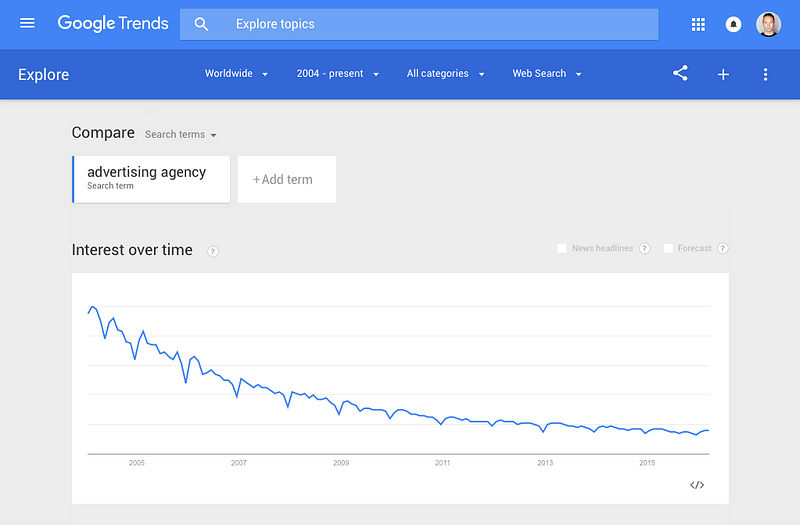
It may seem bizarre to claim that a $50B a year and growing industry is in peril. But whilst executives quaff rosé at the self-congratulatory circle jerk that is Cannes, Rome slowly burns. Multiple fires have been smouldering away over decades with more starting every year: service commoditisation, low technical competence, failure to grapple with digital product work, death of linear TV, ad blocking, robots, data judgement, the end of AOR, a people and lifestyle problem, a talent drain, and… a new gang in town out to steal their turf.
The rapid commoditisation of the services the industry offers will continue to erode profit margins. As mobile engineers slowly become as ubiquitous as web engineers the premium on skin deep mobile marketing work will disappear. Margins will go south the same way of once bountiful web marketing work. We have seen that pattern play out on platform after platform.
People are deleting advertising from their lives. Many simply don’t like or want it and now for the first time they have a choice in the matter. With the shift to streaming, the so-called ‘millennial’ has abandoned linear TV and, in turn, the ads that grace it. (Who can blame them? Have you tried watching an episode of anything in the US without developing ADD from all the ad breaks). Higher-income consumers are more able to afford an ad-free existence by paying subscriptions for ad-free service experiences such as YouTube Red, Hulu+, or Spotify. This further erodes the pool of young, upwardly-mobile consumers that the ad industry so covets. In the future, only older, poorer people will experience advertising.
The industry found hope in Nielsen’s 2015 ‘Global Trust in Advertising’ report. It heralded millennials as showing “the highest levels of trust in online and mobile formats.”. But a 2016 KPMG study found that the very same group was most likely to block ads with 60% of 16- to 24-year-olds planning do to so in the next six months. It also found that wealthier consumers are more likely to block ads. In the US alone an estimated 45 million are using ad-blocking technology and eMarketer predicted that 15 million people in the UK would begin using ad-blockers by the end of 2017. Clearly the issue of trust is meaningless without like or want (I trust my dentist, which doesn’t mean I want to unnecessarily spend time with him). This presents a serious challenge to an industry which has principally relied on these channels since inception.

The robots are coming! Software is going to eat a large majority of non-creative agency roles in the coming years. With great irony, like turkeys selling thanksgiving, the advertising industry is excitedly pushing the very robots that will ultimately replace them (programmatic anyone?). In the brave new world bots will communicate with millennials in a ‘relevant voice’ in their channel of choice about a product/service they are, according to data, likely to purchase. Dystopia here we come!
The shift to digital channels has delivered a data-rich world of less imperfect information. So the actual impact of what effectively constitutes shouting into the ether (legacy advertising) can now begin to be measured. TV advertising has long been considered effective, but for how long if it becomes measurable or people are not watching it? As consumption of viewing and advertising moves to the internet, quantifiable data means accountability and judgement. That should scare the hell out of agencies and publishers which have, outside of TV advertising, thus far survived and thrived on at best cloudy metrics.
For example a display ad is considered as ‘viewed by the visitor’ if “at least 50% of its pixels were displayed on the visitor’s browser for at least one continuous second”. The bar is clearly low. Kalkis Research recently released an End Of The Online Advertising Bubble report foreboding a beautifully coined “sub-prime crisis” in ad tech. It is well worth a scan. Gabe Leydon, founder of Machine Zone, buys a lot of ads and a lot of TV spots (you know, the ones with Kate Upton and Arnie in them). He gave an epic takedown of the agency/media industry at code/media 2016, characterising “almost all brand advertising as nothing more than a slush fund that feeds lazy advertisers, publishers and networks, who want to avoid accountability.” Ouch! It’s a must-watch if you are in the ad or media industry or if you like watching slow motion car crashes (seriously, the Q&A is like a post-coital cigarette… “Desire is an art and advertising is art and science!” someone forlornly pleads).
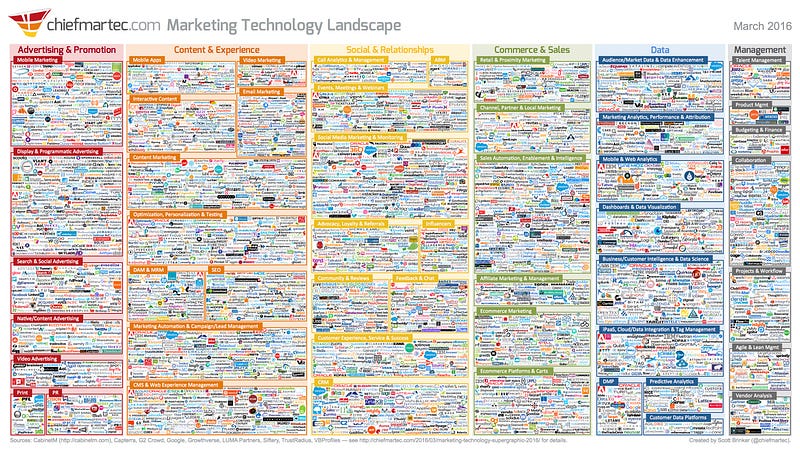
The era of the Agency of Record and retainers is coming to an end. I have met with many client-side teams and senior business decision makers at leading brands over the last year. I can tell you that the value and returns on comfortable, long-held agency of record relationships are in question. Feeling gauged and exploited, they are also asking the same of the many millions spent on bloated retainers over many years. The age of mega-retainers is coming to an end and the big brands such as Pepsi are calling it. As a new generation begins to take the helm, brands and clients are seeking out more open relationships than those of the AOR era. That shift presents a significant structural risk to the largest agencies who have grown fat on these arrangements. Everyone will need to figure out an operating model in a post-AOR world.
The ad industry has a talent, lifestyle, and purpose problem. Behind the generation of career-coasting marketers maintaining business as usual sits a frustrated, hungry, product focused, and purpose driven generation of progressives. For anyone working in and around agencies and brands those generational fault lines are clear to see. With so many options this talent is not hanging around. Many are emerging from a career-long bout of Stockholm syndrome, the self-justification for the all-hours, all-sacrifice lifestyle of the industry. Some agencies are beginning to act on the damage such as Wieden & Kennedy London trialling limits to work hours and email curfews for its staff. The fresh young talent that used to fuel agencies is increasingly altogether eschewing the industry despite desperate cosmetic makeovers.
It may be a case of too little, too late to change the tide. For more and more the question arises of what’s the point of putting up with all this? Confronted by his mortality following inoperable esophageal cancer, Linds Redding, a New Zealand-based art director who worked at BBDO and Saatchi & Saatchi put it like this…
“I think you’re all fucking mad. Deranged. So disengaged from reality it’s not even funny. It’s a fucking TV commercial. Nobody gives a shit.” — Linds Redding
Where once the talent was trickling from the leak in the dike, talent is now flooding out of the industry. Many are finding roles in tech companieswith better pay, better conditions, and greater meaning and fulfillment in the work. From the top down, the very people that could save the industry are leaving it. Rei Inamoto leaving AKQA to open a business invention shop or pretty much all the product-focused talent at Huge leaving to set up the product-focused agency Work & Co are two of countless examples. All of the above means that attracting talent, especially engineers, is approaching the impossible.
The script flips further. Tech giants such as Google and Facebook were once simply vendors and channels for the ad industry. However, both are now taking their talent and offering quantifiable performance marketing services directly to their clients. The parasite has become the host.
There is clearly a real impetus for change and none of this is new. Someone should do something right? Unfortunately the industry suffers from a false sense of security and lack of urgency. This has been fostered by the billions still being generated through a generation or two of marketers who are fully invested in maintaining the status quo (I suspect in order to ride out careers, pensions and mortgages). The fact is that both agency and client side have been complicit in selling and buying things to and from each other that no one cares about because it’s what has always been done.
A macrocosm of exactly this pattern is cloud advertising. Actual human beings give zero fucks about the cloud aka just someone else’s computer. Yet this untargeted, expensive and pointless noise that exactly this generation has sold to each other is plastered absolutely everywhere: TV, online, stations, billboards, outhouses, sporting events, and ensuring utter global inescapability in practically every major airport on the planet. VR is undoubtedly next as the “I need VR” becomes the new “I need an app” and branded VR content from vodka brands floods our consciousness.
The party is not going to end any day soon. But the industry will continue a slow and inevitable march to redundancy unless it responds to the many forces at play. There is another industry that went from nearly $40B a year to under $15B due to failure to grasp digital. This was the global recorded music industry which was decimated in just over a decade.
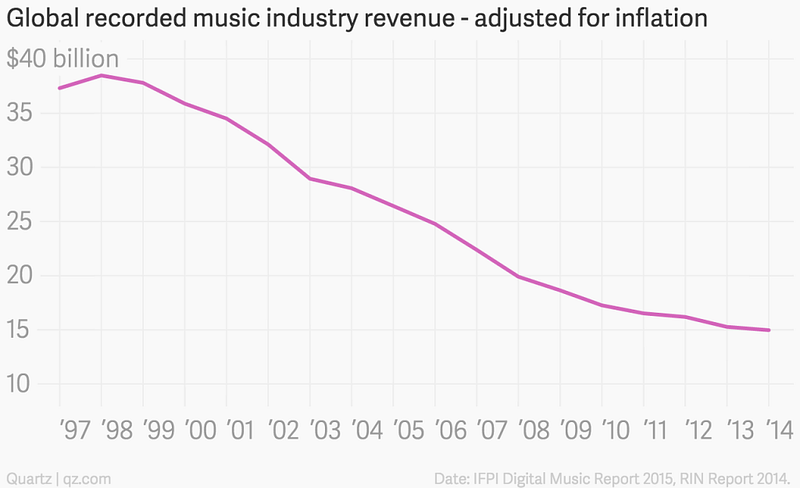
Digital product work with its margins, purpose, and engagement is one of the paths that could save the industry. With the writing on the wall for so long, why is the ad industry still not in the game?
The Great Pretenders

There was time when the ad industry had influence over more than Promotion, one of the Four Ps in the traditional Four Ps of marketing (Product, Price, Place, and Promotion). Way back in the Mad Men era so celebrated by the modern advertising industry they heavily informed Product. But as their clients in the 70s and 80s established in-house capabilities for those skills (doesn’t that sound familiar!) they were increasingly limited to Promotion. Decades later, the golden opportunity to reclaim the lost P and properly integrate digital product capabilities and culture is being spurned. The focus appears to be on rebranding existing capabilities to posture as business-building product shops, or even somewhat delusionally as startup disruptors…
Scan the positioning, websites, and decks of design, advertising, marketing, and branding agencies and you will see that everyone is now talking about building products and businesses. Old case studies have been repositioned in a new ‘product’ context. Has everyone transformed themselves into product organisations? No. They’ve mostly painted stripes on their horse to make a zebra. But it’s still a horse. To bastardise Dan Ariely’s beautiful Big Data quote, a lot of people are putting on a good show…
“Digital Product is like teenage sex: everyone talks about it, not many know how to do it, everyone thinks everyone else is doing it, so everyone claims they are doing it…” — (sort of) Dan Ariely
Ad holding group agencies such as BBH, Huge, Rockfish, Wieden & Kennedy & Ogilvy et al all established innovation ‘Labs’. Based on evidence that’s yet to be discovered, they have thus far proven to be marketing and client seduction efforts. They have shown little in terms of real world product output… repeat after me “A Digital Product is a software enabled product or service that offers some form of utility to a human being”. These labs do not reflect a true intent or investment in building a product for the world — indeed the Ad industry’s lack of intent was epitomised by Ogilvy shutting down their lab in 2016. The dust-gathering 3D printers, soon to be joined by dust-gathering VR headsets, are symbolic. This wonderful piece on agencies and products from 2012 still stands strong today.
Despite the many acquisitions of digital shops, the ad industry is still characterised by a low level of technical competence in digital product. It has yet to effectively structurally, or culturally integrate digital within its walls. There are simply so few examples that demonstrate success (before you wheel out RGA and Nike Plus, please… that was launched four James Bonds ago). The industry has struggled to effectively deliver beyond web marketing and e-commerce work into mobile software development. It is hard to see how it will command emerging technologies such as VR or wearable tech let alone complex digital product work.
This is precisely where the industry’s failure to grapple with digital product work, which commands a much higher premium and margin, will have consequence. If digital advertising and not products and services are to be commoditised and if ‘The future of marketing is to be useful’ then there should be no greater impetus for the industry to drive towards the delivery of digital products and services. Brand clients, nearly all of whom are becoming software oriented businesses, will ultimately seek out partners who are able to deliver digital product work. Within the confines of a confine of digital, the ad industry will be left to operate in the low end of the market. It is here that margins and profits will dry up. (Maybe then the focus will shift again on selling brands by making, well… advertising).
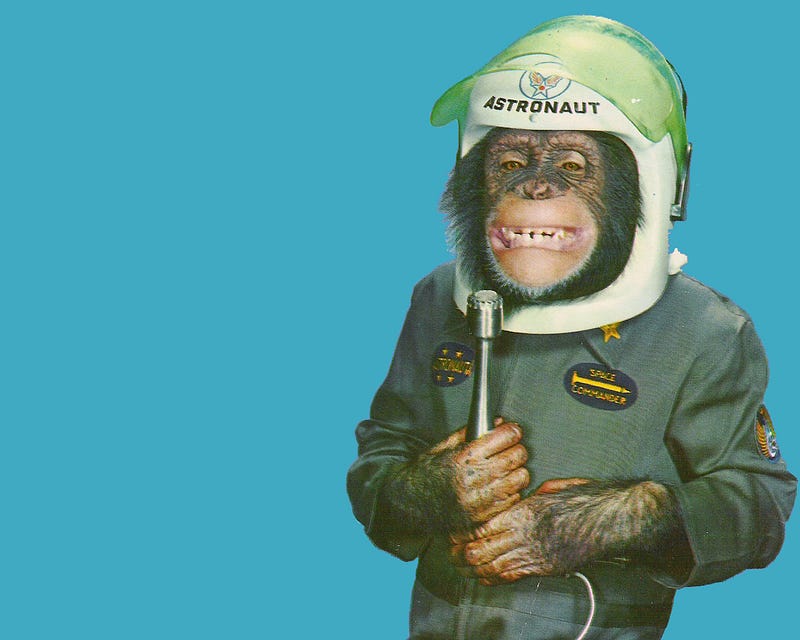
All in all the evidence points towards an Ad agency having as much experience in building businesses or digital products as chimpanzees do in space travel. Yes, chimpanzees have been in space, but that doesn’t mean you should let them fly the spaceship. So should a startup let themselves be advised by people who have never launched a startup themselves? That’s why tech companies and startups will let ad agencies market their core consumer facing products but won’t let them work on the products themselves.

The Ad Holding Groups have made an art form of establishing relationships with global brands. They have had the ear of the business decision makers more than any other vendor. I would venture that few do it better. However, with every fumbled product initiative another decades-old bridge gets burnt. As George Walker Bush said “Fool me once, shame on … shame on you. Fool me… You can’t get fooled again!”.
Clients need to question how honest a partner is incentivised to be if their agency delivers on only one part of the process. If you’re married to only one part of the process, selling purely strategy, design, branding or media, you’re most likely going to make that as big and expensive as you can as that’s how you make money. In contrast, being responsible end-to-end for getting a product to market, promotes honesty and efficiency as you’re invested in the outcome and post-launch iteration.
It begs the question of whether, like supertankers trying to navigate rapids, the big ad firms are too big to function in the new world of digital product. For the 500-plus person vessels sailing the marketing seas I am not confident the patient would survive the necessary surgery, nor their holding group masters allow it. But hold tight, we’re not done yet because adding to all of the above, shit just got real…
Enter the Big Five / Four
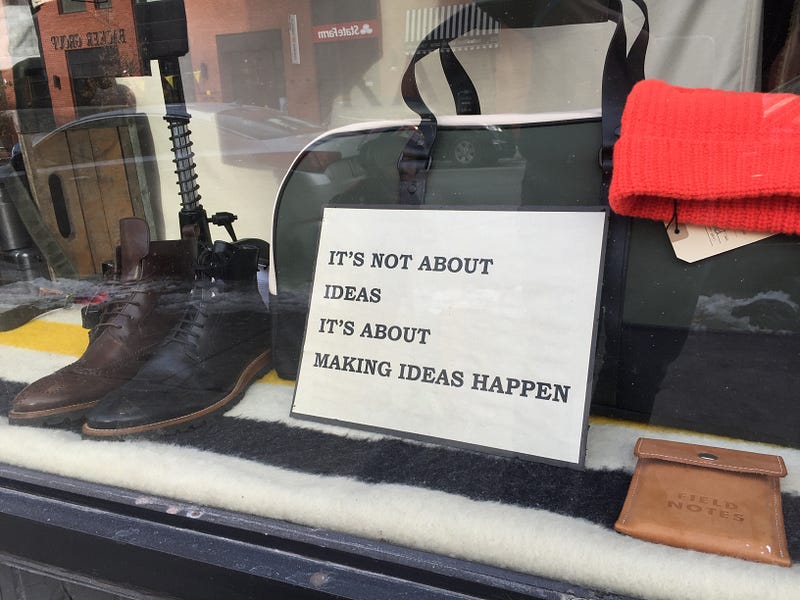
Management consultancies have entered the arena through a glut of digital consultancy acquisitions. They have done so for reasons both similar and different to the Ad Holding Groups. They already have C-suite access and accounts from which they are generating tens or hundreds of millions of dollars a year per client. Now they are slip slidin’ along the value chain to sell them more stuff and they have their eye on the ad holding group’s slice of the pie.
“It’s not about ideas, it’s about making ideas happen” — Scott Belsky
They are also responding to market demand. Much as visions of 2030 spur the imagination and inform strategy, they don’t impact more immediate business cycles. Increasingly their clients (and the world) are slowly edging away from buying ideas in multi-million dollar, 300-page powerpoint decks towards actually making ideas happen. In the same vein that the value of AOR and retainer relationships are being questioned by clients, the same is being asked of the strategic engagements of management consultancies. Their clients have become increasingly focused on a meaningful and actionable return on their not inconsiderable investment.
“Management consultancy… The art of stealing someone’s pocket watch and telling them the time”. — anon
A broadening of services from idea to encompass execution was required. By ‘buying’ design, management consultancies could now sell ‘design’ through their newly minted, execution focused storefronts; McKinsey Digital Labs / Accenture Interactive / Deloitte Digital / Capgemini Digital Customer Experience / IBM iX etc. They have ready buyers in existing clients, whose businesses are becoming digitised and running on software.
Now they have creative credibility by acquisition, digital chops, and a new and very large product and service design banner to wave to their clients.Something we need to see play out, given the sheer size of these client accounts, is whether design and digital product delivery will be central to or an afterthought in their relationship with the client. This will have a telling impact on the environment in which that work is carried out.
Clash of the Titans
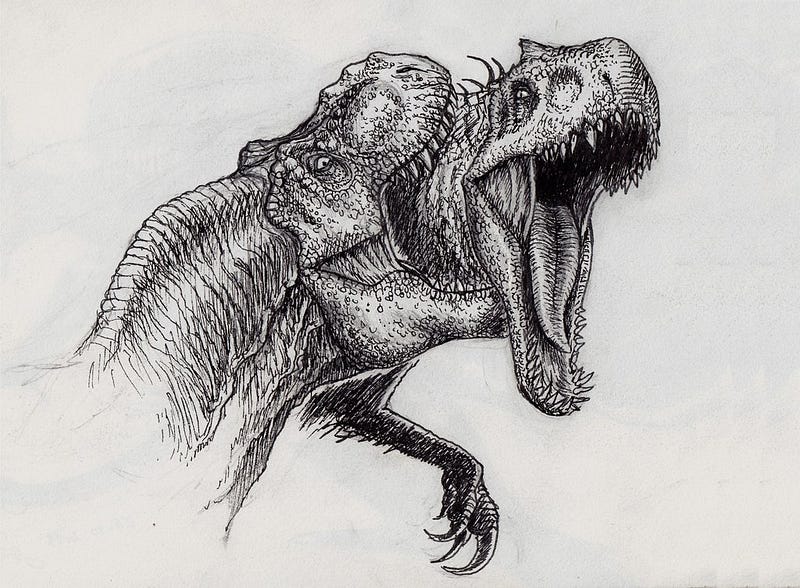
All of this has the behemoths colliding. The old school T-Rex ad holding firms are now fighting over prey with the genetically engineered I-Rex management consultancy design groups (sincere apologies if you haven’t seen Jurassic World). Let’s take a look at the 2015 revenues of the big management consultancies versus the Ad Holding Groups:
- IBM $81.7B, Deloitte Consulting $35.2B, Accenture $31.0B, Capgemini $13.2B*, McKinsey $8.3B (2014)
- WPP $17.5B*, Omnicom $15.1B, Publicis Groupe $10.7B*, IPG $7.6B
*Revenues crudely adjusted to USD from their reported local currency
Make no mistake these are absolutely giant companies fighting it out and the battle will be epic!
Outro: The impact of these seismic shifts in the industry are yet to fully play out. Will the management consultancies entering the market be able to escape the forces plaguing the Ad Holding Groups? Will either be able to shape compelling and sustainable digital product propositions for their clients — the ability to ‘actually make ideas happen’? Will they be able to hold onto the talent they have gathered up via expensive acquisitions?

The answers to those questions we will only know a few years down the line, but all the signs are of an industry in supernova. However, from destruction comes creation and opportunity aplenty. So watch this space as a new order slowly takes shape in the coming years.
If you want to read the piece where this came from, check out ‘State of the Digital Nation 2016’. Grab yourself a flask of coffee and a few packets of smokes as it’s a good old fashioned ‘long read’. Peace.


