
Roll Over Dalmations This 23 Year Old Wants 101 Babies
Is collecting babies an acceptable hobby?
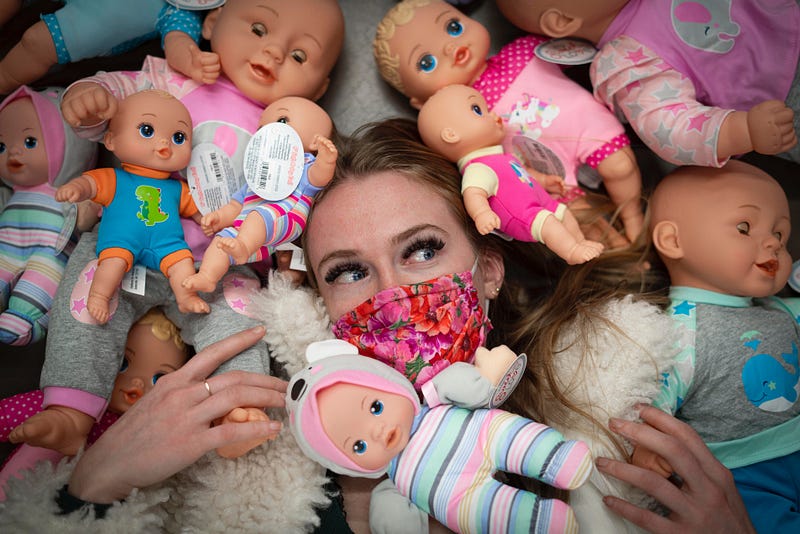
How many children are too many? We all have our own views on what makes a perfect family setup and how many children this involves.
For a rising number of people like myself, the right number of children is a big fat zero.
Whilst others may opt for anything from one child upwards. Although large families are a thing of the past, with an average of 1.54 children per woman in the UK.
Family sizes are decreasing with each generation and women are having fewer children. These UK statistics are reflective of the global trend of a reduction in birth rates.
Yet it seems 23-year-old Christina Ozturk hasn’t received the memo.
In February 2021 Christina’s story hit the media. She currently has 11 children, 10 of which have surrogate mothers. She and her millionaire husband, Galip, have notions of accumulating over 100 babies. The 10 babies through surrogate mothers are all a similar age.
Let that sink in for a bit.
One hundred children in one family. Their current setup of 10 babies and a 6-year-old is extreme. But striving for over 100 is, in my opinion, completely irresponsible on many levels. I do not say this lightly.
Should We Revere Her?
The media articles seem to celebrate her and are in wonderment. There is no discussion of the practicalities of so many children. There is no mention of the psychological impact on the children themselves.
So let’s untangle exactly why this is irresponsible and deep dive into my concerns. I will group my thoughts into the following categories:
- ethics of surrogacy
- psychological wellbeing and development of the children
- psychological wellbeing of Christina Ozturk
- practicalities and climate change
Ethics of Surrogacy
Surrogacy is a family planning option. It is normally considered when a woman is unable to conceive or carry her own child due to health issues or the risk of health complications. It is also used for same-sex male couples to become parents.
Surrogacy is an expensive option and viewed as a privilege. With costs normally starting from twenty thousand pounds.
Surrogacy is controversial and the laws around it differ globally. This article describes some of these differences.
France has an outright ban. Suggesting it violates the dignity of women. Other countries, including the UK, allow an “altruistic” arrangement. They allow it as a gift from one woman to another person, with an expenses-only payment set up.
There are some countries including Russia and Ukraine which allow commercial surrogacy as part of women’s own free will.
Is it exploitation?
There are obvious concerns surrounding the exploitation of women in poorer countries.
According to this article, on the whole, surrogate mothers do not suffer from psychological issues as a result of surrogacy.
It is fair to say, surrogacy in itself is not straightforward.
Very often surrogacy is a last resort to allow people to become parents, who otherwise may not be able to. I have to question the ethics of growing a family exponentially with the use of surrogate mothers.
Each baby puts a woman at risk during the pregnancy. Women still die during childbirth. In 2017 The World Health Organisation reported 295,000 deaths of women during pregnancy or childbirth.
The surrogate mother may well have the free will to choose for herself, but the payment may be too big an incentive to refuse.
Is using surrogate mothers to produce anywhere from 10 babies upwards for one family morally right? Is it a blatant sign of disregard for the risks to the surrogate mothers and a grotesque show of privilege?
Psychological Wellbeing and Development of the Children
Many parents struggle to meet the demands of a standard family size of 1 or 2 children, let alone 10 to 100.
Parenting is challenging and a constant balancing act. We are living in an era of helicopter parenting and the expectations placed on parents are enormous.
We know our upbringing affects us in adulthood.
This article outlines some of the consequences when parents do not spend enough time with their children. For children to develop healthily, they need quality time with their parents.
As it doesn’t say otherwise, let’s assume the Ozturks have a traditional family setup. With Christina being responsible for the lion’s share of the child care and Galip as the financer.
Giving Christina a generous 8 hours sleep each night (I know parents will laugh at this, but hear me out), we allow her 16 hours a day with her children. This breaks down to just 1.45 hours per child in her current circumstances. If they progress up to their goal of 100 babies, this will equate to a quarter of an hour each day per baby/child.
Can anyone develop a bond with a child based on a quarter of an hour a day?
Now, I suspect given money is no object, they will employ help. However, this then starts to resemble an orphanage or boarding house set up. Which in itself raises concerns.
Can you even have a connection with 100 babies/children?
Moses Farrow
In February 2021, Meghan Daum interviewed Moses Farrow on her podcast The Unspeakable.
Moses is one of the 14 children of Mia Farrow. This includes both adopted and biological children. The interview touches on the obscurity of Mia’s almost obsession with “collecting” children. Money is no object and Mia supports the children financially. However, there is a lack of time, love, and nurturing towards the children. This is a probable cause of longstanding trauma into adulthood.
Interestingly Meghan suggests Mia has some sort of compulsion in relation to adopting children.
Are 14 children too many to nurture?
These are completely different circumstances. Yet, I can’t help but wonder if there may end up being some similarities with the Ozturks.
Do the Ozturks have a similar compulsion in relation to collecting surrogate children? Time will tell.
Psychological Wellbeing of Christina Ozturk
Is Christina Ozturk of sound mind for wanting so many babies?
This article suggests she can’t stop thinking about having children. Maybe she requires therapy as opposed to gratifying her thoughts and bringing more children into the fold?
Is Christina an addict?
The Sun describes Christina as “addicted” to having children. Whilst the article is not derogatory, the choice of the word “addicted” is interesting.
Dr. Gabor Mate is an expert in the field of addiction, he defines addiction as:
“any behaviour or substance that a person uses to relieve pain in the short term, but which leads to negative consequences in the long term”
He asks the question “why the pain” not “why the addiction”. If Christina is displaying addictive behavior, what is the pain she is relieving? Is there suffering from her upbringing which is causing this behavior?
Does she undergo any psychological testing by the surrogacy clinic she uses?
We know many mothers struggle with their mental wellbeing when they become parents. Meeting the demands of a child can be extremely difficult. Sleep can be evasive when children come on the scene. Does Christina ever sleep? The likelihood is, she has paid help, but how does she cope emotionally? How will she cope in the future as the babies increase in numbers?
Christina was a single mum, aged 17 years old when she met her millionaire husband aged 50. Maybe age isn’t an issue. Maybe it is. I can’t help but feel she was in a very vulnerable position and may have been easily influenced.
Practicalities and Climate Change
I can’t comprehend the practicalities surrounding 11 children with plans to add to these numbers exponentially. From shopping for a family of 100 to cooking, bathing, changing diapers, and doing the nursery run.
And what about when they start to grow older and develop different interests. I know parents who struggle to meet the extra-curricula interests of 2 children, let alone 11–100! What size will their house need to be? How many cars (or buses) will they have?
If they have 100 children, almost every third day will be a birthday! I just can’t comprehend how any of this is possible unless there are as many staff members as children. But this then feeds back into the psychological wellbeing of the children and begs the question of WHY!
Cost
The Ozarks may profess to be wealthy, but it’s not just the cost of surrogates (they pay roughly eight thousand pounds per baby). There’s the cost of food, clothes, hobbies, schooling, activities, medical care, holidays. Then on to driving lessons, cars, university, social life, and accommodation.
In America, raising a child costs parents just short of a quarter of a million dollars. Multiply this by 11 and then 100!
Climate change
In less than one hundred years, the world’s population has nearly quadrupled. We are facing a population crisis and our consumption of the planet’s resources is unsustainable.
Whilst there are a number of ways we can reduce our carbon footprint. Studies suggest having one less child than planned is the single most significant influence to reduce carbon emissions.
Meghan and Harry have outlined their plans to only have 2 children, to remain environmentally responsible.
In America, the average annual carbon footprint of a child is 58.2 metric tonnes. This is a staggering number. For the Ozturk family as they are currently, this amounts to 640.2 metric tonnes a year. And if they reach their goal of 100 children, this will amount to 5,820 metric tonnes per year.
If the well-being of the children isn’t reason enough. The carbon footprint of having in excess of 11 children and up to 100 children, is an unjustifiable amount.
Is it environmentally selfish for the Ozturks to continue adding to their family?
Take Away
I’ve considered the Ozturks family ambitions under the terms of the ethics of the use of surrogacy in their own circumstances. The psychological wellbeing and development of the children and Christina herself. I considered the practicalities of life with so many children and the impact on climate change.
My conclusion is simple. I believe the Ozturks are putting their desires and goals for an excessive number of children, before the wellbeing of the children themselves. They are also putting this before the wellbeing of the surrogate mothers. Although I appreciate both of these views are subjective.
I can say for a fact they are selfishly putting their own desires and goals for an excessive number of children before the needs of the planet.
I sincerely hope my deductions are false. I hope all the children lead full and thriving lives with the necessary care and attention to develop into content and successful adults.