
GENEROSITY
Want to Help Ukrainian Refugees? Try Drafting the Support of Local Merchants to Multiply Your Efforts!
Ukraine needs our help — be generous

I received an email promo a couple of days ago.
It came from the largest, most financially successful Cannabis grower and distributor in Florida. It was a promotion tailored around “The International Day of Happiness.” Here’s the email header:

Opening the email revealed a full color graphic with the prominent headline “International Day of Happiness,” followed by a list of various products and cost-saving specials. The company’s Facebook page echoed the promo with:

The promotion pissed me off — bigtime!
Here’s the email I wrote to their customer service department:
“You’re actually doing a promotion based on the International Day of Happiness???? Are you aware of what’s going on in the world?? Personally, I find your marketing ploy insensitive, crass, and self-indulgent.
If you want to use theme-based promotions to boost your business, try donating a portion of the profits you generate directly to Ukrainians. Take up the cause to do something that matters, something that will make a difference. You’ll still make plenty of money. And if customers know their purchases are going to help ease the suffering of Ukrainians, I would anticipate a large increase in total sales volume as a result.
But there’s a catch: You’ll actually need to take action by making a real donation — not just a token one percent to satisfy legal oversight. Make the effort to help as many displaced lives as possible. The positive press you’ll receive will more than offset any initial and temporary impact to your bottom line.
I hope you’ll act on this suggestion. But it’s your decision. I urge you to make it with compassion.
I look forward to receiving your response.
Roger Reid, Ph.D.”
A few hours later, I received this response:
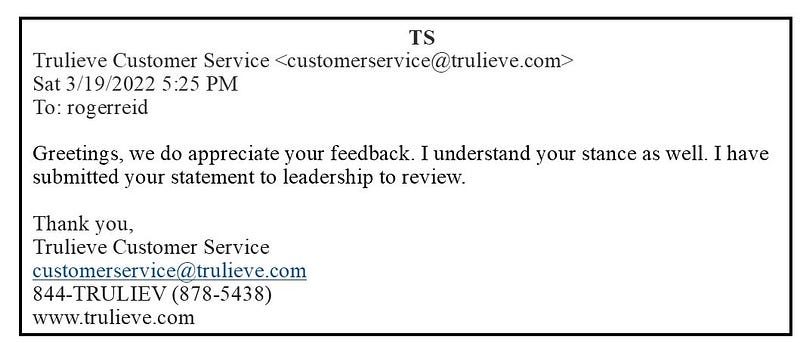
So far, I’ve received nothing further from Trulieve.
But I did notice they removed the promotion from all their email servers by retroactively changing the graphics in the original promotional email. Now it reads: Oh Happy Day . . . Deals Worth Smiling Over!
The reference to International Happiness Day has been removed.
I won’t pass judgement at this point, but if that’s all this company is going to do — save face with a little damage control on social media — then they will continue to occupy a permanent spot on my shit-list.
Why am I sharing this with you?
Because there are companies we buy from every day who regularly use charities, popular causes, and holidays to increase the emotional and logical motivation to buy from them.
The practice is nothing new. By sponsoring fund-raising activities for everything from local animal shelters to national medical research, the business provides actionable proof of their corporate values and socially responsible policies.
For example, the largest retail grocery chain in Florida is a company called Publix. There are 833 stores in Florida, with another 464 locations scattered in six other states. At the two stores where I personally shop, I usually see small cardboard tents and placards at the end of the check-out line asking patrons to contribute to The March of Dimes, or The Muscular Dystrophy Association, or some other organization dedicated to feeding the homeless and less fortunate.
Yesterday, I noticed a new promotion — to help the displaced Ukrainian war refugees. My initial reaction was positive. I wanted to contribute. But first, I asked the question: Does Publix match my contribution?
The clerk didn’t know. Or wasn’t sure. Then she said, “I don’t think so.”
I asked to speak to a supervisor . . . who turned out to be an “assistant” manager.
He wasn’t sure either, so he contacted the store manager, who assured me that YES, Publix would indeed match all contributions.
My wife and I are already supporting relief efforts through other channels, but if Publix was willing to match our contribution — essentially doubling the effectiveness — then yes, absolutely.
To their credit, Publix was asking customers to give to a cause that is damn important. How important? So important they not only established their stores as designated collection sites for this relief effort, but they were reaching into the corporate coffers to add their contribution.
I realize company sponsored charitable giving must have limits. I can only imagine the number of solicitations a business like Publix no doubt receives from organizations wanting financial help. Realistically, they can’t afford to help them all, so it’s always a question of choosing from those who do the most good for the greatest number in need.
With that said, it’s not unusual to see a socially-responsible company match funds from customer donations up to a specific amount. It’s an excellent way to demonstrate company values as well as validate the charitable mindset of their customer base.
By comparison to Trulieve’s mad scramble to correct a ill-conceived marketing gaffe, Publix’s response makes it clear that Publix recognizes the need to give back, to make a positive difference in the lives of those who need it most. And in this case, there’s no better way to do it than with a dollar-for-dollar matching contribution.
I urge you to encourage the stores and businesses in your area to take the same approach. Ask them to set up a charitable donation fund that will directly help the Ukrainian relief effort. Ask them to match customer contributions up to the maximum they can realistically afford.
Need contact info for organizations that are using donations to feed, house, and cloth Ukrainian refugees? Here’s four, recently vetted by Today Show researchers:
- World Central Kitchen (www.WCK.org): This organization is up and running at the Ukraine-Poland boarder providing free meals for hungry refugees.
- Global Giving Ukraine Crisis Relief Fund (www.Globalgiving.org): Supplying food and medical services to Ukrainian communities.
- The International Committee of the Red Cross (www.ICRC.org): This International arm of the Red Cross is helping to fund the humanitarian efforts.
- United Way Worldwide (www.Unitedway.org): This is a global relief fund providing refugees with food, shelter, medicine, transportation and childcare supplies.
If your political, religious, fraternal, social, or work affiliations prohibit civic or community involvement in charitable activities, then make as large a personal contribution as you can, and ask your friends to do the same.
I’ll leave you with this:
I know many people feel strongly about keeping their charity-giving private. They believe it should be a personal choice — you support who you choose, and I’ll do the same. And that’s fine . . . under normal circumstances.
But the situation in Ukraine and the relief effort in neighboring Poland is not business as usual. I realize asking your favorite store or business to donate to the cause may be uncomfortable for you. Even asking your friends, co-workers, and business associates to donate may spark a little apprehension.
If that’s the case, how would you compare your level of anticipated anxiety to that of Ukrainian children, their mothers, and families?
You decide.
© 2022 Roger Reid. All Rights Reserved.
Roger A. Reid, Ph.D. the host of Success Point 360 Podcast and author of Better Mondays and Speak Up. A certified NLP trainer with degrees in engineering and business, Roger offers tips and strategies for achieving higher levels of career success and personal fulfillment in the real world.
Become a Medium Member today for full access to every story — sign up Here!


