
Rockin’ Roly Poly, the Come Back Kid in Pastry
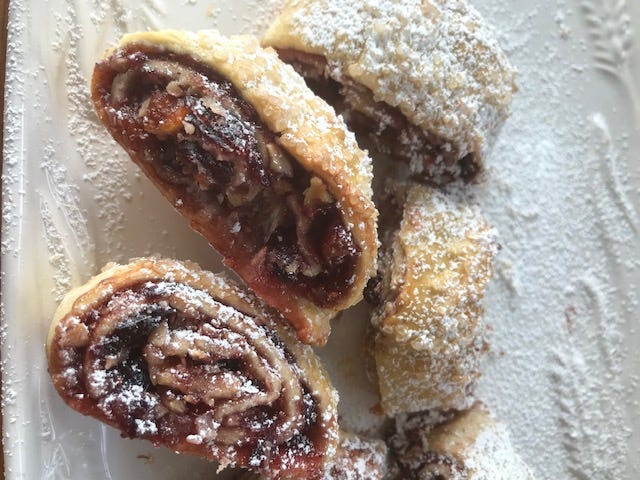
Vintage Baking that Still Rocks and Roly Poly….
As the author of a definitive book on Jewish baking and a professional baker, I thought I knew a substantial amount of Intel on this genre of food. I might know a lot but it turns out, about a baked treat with a funny name, Roly Poly, I don’t know much. And guess what? It’s not as quintessentially Jewish as I assumed; actually it seems to have its roots in the kitchens of jolly old England. First — what is Roly Poly? It’s a rolled up pastry, filled with jam, dried fruit, cinnamon and sugar. Turkish Delight also figures in Roly Poly but I have some swaps for that if you don’t like rose or bergamot flavoured Turkish Delight (or any Turkish Delight) but I’ll tell you about that further on. You roll up the pastry into a log and then cut it into pinwheel cookies which bake into golden, pastries with an ambrosial filling. If you like rugulah, you’ll absolutely adore Roly Poly. If you like wonderful and unusual baking, you’ll also love Roly Poly.
I always thought Rely Poly was an old-school, bubbie-style treat (circa 1950–1980’s) that (alas) went out of fashion when boomer cooks took over the kitchen. Each generation brings some recipes forward and leaves others behind and Roly Poly figures in the latter. It disappeared along with old faithfuls such as mun (poppy) cookies and various ‘haimish’ squares which were once the mainstays of canasta and bridge nights. I suspect it simply fell out of favour because of the Turkish Delight; Roly Poly traditionally includes Turkish Delight and let’s face it, lots of people aren’t Turkish Delight fans (and the rest don’t even know what it is). Unless you’re Edmond in the Lion, the Witch and the Wardrobe or grew up in a household where Turkish Delight is a cultural norm (like milk chocolate is for me) Turkish Delight is an acquired taste. But: Turkish Delight does melt and get faintly chewy and in Roly Poly, that sweet, gentle chewiness in the filling is a must. But read on because I found a great hack for that. The more I’ve researched however, it seems that traditional Jewish baking, once-iconic Roly Poly seems to have its vintage British cuisine roots albeit that version is a steamed Roly Poly pudding. My only conjecture is that perhaps British Jewish immigrants brought that recipe with them when they hit the American shores. As a kid, I recall it was rare that a Jewish event (brith, bar mitzvah, wedding or Shabbat dinner) didn’t feature a platter of this absolutely amazing delicacy. Indeed, women who made it well became community legends, as in “No one makes Roly Poly like Ethel”. You get my point. I recently revisited Roly Poly and made several test batches to update tradition and give it some gentle tweaks for today’s palate. I swapped the usual bergamot or rose-water-flavoured Turkish Delight with kosher Gummy Bears to get that chewy sweetness and that was perfect until I lucked out and found natural berry and also pomegranate Turkish Delight in my local spice store. You can also use wine gums instead of Turkish Delight. Replacing the Turkish Delight (although you don’t have to if you like it) was a miracle! I ended up using pomegranate Turkish Delight, as well as Gummy Bears.
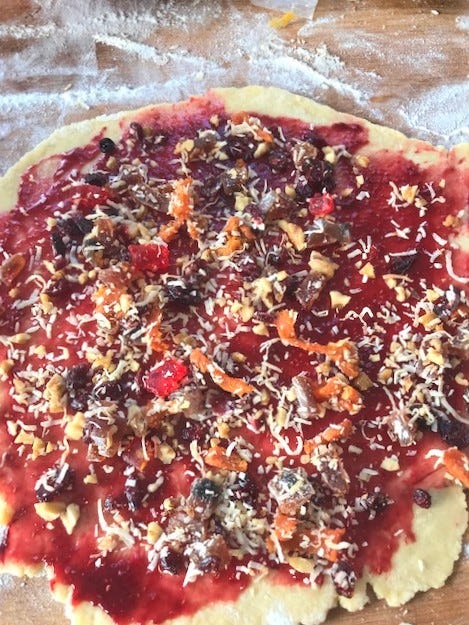
I also ditched the glace cherries Roly Poly used to have as they remind me of fruit cake. Instead I tossed in slivered dried apricots, dried cranberries along with the usual raisins. That was the filling. There was also the dough which is easy oil, sugar, eggs, flour, orange juice dough. It’s good but I thought a sour cream dough might be better. But the truth is the typical Roly Poly Dough was really perfect. In the end, overall, there was not a whole lot to ‘fix’ in this sumptuous memory-lane recipe. The only real fix is to remedy the lack of Roly Poly in the landscape by making some for your next gathering, be it a holiday (especially Succoth) or Shabbat. There is one caveat to Roly Poly however and that is to let them ‘cure’ overnight allowing the filling some time to soften the baked dough. The taste and texture is totally altered and you have pastry that is delicate and replete with a cornucopia and ambrosial filling of all the good things you can stuff into it.
Marcy Goldman’s Roly Poly Recipe
Orange Oil Roly Poly Dough 2 eggs 2/3 cup sugar 1 teaspoon pure vanilla extract 1/2 cup orange juice 1/2 cup vegetable oil 3 cups all-purpose flour, approximately 3/8 teaspoon salt 1 teaspoon baking powder
Filling 1 cup raspberry, apricot or sour cherry jam * 1 cup sweetened shredded coconut 1 cup plumped raisins or dried cranberries 1 cup ground walnuts 2 teaspoons cinnamon 2/3 cup minced dried California apricots 1 ½ cups, approximately, Turkish delight, cut into small slivers **
* The sour cherry jam made the best pastries ** I use a mix of Gummy Bears and Turkish Delight for the perfect balance of colour, taste and chewiness. (Use red or pale yellow Gummy Bears’ avoid green and orange) Stack two baking sheets together and line the top one with parchment paper.
For the dough, in a medium bowl, whisk together the eggs, sugar, orange juice and oil. Fold in the flour, salt and baking powder to make a soft but rollable dough (you might need to add a few tablespoons more flour). Knead dough very briefly and gently on a lightly floured board only to make smooth and cohesive. Don’t overwork it. Cover dough with a towel and let rest a couple 15 minutes or refrigerate until you need it (up to three days).
Preheat oven to 350 F. On a lightly floured board, roll out half the dough to a thickness of 1/4 inch thick, to form a rectangle 12 by 8 inches.
To fill the dough, spread half of jam on each rectangle. Sprinkle on half of listed ingredients (coconut, raisins, nuts, cinnamon, cherries, and Turkish delight). Turn in ends, and roll up into jellyroll shape. Cut into ¾ inch slices and place on the prepared baking sheet. Bake until golden brown all over, 35–40 minutes. Let cook a bit and then sift confectioners’ sugar on top.
Makes two 12 inch rolls, about 10–15 slices each