
Remember The Future
Robot Patrols Are Just The Beginning
Due to the COVID-19 pandemic, public discourse has significantly changed tone and direction. The Overton window has stretched on many issues. Robot law enforcement is one of them. It will be here to stay.
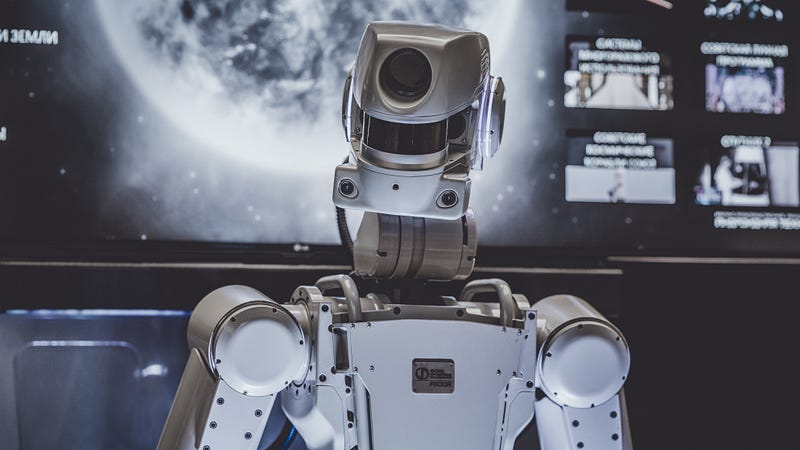
If you want to inform yourself about the robots that will soon be patrolling around the world, look no further than Boston Dynamics’ YouTube channel. Their robots have seen a lot of publicity over the last decade, often paired with commentary linking their act and likeness to a Terminator-like future (FastCompany, New York Post).
Public reception so far did not indicate a great acceptance of the idea of these robots performing important civic duties in everyday life.
All that seems to be changing now, with the public terrified by a global pandemic, human interaction being vilified, and social coherence being of high importance. There are indications that the idea of seeing robots patrol and help to enforce basic regulations is becoming acceptable. Singapore recently made headlines for using Boston Dynamics’ Spot robots in public parks to remind people of social distancing:
And that was only the beginning. We are already seeing a new wave of patrol robots being released into public life:
This raises the obvious question — What is next?
The Overton Window Is Opening
One theory can help us explain what is going on and try to understand where this might lead. It’s called the Overton Window and comes from the realm of political discourse.
The key idea is that at any given point in time, there is a whole scale of stances on a given issue. Those stances can be ordered by how acceptable they are to society — very fringe ideas being “radical,” while the mainstream sits in the middle as “policy” or “popular.”
The Overton Window tells us which ideas are acceptable to society at a given point in time, which can help understand the discourse of the time.
The Overton Window is, of course, not static. New ideas enter the world regularly, and attitudes shift often. Charting political history, as marked by debate and policy, every country has clear changes in their Overton Window over time. Just think of topics such as Universal Basic Income, which has entered as a fringe idea, and is now being trialed in several cities around the world.
Major events have the potential to radically change the shape of the Overton Window for the society living through them. They change how people see reality and what ideas are acceptable. One example would be the expansion of the US government’s powers after 9–11 through the Patriot Act .
Similarly, the COVID-19 pandemic is reshaping the Overton Window in societies around the globe right now.
What’s Next For The Robot Police?
The use of robots in law enforcement is not new in general. Various forms of robots have been used for different scenarios for quite a while in various countries. What is new is the idea that there would be no unusual scenario needed for robots to be used. They would essentially just become part of public life, and seeing a robot patrolling and calling citizens to order would suddenly be normal.
When these everyday use cases become acceptable, our habituation starts to kick in. While at first, it still feels odd, very quickly, we get used to it, and soon we will not recall that it used to be different. Similarly to how smartphones are just standard now, and it takes some serious reflection to remember what we did before. Hence we will become used to seeing robots uphold the law.
Once there is nothing odd about robot patrols, the Overton window has again shifted. Those are now “policy,” and it is just the state of affairs. This means that more radical proposals, such as fully autonomous police robots (most are currently operator-controlled), become thinkable. Not only that, but the application of force by a police robot might become an idea that slowly moves into the area where it is acceptable.
Our psychology, driven by the interpretation of reality and quick adaptation, does easily allow us to go down those rabbit holes. First, we change our view on reality, and then we change our actual reality. I would urge us all to watch and reflect carefully, to make sure the actual reality we allow to unfold is one that is desirable.
If you have any thoughts, responses, or questions to add, I would love to hear from you in the comments below, or feel free to reach out to me directly via LinkedIn. Thank you for reading.


