
Robin Hoodwinked: How Billion Dollar Powerballs Reflect 21st Century Inequality
State lotteries take from the poor to give to the rich, but we have options and there is a game-changing alternative
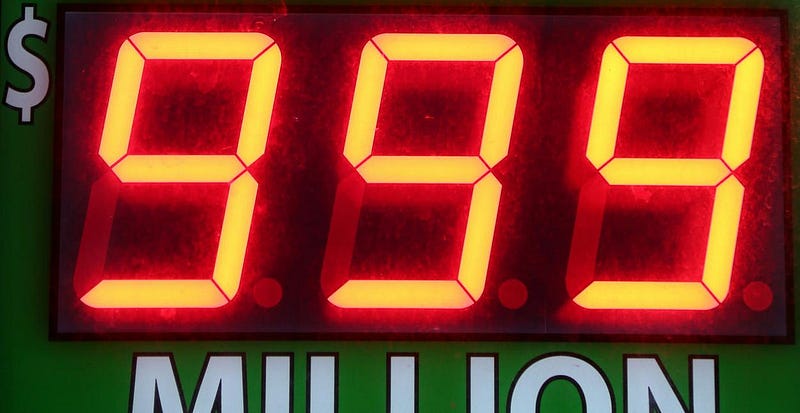
Back in 2015, I drove past the same sign I drive past daily, but looked at it with fresh eyes. It was a Powerball sign and it suddenly struck me how it was over a quarter of a billion dollars, and how that massive amount so perfectly fit the economy of the US, where a few really big winners are made, and everyone else loses year after year after year. I wondered when that sign would need a fourth digit. I apparently didn’t have to wonder for that long...
Here in 2016, we just experienced a lottery frenzy thanks to a world record-breaking Powerball jackpot of $1.6 billion, where there existed the distinct possibility one lucky winner could walk away having beaten odds of 1 in 292 million, to win a lump sum payout of $983.5 million. FYI, you are 8 times more likely to die in a car accident driving one mile to purchase your lotto ticket, than to beat those odds. But if you did win, after federal and state taxes, you stood to be vaulted immediately halfway to the three comma club.
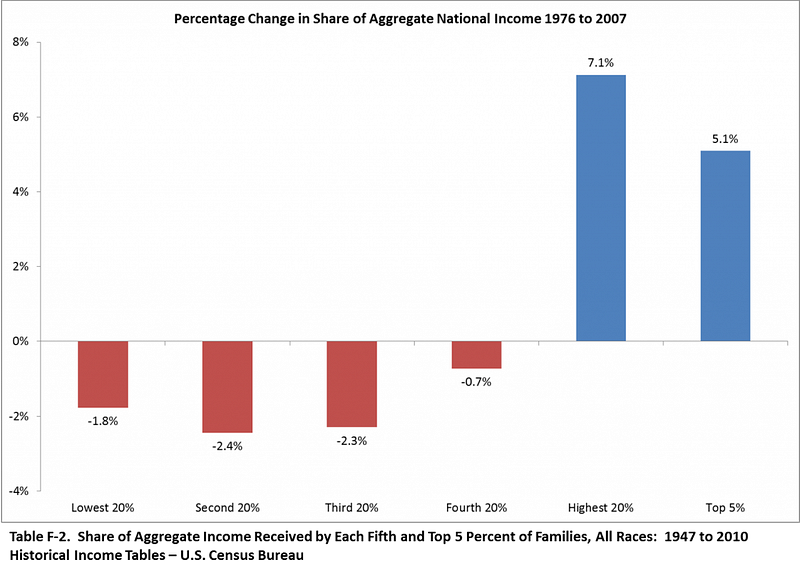
Is this kind of instant and massive windfall of wealth a perfect example of an alive and well American Dream? Or is it a troubling reminder of an increasingly maldistributed nation where just 1% of the population owns more of the wealth than 92% of Americans think would be ideal for the entire top 20% to own, and a world where 1% now owns more than the other 99% combined?
Answering such a question will involve looking more closely at lotteries.
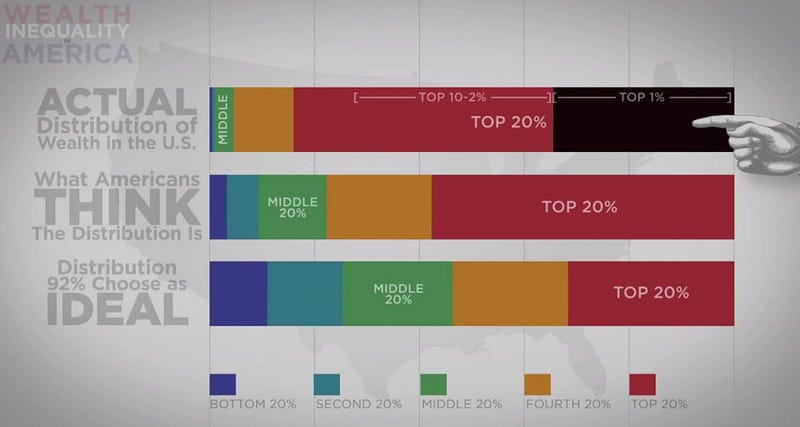
Prepare to get angry as we dive into the economics and politics of state lotteries that are being used as an incredibly regressive invisible tax, then take some deep breaths by looking at alternative lottery designs in other countries and what they have to teach us, before finding new hope in a possibility that could change the game entirely - universal basic income.
A Regressive Problem
Lotteries were not always so popular here in the US. In fact, thanks to my own state of Louisiana and its historic penchant for massive corruption, they went by the wayside in the late 1800s and didn’t return until the 1960s when New Hampshire rediscovered them, before then booming in the 1980s. It turns out lotteries are extremely alluring to US legislators, especially post-Reagan when lawmakers found themselves starved for new sources of revenue.
State lotteries are so alluring because they provide a way for governments to raise hundreds of millions of dollars without raising the usual taxes. On top of this, once one state does it, bordering states must follow, or lose out on the revenue of their residents crossing borders to buy tickets in other states. And so, state lotteries spread like wildfire at the end of the 20th century to all but four of the contiguous United States.
On its face, this can sound pretty great. It did to me at first. What a wonderful idea to have what is effectively a voluntary tax, right? A problem reveals itself however when the statistics are put under scrutiny, and it turns out that poor and minorities are far more likely to be frequent purchasers. Here we are arguing over flat taxes being good or bad where everyone pays the same percentage, and it turns out lotteries are an invisible tax that are the exact opposite of a progressive tax and far more regressive than a flat tax. There is no getting around the fact that the inordinate share of the burden of state revenue from lotteries falls squarely on those at the bottom.
This is how it actually breaks down, and it should be somewhat unsettling:
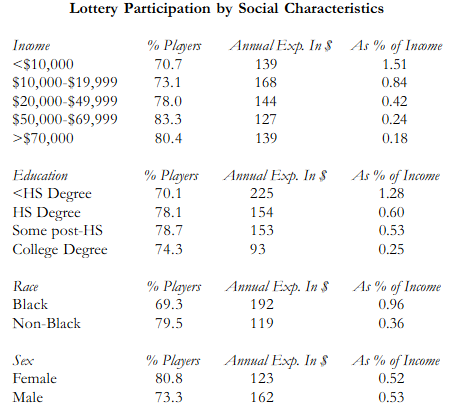
The above Detroit study found their state lottery to be an additional 1.3% tax on those earning under $10,000 while only being a 0.18% tax on those earning over $70,000. This is despite both demographics spending an identical $139 annually in 1991, because again, that amount of money is a larger chunk from smaller wallets. In South Dakota, the average per person spent on lottery tickets is $755, which is a whopping 6.4% of a federal poverty level income of $11,770 while being 1.8% of a $43,000 US per capita income.
Admittedly all this kind of data varies by state and city, but if we were to extrapolate these numbers as an average to the rest of the US, the poor would be spending almost 10 times as much of their income than the rich in state lotteries. Is this why they’re poor? Or is it because they’re poor? The simple fact is that lotteries represent a way out of poverty, and those who run lotteries market them most heavily in poorer neighborhoods, because they damn well know it.
“Lotteries represent a way out of poverty, and those who run lotteries market them most heavily in poorer neighborhoods, because they damn well know it.”
How States Use the Money
This is where you may be thinking that the revenue earned by states is actually invested in government services which then disproportionately benefit the poor, and to a degree, you’d be right. But not as right as you would likely hope. Here’s the three-fold rub:
First: If we’re going to fund public services, shouldn’t we do it more efficiently than applying a tax and only using less than half of that tax revenue? About 30–50% of lottery revenue goes to government (before federal taxes), which means 50–70% of everything spent is going to the winners, and to the costs of lottery administration, not to public services. It’s such an inefficient way of raising government revenue that more revenue could be raised by simply increasing sales tax by just 1%.
Second: Lottery revenue once raised, problematically tends to replace instead of add to existing revenue.
Patrick Pierce, a political science professor at St. Mary College, has studied lotteries and how states spend the revenue lotteries generate. He found that education spending does jump in the first year after a state adopts a lottery system. But after that, the pace of education spending tends to slow. By the eighth year, education spending is actually lower than it likely would have been if the lotto had not been adopted. Pierce says the money that would have gone to school spending is diverted elsewhere or used for voter-friendly tax cuts.
Most states do indeed spend the bulk of their lottery revenue on education, but if a school district is for example receiving $2 million, and they get $1 million in new lottery money, instead of ending up with $3 million and better education, states tend to shift $1 million in tax revenue away from that district elsewhere, or even cut it entirely by reducing taxes. This is where the comparison to a regressive tax really becomes clear. It’s because states are using lottery revenue to avoid raising taxes, even though it’s functioning just as a tax would, but in a hugely inefficient and regressive manner. Some states are even surprisingly blatant in this. In Wisconsin, 99% of its lotto revenue goes to lower property taxes. Who tends to own the most property? Not those with low incomes.
Third: Even in the best possible circumstances, in states considered to be shining examples of how to use lottery revenue to fund educations to provide greater opportunity, the outcomes disproportionately assist in the educational successes of the rich and middle classes. Our intent may be to help those with lower incomes by providing scholarships, but because recipients of these scholarships end up being firstly, primarily white, and secondly children of those who don’t or rarely buy lottery tickets, the actual end result is not what we intend.
What is the end result? Here’s a study that attempted to reveal the answer:
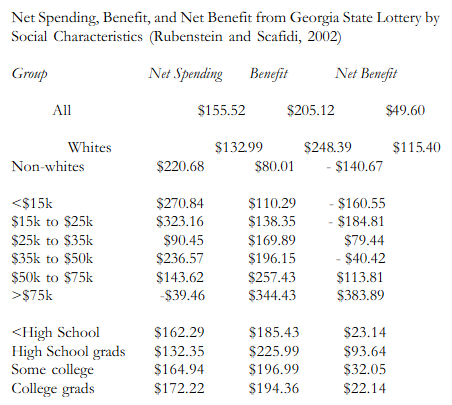
Where spending is what is spent on lottery tickets, and benefits are the services provided by government in return, despite there being a net benefit for all, there is only a net benefit for whites. There is a greater net loss for non-whites.
Furthermore, there is a net benefit for all those earning more than $50,000 per year, but a net loss for all those earning less than $25,000.
Imagine if a tax like this was put on a ballot and you got the option of voting for said tax. It would promise to hit the bottom more than the top, and use that revenue to benefit the top more than the bottom.
How would you vote?
The uncomfortable truth is that state lotteries are doing more to amplify and exacerbate our growing inequality than they are to alleviate it. States use lottery funds to primarily benefit the rich, white, and middle classes. Thus, in many ways lotteries function as a blatant reversal of Robin Hood’s motto: they systematically take from the poor and give to the rich.
“In many ways lotteries function as a blatant reversal of Robin Hood’s motto: they systematically take from the poor and give to the rich.”
Alternative Solutions
Let’s face it. Americans love games of chance. We love beating the odds and getting rich. It’s like the American Gold Rush never died. It’s seemingly in our blood. But are there ways of distributing the revenue that could have better outcomes than giant windfall jackpots? And do such alternative outcomes potentially have something important to teach us about human behavior?
Imagine instead, a form of lottery where you have a monthly subscription. Every month, you pay into the pot. When the winning number is drawn, it does not go to one person, but to an entire neighborhood. If your neighbor wins, you win too. Everyone around you wins who has subscribed to play. This model exists and it’s called the People’s Postcode Lottery. It was born in The Netherlands in 1989. Instead of one person walking away with $500 million dollars, up to around a hundred households in one community can walk away together with $50,000 dollars each.
The revenue not distributed to winners goes into a trust fund. Again, it would usually be spent on government services of some kind, but in the case of the Dutch PCL, it goes to funding charities and community projects. What if instead, that fund was setup in the same way the Alaska Permanent Fund is setup?
Started in 1982, the APF is now worth $50 billion after 34 years. In 2014 alone, the US spent $70 billion on state lotteries. Furthermore, last year the APF paid a dividend like they do every year, of $2,072 to every resident of Alaska, man, woman, and child with their $50B trust fund. What if we did the same thing by creating lottery dividends? (We already have casino dividends)
Well, for one, that would incentivize everyone in the state to buy monthly subscriptions, as the more who subscribed the larger the fund would grow, and in addition, the better their chances would be for their neighborhood to win. Through the dividends, they’d always win something, and through the lottery, they’d always have a chance of winning much more on top of it. Secondly, because everyone would get the same dividend, the regressivity could be negated. If you’re poor and spend $100 on tickets, but get a $100 dividend, you effectively just got taxed 0%. Finally, because it was a fund that always grew, and that fund was invested in the market, it would grow even more over time paralleling productivity growth in the national economy. People would get more money as GDP grew.
So what could we learn from such a lottery system aside from what we’ve already learned from Alaska? Well, fortunately for us, there’s a study that was done on winners of the Dutch PCL, who on average won around $18,000. Since a common concern is how people spend free cash like this, how did they end up spending it?
Consistent with a simple life-cycle model of consumption, we do not detect any effect of winning the postcode lottery on most components of winning households’ expenditures, including food at home, transportation, and total monthly outlays. However, we do find effects on car expenditures and other durable expenditures of winners… We also find that participants in winning codes were 4.5 times as likely to initiate major exterior home renovations during this period and spent over €500 more on noncar durables than participants in nonwinning codes.
In other words, lottery winners didn’t really alter their behavior all that much, except for basically buying new cars, new washer/dryers, and investing in home improvements. They did not stop working. They did not burn their money on drugs and alcohol. They essentially treated their winnings like ordinary raises, and went about their lives as normal, driving slightly nicer looking cars, to slightly nicer looking homes. However, there were some truly fascinating effects observed on their neighbors.
Turning to social effects, we detect statistically significant effects of lottery prizes on the car consumption of neighbors of winners. For example, having an immediate neighbor win the PCL raises the probability that a household will buy a car in the next six months by close to 7 percentage points... Relative to the modest effects of the lottery prizes on the consumption choices of winning households, these effects on neighbors are large.
Thus a surprising effect was that nearby neighbors who didn’t win anything, were far more likely to buy a new car, simply because they lived sufficiently close to a lottery winner. This matches a “Keeping Up With the Joneses” hypothesis, and is described by the study’s authors as “encouraging news for fiscal policies such as unexpected tax rebates designed to stimulate consumer spending in developed economies.” Essentially, this is neat evidence of social multiplier effects, where a boost in income doesn’t just increase consumption of durables among those receiving the boost, but also among those nearby who don’t receive a boost but spend more anyway to try to keep up.
These multi-thousandaire instead of multi-millionaire winnings may sound small, but they have real economic multiplier effects. Consumers consume a bit more, and inspire fellow consumers to consume a bit more too. But that’s only the economics. What are some of the emotional impacts described by winning households of such seemingly small amounts? Here are some quotes from actual PCL winners in the UK and the amounts they won:
Katie B. (£8,162): “It’s just astonishing. I burst out crying because it’s a life-changing amount of money for us.”
Mark B. (£20,407): “I couldn’t believe it. It’s a life-changing amount of money.”
Lisa Q. (£24,489): “As a single mum this is a life-changing amount of money. I was just excited that I can buy a new phone for the first time in 20 years!”
These are not million dollar jackpots. They are equivalent to small annual salaries, and they are still described as “life-changing amounts of money.” Apparently, changing lives does not require millions of dollars. It merely requires meeting the most basic needs of life, so as to provide a sense of security.
“Changing lives does not require millions of dollars. It merely requires meeting the most basic needs of life.”
Winning for Life
What about wins of a very basic size, but given on a regular basis, forever? That kind exists too, with its own lessons to teach us, and one such lottery is called “Win for Life” in Belgium, and it provides around €1,000 every month for as long as the winner is alive to receive it. Here is an interview with one such winner:
After winning the WFL lottery, Anja became self-employed and now works more than ever, but it doesn’t feel like work to her because she enjoys it so much. She doesn’t feel the kind of pressure she once felt. If she loses her job, it’s not the end of the world. She’d also have never started her business otherwise, out of fear of failure and even bankruptcy. Her income security increased the amount of risk she felt comfortable taking, and the result was entrepreneurship.
The case of Anja is just one story and of course results may vary, but there actually is some data that’s been gathered on other W4L recipients like her, in the form of a fascinating study of 82 winners. Here are some of the highlights:
- Most singles worked both before and after winning.
- Most winners in steady relationships did not change their working behavior. Only 7 out of the 45 cases who were working before W4L and 2 out of 21 who were not working changed their behavior.
- Two winners decided to work less. Of these two, one decided to work 27 instead of 38 hours a week, the other 24 hours instead of 32.
- Of the 4 winners who were unemployed at the time, one started working after winning. The 3 remaining winners that stayed unemployed after winning were all women with children, 2 of whom explicitly related their staying at home to having time to raise their kids.
These results are actually very similar to the results observed in both the American Income Maintenance Experiments and the Canadian Mincome Experiment performed in the 1970s, where people given a small income by the government separate from work mostly all continued working as they were before. The only real work disincentive effect was slight and seen in new mothers deciding to spend a bit more time parenting at home, and students returning to school, which can both readily be argued (just as Judith Shulevitz did recently in The New York Times) as not a work disincentive at all, but instead a shift in work from paid to unpaid.
If we add all of this up, the Dutch Postcode Lottery, the Belgian Win for Life lottery, and both the economic and psychological benefits of winning smaller amounts of money on a perpetual basis, it all seems to draw a picture of a more ideal lottery system that is entirely antithetical to the Powerball system we have now in the US, where one person can walk away with many millions of dollars. Contrary to such a distributional model that mirrors our growing inequality where the system benefits a few, alternative model lottery findings instead point to a distributional model that actually mirrors the idea of a universal basic income, where the system benefits the many by providing entire communities small amounts of money, paid individually and regularly, for life.
Universal Basic Income Pilot, USA
Now discussed all over the world, in more and more countries, with ever increasing frequency, universal basic income (the idea of everyone winning for life without even purchasing a ticket), though backed by a lot of supporting evidence, is still mostly theoretical, as described by Federico Pistono at TEDx.
Yes, there have been pilot projects done for a year or two at a time covering 1,000 people in Namibia and 6,000 in India, but as critics are fond of pointing out, neither of those are the United States.
Yes, there have been experiments done with something similar to a universal basic income in the United States, but those experiments took place decades ago, again for a matter of years, and again for just a population of thousands.
Yes, there has existed the annual Alaska dividend since 1982, paying everyone every year universally, but it’s currently only about 1/6th of a basic income.
Yes, Finland is planning an experiment to study universal basic income, by testing it in various ways using around 100,000 people for two years, but that is again not the United States, and even though the sample size will be the largest ever, the duration is still short and the location is Europe.
Something is missing…
A decade long, region-wide, privately-funded universal basic income experiment done in the United States.
What? How?
The Powerball jackpot we just witnessed had a lump sum payoff amount of $983 million. Let’s not worry about the federal taxes owed for a moment and consider what else could be done with such an amount. That’s enough to fully saturate a micropolitan area of almost 10,000 people with $1,000 every month, (and $300 for all under 18) unconditionally, for 10 years.
If we were to do that, and compare it to a similar micropolitan area as an appropriate control group, it would be an experiment with a larger sample size than either the Namibia or India experiments. It would be an experiment within the US, and thus not one to hand wave away as being nonapplicable to the US. And it would be powerfully longitudinal in length, allowing us to evaluate long-term effects over the course of a decade.
So where could we come up with the $1 billion in funds to do this? Consider a hybrid between Powerball, the Postcode Lottery, and Win for Life. What if we created a new multi-state lottery in the US, where entire neighborhoods of players win $1,000 per month, for life, and the revenue not spent on winnings went into a BIG pot. Then upon reaching $1 billion, the universal basic income pilot would begin in a suitable geographic area. Further revenue could go towards another pilot or simply Alaskan-style state dividends.
This kind of setup could provide more data on basic incomes from day one by being given in identical amounts all over the country, and to entire neighborhoods. Winners would immediately know what it’s like to feel basic security for the rest of their lives, and non-winners would still know their money is going to a full-blown basic income experiment that would advance the date of the receipt of their own unconditional basic incomes once the idea had reached a critical mass in the minds of the voting public. And once everyone has a basic income, no one need buy a lottery ticket out of desperation ever again, and inequality will be returned to productive levels.
Think about it. This wouldn’t be Powerball. It would be Empowerball.
How many people are purchasing lottery tickets right now, simply because they don’t have a basic income? How much of this invisible taxation could be avoided by simply providing people the income floor everyone needs for basic security, and funding it in an entirely visible and functionally progressive manner? Instead of invisible regressive taxation like lotteries, we could use methods like carbon taxation, land value taxation, financial transaction taxation, and even simply the elimination of loopholes and subsidies. Taxing poverty as a means of funding a variety of government programs intended to make educational outcomes less unequal to try to fight poverty, instead of just giving everyone the same starting point above the poverty line as a bipartisan American birthright, makes no sense. We can do better, especially in lieu of advancing income-eliminating technology like self-driving trucks and AI.
Robin Hoodwinked
The way state lotteries work right now are the exact opposite of any system we would ever as a democratic society actually vote for. It disproportionately takes revenue from the pockets of those with mostly empty pockets, and in turn disproportionately stuffs that revenue into the pockets of those with mostly full and even overflowing pockets. It is a clear reflection of the society we’ve spent decades building, one that serves as an ongoing engine built for upward redistribution. Simply stated, the net result of our state lotteries is a significant exacerbation of our already worsening inequality.
In a country where our public officials treat their terms of office as internships for lucrative positions in the private sector, it only makes sense that even Robin Hood himself has now walked through the revolving door to apply his skills for the enrichment of the wealthy at the expense of the poor. But this need not continue forever. The odds may be against us, but as every Powerball drawing reminds us, and our casino-like society pleads we remember, we can win. We can be lucky. We can be the one to beat the odds.
So how about it, America? Are we ready to bet on Basic Income?
Or do we wish to continue incessantly arguing as we are Robin Hoodwinked?
Suggested further reading:
- The Economic Inequalities of State Lotteries by Martin Tomlinson
- WIN FOR LIFE: What, if anything, happens after the introduction of a Basic Income? by Axel Marx and Hans Peeters
- Can Money Change Who We Are? Estimating the Effect of Unearned Income on Incentive-Enhancing Personality Traits by Nattavudh Powdthavee, Christopher J. Boyce, and Alex M. Wood
This article was written on a basic income. If you found value in this article, you can support it along with all my advocacy for basic income with a monthly patron pledge.
What is the BIG Patreon Creator Pledge?
Special thanks to Steven Grimm, Arjun Banker, Larry Cohen, Aaron Marcus-Kubitza, Andrew Stern, Topher Hunt, Keith Davis, Chris Smothers, Richard Just, Albert Wenger, Mark Witham, Kian Alavi, Cameron Ottens, Susanne Berg, Gerald Huff, Michiel Dral, Louise Whitmore, Dan O’Sullivan, Harish Venkatesan, John David Hodge, Gary Aranovich, Kai Wong, Michael Honey, Katie Doemland, Stuart Matthews, Natalie Foster, Chris McCoy, David Ihnen, Joe Ballou, Jack Wagner, Joe Esposito, Jan Smole, Danielle Texeira, Paul Wicks, Masud Shah, Elizabeth Balcar, Jeff Schulman, Olli Niinimäki, Casey Young, Thomas Welsh, Amy Shaffer, Kris Roadruck, Lee Irving, Rise & Shine PAC, Kirk Israel, Luke Sampson, Robert Solovay, Dave Shelton, Bryan Herdliska, Stephane Boisvert, Andrew Henderson, Erhan Altay, Johan Grahn, Tony DeStefano, Shane Gordon, Paolo Narciso, Martin Jordo, Victor Lau, Robert F. Greene, all my other funders for their support, and my amazing partner, Katie Smith.
Would you like to see your name here too?
Scott Santens writes about basic income on his blog. You can also follow him here on Medium, on Twitter, on Facebook, or on Reddit where he is a moderator for the /r/BasicIncome community of over 30,000 subscribers.
If you feel others would appreciate this article, please click the green heart.


