
MONTHLY CHALLENGE
Road Trip in Japan
Kindness and gratitude go hand-in-hand when you’re travelling
I didn’t start travelling until I was in my fifties. My children were growing up, I had divorced my husband and I could now I could travel as I pleased. I started to travel far and wide and experience the kindness of strangers. Nowhere was this more evident than in Japan.
Let me tell you of the kindness offered to my daughter and me on our road trip of Northern Honshu. We were beginning our trip from Tokyo which meant we had to walk to the train station with our luggage and camping gear, catch a train to the suburb where her friend lived, and then walk to his place to collect the car which we were borrowing for the week. I was exhausted before we even left Tokyo! It was past midday before we finally made it out of the city.
We drove for a couple of hours before pulling into a roadside stop for an iced coffee, a bite to eat and a toilet break, and I took over the driving. It was the first time I’d driven outside of Australia! But it was okay as the Japanese drive on the left-hand side of the road like we do. I wondered about this as most countries who drive on the left side of the road are former British colonies. And Japan was never a British colony. Interesting.
“In Japan, driving on the left has little to do with cars. Quite the contrary, it’s all for the convenience of the samurai and Japanese road usage logic. You see, at the time of the samurai, city streets and footpaths were quite narrow. In addition, most samurai were right-handed and wore their katana on the left.”
It was freeway driving — 3 lanes — so not too difficult except traffic was going too slow (80 kph) or too fast (140kph). I sat on 120 in the fast lane except when one of these speedsters appeared up my arse. We found the correct exit and pulled off the freeway. Stacey started navigating to the Echigo-Tsumari Art Field. I wanted to turn left just following my instincts but Stacey said to turn right, so right I turned.
After a couple of minutes it was obvious we didn’t have a clue where we were so I pulled into some shade in front of a house with a triple garage. Now, one would think if they had a triple garage, they would use it to park their cars and the entrance would be driveable. True, except for one concrete slab about 3 feet by 1 foot that was missing from over the gutter, actually a drain.
Of course, I hit that- Bang!- and then hear hissssssss! We get out to survey the damage. The front passenger side tyre had burst! I was relieved as I imagined the entire side of the car was damaged beyond repair and what were we going to tell the car’s owner.
We just needed to change the tyre. We managed to get the car up on the jack — no mean feat as neither of us could use that bloody ratchet mechanism! I knew how to take off the wheel nuts — the only problem was the wheel brace that was in the car was the wrong bloody size!
Grateful for help on the road
The first random act of kindness came from two cars who stopped to help us — a young couple with a pregnant wife and an older Japanese gentleman who had a four-pronged wheel brace. Aha! He removed the damaged wheel and put on the spare tyre — which was just that, a spare and never meant to be used! It wasn’t even the same width — it looked like a trailer tyre but we put it on anyway. It was better than nothing!
Stacey was keen to see as many of the art installations before dark, but I just wanted that bloody tyre fixed. It was making terrible noises the whole time on the winding mountain road — I was a nervous wreck. Fortunately, we came to a crossroads where there was a petrol station that looked like it might be able to fix our tyre. But it was too far gone — we had to buy a new one — this wasn’t in our budget. 100,000 yen later, we were off to see the art exhibits.
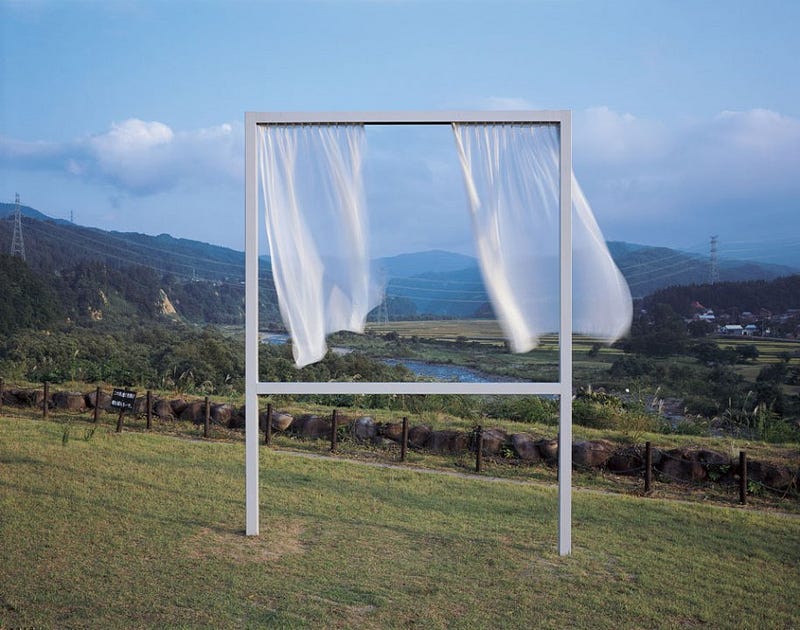
The first one was a metal frame with huge white curtains blowing in the breeze, through which the viewer looked to admire the scenery as if through an open window. The view was breathtakingly beautiful. Then we spied a huge wooden ring, about 10 metres in diameter, suspended in the forest. All of these artworks have meaning involving nature, the forest, the land, the sea, the people, the circle of life etc — all very important to the Japanese.
After visiting a few more installations, some weirder than others, we stopped at an onsen where we ate a delicious meal of curry and rice before heading to the soothing hot water. Not before thoroughly cleansing our bodies all over including washing our hair. There were two pools to choose from — an indoor one that was far too hot even for me and an outdoor one that was a very pleasant, soothing 41C.
Revivified, we drove to do some “star-catching”. There were hundreds of people there at the star-catching exhibit. I was totally mesmerised and I could have spent hours catching stars. However, I handed in my star-catching net and headed back to the car park. Here, while waiting for Stacey, I was lucky enough to talk to the father of the artist who designed the star-catching exhibit. I thought it was so lovely he had taken the time to speak to me — a ragged, tired gaijin (foreigner) — I felt kind of special. We had encountered nothing but kind, generous people all day and hadn’t seen a single Westerner.
After we had had our daily quota of art, filled out bellies, and soaked away all of our aching muscles in a gorgeous onsen, we needed to find the campground to pitch our tent. We drove to Matsudai where there was a camp-jo (campground) nearby. We stopped at a 7/11 to buy some water and food for breakfast. Stacey asked for directions to the camp-jo only to be told it was closed for the summer. (end of summer is 31August!) It was now the 3rd of September and as hot as any summer’s day in Brisbane.
Best laid plans (or lack of them I thought but said nothing!) Stacey continued to chat with the clerk about where we could stay for the night. The options were sleeping in the car at the station or booking a very expensive night in the “love hotel” — there was only one in Matsudai. Neither of these options appealed to me.
Grateful for accommodation
A young Japanese girl with her husband in tow approached Stacey and volunteered her parents’ house for the night. She called her parents to make sure it was okay and we followed their little yellow car all the way to her parents’ house. Tomoko and her husband Yasu were on their way home to her parents’ for the weekend even though it was 10 pm on a Saturday night.
I was blown away by the kindness and generosity of Tomoko’s mother. She gave us food — tomatoes and onions and okra grown in her own garden and plied us with drink — first green tea then a lovely alcoholic prune juice she had made herself. It takes a whole year to mature.
We sat around chatting — well, Stacey chatted with the four family members and I tried desperately not to fall asleep — I caught an occasional word. Tomoko must have noticed my tiredness and prepared two futons for us in the guest room which normally served as a formal dining room. I fell asleep as soon as my head hit the pillow.
I couldn’t believe this family had taken us in — total strangers — and made us feel so welcome. Australians are known as a friendly lot but I just couldn’t imagine this ever happening in Australia or anywhere else for that matter! But the hospitality didn’t stop there.
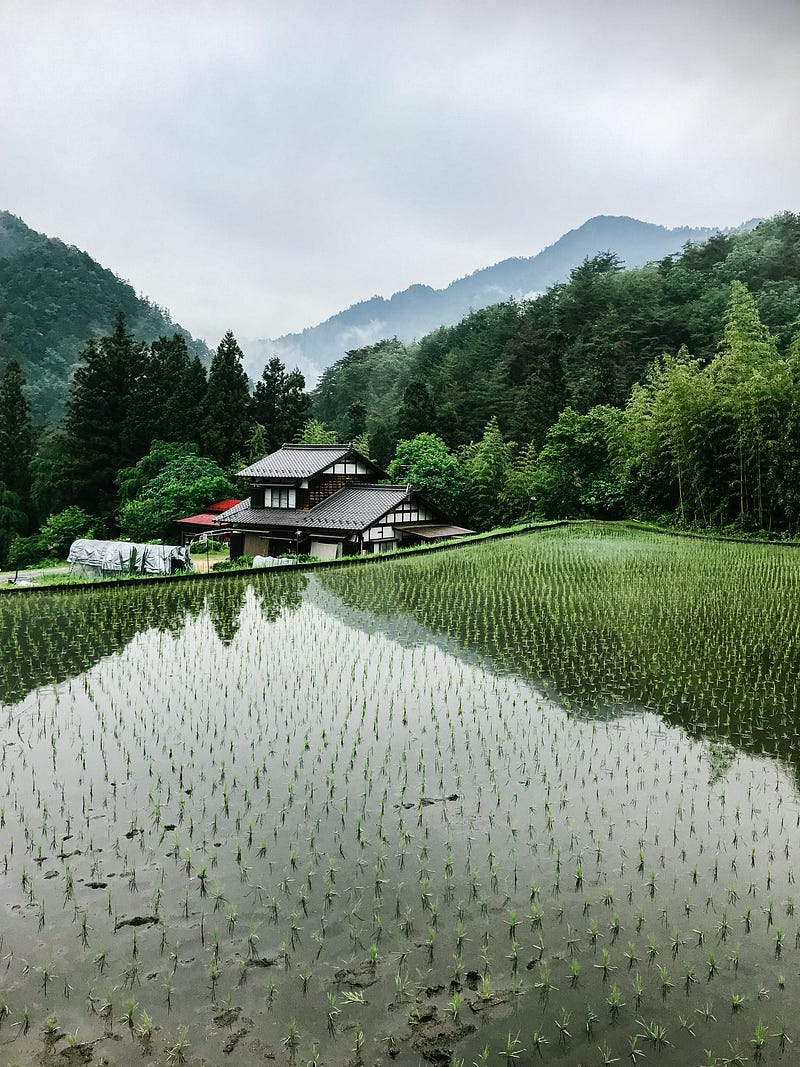
The next morning I walked to the kitchen to admire the view of their farm — her parents are rice-farmers. Tomoko then took us to see another art installation — mauve and purple beads in differing hues woven into thousands of flowers and planted on the forest floor of beech trees. The exhibit was truly beautiful. The early morning sunlight filtered through the trees and made the “planted” flowers sparkle. I wish I could show you one of the many photos we took.
Grateful for the best breakfast ever
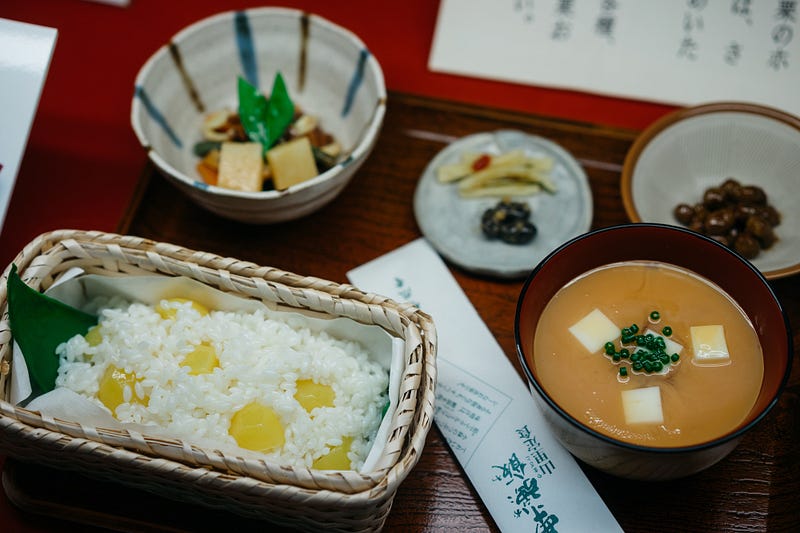
Tomoko then insisted we come back to her parents’ house for breakfast — more like an all-you-can-eat buffet — eggs, chopped cabbage, rice, marinated fish, shellfish soup, cucumber, tomato, a delicious eggplant dish and some other yummy vegetables I don’t know the name of. And mugicha — a type of tea — an acquired taste that I haven’t acquired yet 😜 It was cold and refreshing though so I drank several glasses. Breakfast was followed by green tea served in the living room. We were shown the ducks being fed, the vegetable garden ( all of those delicious veggies came from their own garden) and the rice-harvester shed. No picking by hand here!
After saying our sayonaras, we left to check out some more of the art installations. Tomoko was saying if we were still in the area to come to stay the night again with them. Just so friendly that I was completely shocked. We hadn’t gone far when I needed to use the toilet urgently. I hadn’t waited long enough after that enormous breakfast.
Grateful to use a toilet in a stranger’s home
Stacey detoured into what looked like a service station but with no petrol pumps. We thought there might be a toilet out the back. There wasn’t. If there was, the tyre business owner wasn’t letting me use it. Instead, he ushered us up the stairs into his home and introduced us to his wife. The house was more ostentatious than Tomoko’s home with a much fancier toilet with automatic everything. I hated to have to dirty it but, believe me, I had no choice.
I simply can not believe the hospitality of these people. Nor can I believe my audaciousness in rocking up to a stranger’s house and asking to use their loo. This is something I can’t even imagine happening in Australia — not even out in the country.
After being cleaned and blown dry by their space-age toilet, we thanked them profusely, “arigato gozaimasu, arigato gozaimasu, arigato gozaimasu!” and drove off to see more installations in the Echigo-Tsumari Art Field.
In less than 24 hours, we had experienced so much kindness which I’m grateful for all these years later.
If you’ve lived in Japan or had a shorter visit, did you find the Japanese people to be as helpful and kind as the people we met that day?
If you missed it, here are the details of November’s writing challenge. Let’s be thankful together!


