
RMS Olympic, Titanic’s Sister Ship, Rammed And Sank a U-boat in The War
Nearly identical to the Titanic, she survived numerous collisions and took part in WW1
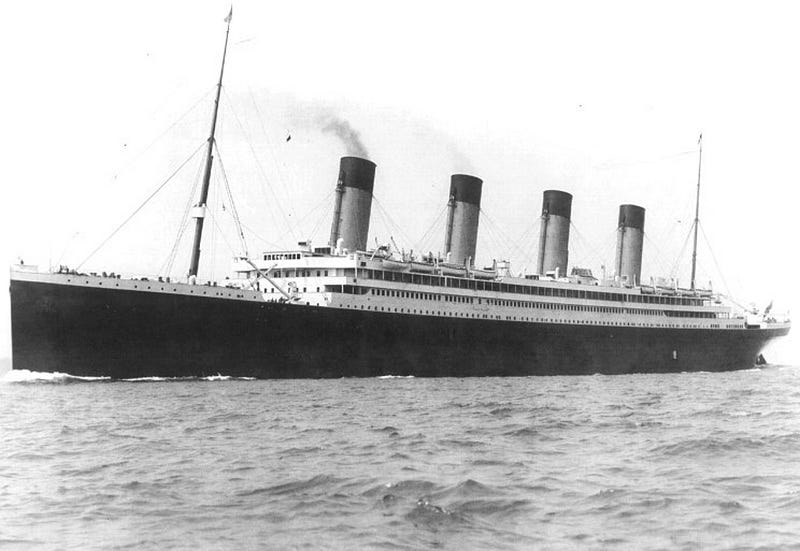
The RMS Olympic was the first of the White Star Line’s trio of Olympic-class vessels. She was followed by the Titanic and the Britannic. The fate of the Titanic is well-known and probably the most famous naval disaster of all time. The Britannic became a hospital ship in the First World War and also tragically sank in 1916 after hitting a mine in the Mediterranean.
The Olympic avoided the tragic fate of its sister ships but only just. She survived direct collisions and even sank a U-boat. Even so, she was incredibly fortunate to have survived and her story is a truly remarkable one that deserves to be better known.
The largest ship in the world and its first collision
When the RMS Olympic launched on 20th October 1910, she was not only the largest vessel, she was also the largest man-made moving object in the world. This record was broken by Titanic a year later, who was just three inches longer and 1000 tonnes heavier. The Olympic, sadly, won the title back after the tragedy that befell her sister ship in 1912.
Having made five successful trips across the Atlantic, the Olympic’s first mishap happened just an hour and 20 minutes after leaving Southampton. The British cruiser HMS Hawke was travelling in the opposite direction when the Olympic started a wide turn. This caught the captain of the Hawke off-guard and the much smaller ship found itself being sucked in by the larger vessel’s propellers and was unable to avoid a collision.
The Hawke was a ship that was designed to sink others by ramming them and her strong bow ripped into the Olympic’s starboard side, tearing two large holes above and below the water-line. Fortunately, two water-tight compartments stopped the ship from sinking and she was able to limp back to Southampton. The Hawke suffered much worse with the vessel’s entire bow caved in.
After this incident, for which the Olympic took the blame, the word was out that it was advisable to steer clear of vessels of this size. An unfortunate consequence for the Titanic was that this collision helped to reinforce the idea that these huge vessels were unsinkable.
In an interesting related side note, the captain of the Olympic at the time was E. J. Smith. This is the same captain who would later command, and famously go down with, the Titanic, less than a year later.
The Titanic, a mutiny, and a refit
The Titanic
On the fateful night that the Titanic sank, the Olympic was 580 miles away. On receiving the SOS, she immediately powered up and went to help. When she was still about 120 miles from where her sister ship had sunk, the captain was told that it was already all over. The RMS Carpathia had saved all the passengers it could. When the Olympic offered to help take on the survivors, the request was turned down. It was decided, understandably, that the survivors of the Titanic would find it too traumatising to be moved to an identical vessel.
The strike and alleged mutiny
The lack of lifeboats on the Titanic was now a known and contentious issue and the Olympic suffered from the same problem. There was a hurried refit with several inflatable second-hand lifeboats being added. A lot of these were rotten and would clearly have sunk. Consequently, the crew went on strike. Rather than fully address the understandable concerns, the White Star Line opted to replace some of the crew. This was an approach that didn’t work.
The strike continued with 54 sailors deciding to leave the ship, complaining the lifeboats were unsafe and that the non-union replacement crew were unqualified. They were charged with mutiny. At this point, the White Star Line realised that the negative publicity was making them look bad and the strikers were allowed to rejoin the ship.
The refit
However, another five months would pass before the Olympic was withdrawn from service and given a full refit. Having learned lessons from the Titanic, the number of lifeboats went from 20 to 68. An inner skin was added, effectively giving her a double hull and some of the watertight bulkheads were raised, correcting a design flaw. This remodelling increased the gross tonnage and by the end of the refit, the Olympic was actually 36 tonnes heavier than the Titanic had been.
The Olympic was better than ever. Which was fortunate, as a year later, the First World War broke out and the ship was to play an important role.
The First World War
At the start of the war, as a precaution, the Olympic was painted grey, the portholes were blocked and the deck lights were turned off to make her harder to see. Her first few trips were commercial and full of Americans trying to return home.
On one of these trips, she came to the aid of HMS Audacious, who had struck a mine and was seriously damaged. After three attempts at towing had failed, the 250 people on board were evacuated to the Olympic and a few hours later, the Audacious exploded and sank. This led to the Olympic and her passengers being held for a week as the loss of the Audacious was deemed to be too demoralising for the British public.
As the threat of U-boats grew, the bookings dried up and the intention was to have the Olympic lie up until the war was over. This was not to be. In 1915, due to her size, she was requisitioned by the Admiralty to become a troop carrier capable of carrying 6,000 people. She was stripped of the peacetime fittings and armed with 12-pounders and 4.7-inch guns.
Now decked out, the Olympic, under the command of Captain Bertram Hayes, loaded up on soldiers destined for the Gallipoli campaign in Turkey. In the Mediterranean, she rescued the survivors of the French vessel Provincia, who had been sunk by a U-boat. This was dangerous and earned a reprimand from the Admiralty — the Olympic’s chief defence was her speed and the huge vessel stopping in U-boat waters was a gamble. The French took a different view and awarded Hayes a Gold Medal of Honour.
The Olympic then returned to the Atlantic and was given a new set of camouflage to make it harder to spot her at speed. She did several troop runs to Canada until, in 1917, the Americans joined the war when she switched to ferrying US troops to Europe. It was while on this duty that she was almost sunk by a German U-boat.
The fight with U-103
Although she was a troopship, the Olympic crew and the American soldiers on board were well aware of the dangers of U-boats. Tensions were high with each Atlantic crossing. Only a couple of years earlier, the British vessel RMS Lusitania had been sunk by a German submarine and had gone down with American civilians aboard. It had been a notorious incident and one of the factors that contributed indirectly to the US entering the war. Over half of its nearly 2000 passengers had died.
While near the Isles of Scilly, a U-boat, U-103, was spotted surfacing ahead. Acting quickly, the Olympic gunners chose to immediately open fire. Rather than flee, the ship turned and headed directly for the enemy submarine. The U-boat tried to emergency dive and moved to a parallel course. As with the HMS Hawke, the U-boat was sucked into the Olympic’s propellers. The portside blades pierced the German vessel’s pressure hull.
The U-boat crew scuttled the submarine and abandoned ship. The Olympic continued on her way leaving an American vessel to pick up the stranded German crew. The Olympic had a couple of dented hull plates and a twisted prow but managed to make it safely back to Southampton.
It was later discovered that U-103 had, upon sighting the Olympic, been preparing to torpedo her. Fortunately for the troopship, the U-boat crew had been unable to flood the torpedo tubes and were consequently unable to fire. The Olympic had been incredibly lucky. As a reward for his service, Captain Hayes received the Distinguished Service Order (DSO). Some of the American troops on board also paid for a plaque to be left on board, commemorating the incident.
After the War, a refit and a surprise discovery.
Over the course of the war, the Olympic successfully carried over 200,000 soldiers and travelled around 184,000 miles. Captain Hayes received a knighthood in 1919 and the ship was given the nickname Old Reliable. It was time for her to be refitted once again for civilian service.
The refit gave her more modern rooms and an improved engine powered by oil rather than coal. This allowed for a refuelling time of hours rather than days.
During the refit, there was a remarkable discovery that further proved how lucky the Olympic was. In dry dock, a dent with a crack was discovered just below the waterline. It had been caused by a torpedo that had struck her and failed to detonate. Later historians have since concluded that a U-boat designated SM U-53 had fired the torpedo while the Olympic had been in the English Channel.
Throughout the 1920s the ship was popular and fashionable, transporting the rich and famous of the day. Douglas Fairbanks and Mary Pickford celebrated their honeymoon on one of the voyages. Other famous passengers included: Marie Curie, Cary Grant, Charlie Chaplin, and the future king, Prince Edward.
Retirement and eventual fate
The Great Depression of the 1930s struck the shipping industry hard. The number of passengers per year on the transatlantic route halved in the first five years of the decade. At the same time, larger and faster liners began to appear.
The White Star Line and Cunard Line merged in 1934. This merger allowed them to build the RMS Queen Mary and RMS Queen Elizabeth, making the older vessels effectively redundant. The Olympic sailed from New York for the last time on 5th April 1935.
There were various attempts to save her, including summer cruises and floating hotels, but it was not to be. She was sailed to Jarrow in 1935 and dismantled over the next two years. Many of her fittings still remain in hotels, museums and collections.
By the time she was retired, the Olympic had successfully completed 257 round-trips across the Atlantic. In addition to the wartime soldiers, she had also safely carried 430,000 commercial passengers.
Unlike the tragedies that had struck her sister ships, Titanic and Britannic, the lesser-known RMS Olympic was the vessel that truly proved unsinkable.


