Risk/Reward ratio: the truth beyond the myth
Every trading coach teaches something about the Risk/Reward ratio. It seems a necessary task in every trading course, as it was the most important thing in a trading strategy. In reality, RR is not the most important thing, but we cannot forget to take a look at it. So let’s go into the deep of this parameter.
Important: in the following article I’ll call RR the ratio between reward and risk (reward / risk). So RR=2 means “a reward 2 times grater than the risk”.
I’ve said that RR is not that important. So what really is? The answer is: expected payoff.
Given RR the Reward/Risk ratio and p the success rate of our trading strategy (i.e. the fraction of profitable trades in a sequence), for any given Risk the expected payoff for a single transaction in the long term is:

There is no magic behind this formula. It’s simple statistics. If you are curious, you can easily read the Wikipedia article on the Expected Value.
Expected payoff is the key of trading. Someone calls it “statistical edge”. In simple words, if expected payoff is positive, our strategy makes profits in the long term, otherwise it’s not profitable and will make us lose money.
So, the key is: keep expected payoff positive. The higher, the better.
Now, this is only statistical stuff. Let’s go back to reality and apply it in the real world.
Everything starts with the success rate of our strategy. This is a simple metric and it can be calculated by Metatrader or Excel. All we have to do to calculate it is:
- Take a sample of our strategy most recent historical transactions (preferably not shorter than 20 transactions). It could be the last 6 months trades or even more.
- Count all the transactions that have produced a gain.
- Divide this number by the number of transactions of our sample.
The result is a percentage. For example, a 50% success rate means that half of our trades have been profitable. Now we have calculated our success rate. Let’s use it in practice.
If we start from a given success rate p we want to know which is the minimum Reward/Risk we can accept for being profitable in the long run (i.e. the RR that gives us at least break even). We can find the dependency of the minimum RR from p by setting the expected payoff to 0. This leads us to this simple formula:

What does this mean? Simple: if our strategy has p as success rate, we need that each transaction has a Reward/Risk higher than this value.
Here are some pre-calculated values for different success rates.
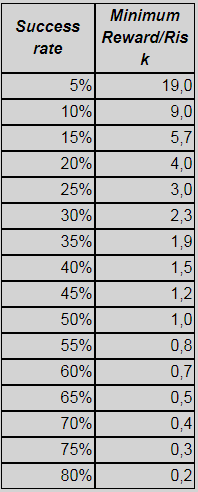
As you can see, if we win very often, we don’t need a high RR value for being profitable. On the contrary, if we lose too much times in a row, we need a high RR in order to balance the losing trades with the few winning ones. That’s the scientific reason why scalpers can be profitable in the long run. They don’t need a high RR, because their success rate is high and the expected payoff is positive as well.
Now, what kind of success probability should we expect from our strategy? Well, this depends on the strategy itself. Personally, I categorize the trading strategies in three big sets: Trend Following, Swing Trading and Short Term (which includes scalping). For my experience, Trend Following techniques have a low success rate, rarely greater than 50%. Market trends rarely (less than 30% of the time), so a strategy based on market trends doesn’t have a high success rate. Swing Trading works with faster movements than Trend Following and its success rate goes from 50% to 70% (in best cases). Higher success rates can be reached only if we work in the Short Term way. It’s widely known that scalpers have a high success rate (over 80% in most cases).
So, putting all these informations together with the statistics above, we can create the following picture, which explains everything much better.
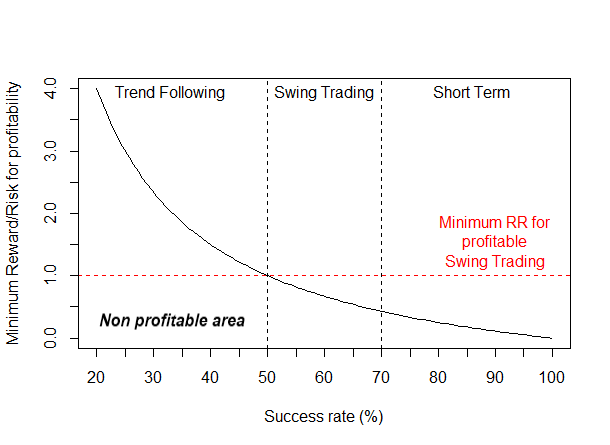
The black curve is the breakeven line. Every strategy that falls below the black curve is not profitable in the long term because its expected payoff is negative. Every strategy that lies above is fine. The higher RR with the same success rate, the better.
Now everything is starting to get clearer. Since we are professionals, we want to manage our risk. That’s why we are trying to identify the worst case in a reasonably bad scenario. Since we are proud swing traders and our minimum success rate is 50%, the minimum RR we must aim at is 1.
That’s it. Simple statistics. No legends, no myths, no self-proclaimed gurus telling you “everything below 2 is crap” without a scientific explanation, nothing about this.
If you are one of those traders who follow the 2 RR rule, my humble suggestion is to relax this rule lowering the threshold to 1. I’m not saying you should put your take profit at 1 risk unit from the open price of a position, I’m just saying you should start accepting targets between 1 and 2 if you didn’t do it before.
So, what’s the problem, then? Well, everything works only if you can manage a min 50% success rate. That is the real challenge. Provided it, everything can work fine in the long term.
The only way to achieve a regular profitability rate is sticking to a good strategy and don’t move an inch from it. Stability is the real key and the only way to achieve it is keep using the same strategy.
I hope this article has helped your understanding Reward/Risk and its properties.
Originally published at www.swingtradingpills.com on July 17, 2018.


