
Risk Management Basics in Trading
The Key to Being Profitable

This story is part of the “Improve your Trading” series. You can find the other stories below.
To be successful in trading, you need to combine several elements. The first and most obvious thing is a strategy with an edge. Second, you must also control your emotions and be disciplined. The last thing is to have good risk management.
If you don’t have one of these 3 things, you will never make money in trading. Worse: you can lose money.
Let’s learn some basics of risk management every trader should know.
What is Risk Management
A trader’s number one job is to manage risk correctly. Indeed, each trade should have 4 outcomes:
- Small loser
- Break-even
- Small winner
- Big winner
As you can see, there is no “Big loser”. But maybe you wonder how we can have “Big winners” but no “Big losers”. You can think if you want to win a lot, you have to lose a lot. But that’s wrong. Actually, it’s even better to lose a little and win a little than to win a lot and lose a lot.
A popular adage in trading is:
Cut your losses and let your winners run.
Risk management is all about that. But it’s easier to say than to do.
Indeed, most people prefer a random loss and a clear gain to a random gain and a clear loss. That’s because people say “as long as you’re still in the trade it’s not a loss”. Usually, it results in a bigger loss than expected.
The other hard thing is to let your winners run. When you’re in profit, you want to close the trade quickly before it turns into a loser, even if you think the price will probably go higher.
I think you understand a bit better now what is risk management. Let’s discover now how to put it into practice.
What is a Risk Unit
A risk unit (an R) is how much you win depending on how much you risk. Let’s say you made 2R with a trade. It means you made 2 times the amount you risked.
We can measure risk units for trades and strategies. For example, I can tell I made 1.5R with this trade. I can also tell, with this strategy I make on average 10R a month.
If you risk 1% a trade with a 10R strategy a month, it means you make 10% a month on average.
The Proven Edge
As you can see before I was talking about a 10R strategy a month. Does it mean I am able to see into the future and know my strategy will make 10R every month? No, but it means I’ve backtested my strategy over some data and I know on average I will make 10R a month. Sometimes I will make 5, sometimes 15.
The thing to understand here is that you should have a proven edge before trading. You should be able to tell “I will probably make 10R this month” before putting any money in. If you don’t have an edge, your balance will probably go to 0 over time because you’re just gambling.
What is cool with the edge is that it gives you an average risk-reward ratio and a win rate, which allows you to calculate how many R you can make with 100 trades for example. Then, if you know how many trades you make a day, you will know approximately how much you will make every month.
Let’s say you’ve found a strategy with a 1.5 risk-reward ratio and a 50% win rate. You’ve confirmed it over at least 50 trades in backtesting. For every 100 trades, you have on average 50 losers and 50 winners. You lose 1R when you lose, but earn 1.5 when you win.
50*-1R + 50*1.5R = 25RSo on average, for every 100 trades, you make 25R. Let’s say you make 1 trade a day, it means you make 7.5R a month. If you risk 1% per trade, you make 7.5% a month.
As you can see, having a proven edge allows you to forecast how much you may earn in the long term.
The Rules
You have to define rules for many things. The two most important are exiting trades and handling drawdowns.
About the rules to exit a trade, you can find them through backtesting. You can also just set a stop loss for every trade you make, to a specific amount calculated using the max risk you want to handle. For example, if I have 100 000$ in my account, and I don’t want to risk more than 1% of my account at a time, I will size my positions and my stop loss in order to never risk more than 1%.
It’s important to define such rules because they will allow you to calculate drawdowns. The drawdown is the measure of the decline from a historical peak. For example, if your balance grew up to 200 000$ and fell down to 100 000$, the drawdown is 50%.
If you know you’re risking 1% a trade and make 3 trades a day, you know your max drawdown for the week can be 21%. It will certainly not happen, but you have to consider it. If you know your average win rate, you can even calculate the probability of knowing such a drawdown (that’s why it’s important to know your average win rate !!). This way, you can choose if you want to keep your strategy or find another one.
For example, if you have a 25% win rate and a risk-reward ratio of 5, you make 50R every 100 trades. If you have a 75% win rate and a risk-reward ratio of 1, you also make 50R every 100 trades. But do you prefer winning a little each trade, or a lot some trades? Also, the smaller your win rate, the greater your chances of experiencing large drawdowns.
Practice
Let’s put it all into practice. We’ll say you want to make 10k per month with a 125 000$ total balance. The first thing to know is how much you want to risk per trade. 1% of your balance? 2%? I will choose 1%.
Then, you want to know how much 10k represents in risk units. 1R = 1% of your total balance, so 1 250$. 10k$ / 1 250$ = 8R. You want to make 8R a month.
The formula to calculate the return is:
Return = nTrades (Winrate(AvgReward + AvgRisk) - AvgRisk)I won’t explain how to find it as I know some people don’t like maths, but it can be done easily. We want to make 8R a month. So, Return=8R . We’ll take 1 trade a day, so nTrades=30 . Our average risk (which is in reality fixed and not an average) is AvgRisk=1R .
The two parameters remaining are the win rate and the reward. Let’s calculate the win rate we need if the reward is for example 2R.
(Return/nTrades + AvgRisk)/(AvgReward + AvgRisk) = Winrate
(8R/30 + 1R)/(2R + 1R) =  0.42
We need a win rate of 42%. With a spreadsheet, we can calculate these things easily for different parameters.
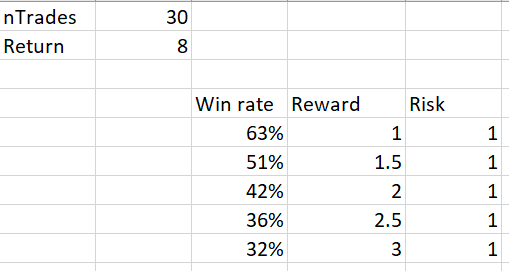
So, let’s go to backtesting now! We need to find a strategy with a 63% win rate and a 1:1 reward-to-risk ratio, or a 51% win rate and a 1.5:1 reward-to-risk ratio, etc… To make 10k per month with a 125 000$ balance and proper risk management.
I’ll leave you here as this article was about risk management and not backtesting!
Final Note
As you can see, the return you can expect in a month is a function of the number of trades, the win rate, and the risk-reward ratio. So it’s essential to take into account these parameters when you try to find a strategy, before trading with real money.
I’ve covered just the basics, there are so much more things to know about risk management. But every trader should know the things covered in this article I think.
If you have any questions, feel free to leave a comment, I would be glad to help you because risk management can be hard to understand!
Just a little disclaimer: all of this is theory. In practice, your strategy will work better on some months and will work less on others. Also, it may seem easy to say I need a 51% win rate strategy and a 1.5:1 reward-to-risk ratio to make 10k a month, but in practice it’s hard. You have first to find the strategy which represents a lot of work, and then have perfect execution of it, without emotions, and without being afraid of losing money.
To explore more of my trading stories, click here! You can also access all my content by checking this page.
If you liked the story, don’t forget to clap, comment, and maybe follow me if you want to explore more of my content :)
You can also subscribe to me via email to be notified every time I publish a new story, just click here!
If you’re not subscribed to medium yet and wish to support me or get access to all my stories, you can use my link:
A Message from InsiderFinance

Thanks for being a part of our community! Before you go:
- 👏 Clap for the story and follow the author 👉
- 📰 View more content in the InsiderFinance Wire
- 📚 Take our FREE Masterclass
- 📈 Discover Powerful Trading Tools