Ripples in the Sand
How escaping missiles and myths helped me explore my shortcomings
When we landed in Dubai, I had little idea what to expect. That’s how I travel. I never do enough research. I’m not proud of it. It’s just a thing with me. Some years ago, I planned a family vacation to Puerto Rico. At the airport, an attendant looked at our tickets and said, no, we were going to Puerto Plata.
“I hope you have passports,” the attendant said, looking sympathetically at my wife, Kim, and our three young children — and sideways at me. “That’s in the Dominican Republic.”
Kim had packed those documents (“just in case”) and we were soon on our way. But I won’t deny it was a long flight to the Caribbean wondering if a round of welcome drinks might be going unclaimed somewhere in Puerto Rico while my family slept on the streets of Puerto Plata.
It turns out I had kept my “Puertos” straight while booking the trip some months earlier. We had rooms. It all worked out. If it hadn’t, maybe I would have become a more careful planner. But it did, and so here we were touching down in Dubai with me not knowing what to expect. Blessedly, a travel expert had arranged our initial accommodations. I might have got us a room in Mumbai.
“In Dubai, tent cities are for glamping in the desert.”
This was my first trip to the United Arab Emirates or any other part of the vast Arabian desert and, if I’m being honest, it was a little frightening. I’m an American. My country has history in the region, which the U.S. deems so volatile it won’t put an embassy in some neighboring nations.
It didn’t take long for me to understand why. A couple weeks into our stay, Yemeni rebels fired a pair of ballistic missiles at Abu Dhabi just 86 miles from our hotel. The missiles were intercepted and locals quickly moved on, much the way Americans move on from the latest school shooting as though nothing can be done. We’re all kind of nuts, right?
Not long after the missile launch on Abu Dhabi, Putin’s tanks rolled into Ukraine. The onset of war prompted masses of ordinary Russians to flee conscription and sanctions by moving to Dubai, which continues to welcome Russians — especially those traveling in super yachts with super bank accounts. At the time, I wrote about suddenly bumping into Russians in every part of the city. Culture shock was now pushing my brain into hyperdrive. Yet even before the missiles and tanks, assimilation in Dubai was proving to be a challenge.
When we first arrived at the airport for what would be a months-long stay, a pre-arranged Mercedes was waiting. Stop. It’s not what you think. They all drive a Benz in Dubai — unless it’s a Bentley. Anyway, moving near the center of town, on day one, a swarm of motorcycles surrounded our car. The riders were fully armored in a way that reminded me a new season of the Mandalorian had just dropped.
Who were these masked menaces? What could they want with two clueless Americans? Well, one clueless American. Kim had been in these parts before and was calmly checking her email. I kept my paranoia to myself. But it wasn’t easy. We were smack in the middle of a James Bond film and Blofeld had sent a team of Kawasaki killers to whack us. Our driver seemed unconcerned. Might he be in on the hit?
Each motorcycle had a mysterious metal box mounted in the rear, some with gang-like markings and others bearing ominous foreign terms like Talabat and Careem. Thank God we had updated our will, I thought, because our car was about to be obliterated by the heinous weapons concealed in those boxes.
Then I saw that most every vehicle on the road was similarly encircled. The Mandalorians were everywhere, urgently buzzing in and out of lanes. Their protective sheathing started to make sense. These crazy riders must have been in countless mishaps. But who were they? Why were they dominating the highway and what was in those boxes?
One rider’s box read Deliveroo. This seemed like an important clue, and as I considered this new information my pulse began to normalize. I asked our driver about the riders. He explained, and I later came to appreciate, that Dubai is known for its speedy two-wheeled meal deliveries. The weapons in those mounted boxes looked an awful lot like lentil soup and lamb kabobs over riced cauliflower.
Had I done a little research, I would have known.
Dubai is a modern, glitzy, international business and tourist hub populated mostly by expats and ruled by royals. There are no homeless, which is astonishing for someone who has spent most of the last 40 years in New York, San Francisco, and now London. In Dubai, tent cities are for glamping in the desert. The city has one of the world’s lowest crime rates; if you do not have a job or documented income or wealth, or a tourist visa, you can’t stay. End of discussion.
Dubai is experiencing breath-taking growth, fueled by oil riches and ruler Sheikh Mohammed’s business-friendly policies. Cranes fill the air in every direction. The skyline changes almost monthly. In this architect’s playpen, towering buildings sprout from the sand shaped like needles and spheres, twisted dough, flowers, full-batten mainsails, and the Lego creations of a gifted child. Dubai is home to the world’s tallest building, the 163-story Burj Khalifa. While I was there, they broke ground on a building that will be even taller. It all has a surreal Jetson’s feel.
The city has plenty of star power. Tom Cruise scales the Burj façade in Mission Impossible: Ghost Protocol. When Will Smith went into hiding after The Slap during last year’s Oscar’s, he partied with royals in Dubai at the invitation of the Crown Prince. Regular visitors include Leonardo DiCaprio and Kim Kardashian. On the Palm Jumeirah, nightclubs pulse until sunup. Beautiful people brunch at Beach by Five, where the food is amazing but by appearances those ordering it never eat. Recreational skydivers rain steadily on the Palm, near a waterway crowded with yachts and jet skis.
All this hedonism/modernism exists side-by-side with traditional Muslim values. Outside of the tourist areas, nearly all women dress with modesty, like their forebears, fully covered and seeing the world through a slot in their niqab. Booze is discouraged. Stores that sell liquor are as difficult to find as water in the dunes. Many sit behind unadvertised doors with few windows — as though locals are ashamed these stores exist. A $20 bottle of wine in the U.S. may go for $100 in Dubai.
Technically, if a man looks too long at a woman in public, he can get 40 lashes under Shariah law — even though, by nearly all accounts, tourists are more likely to find an oil geyser in their hotel than be sentenced to a public flogging. Women need permission from a man to buy alcohol, although that too seems rarely enforced.
This all makes for sometimes fascinating encounters. At the swimming pool, I watched a fully covered Arab woman chase after her small children. The kids ran past a young woman from another world as she vamped in her bikini for selfies angled to capture her bare, Insta-worthy ass.
Some days later I made a friend of a Dubaian named Ahmed. I couldn’t shake the image of the covered mother standing next to a nearly naked woman in real time, and I wanted to know what the covered mother must have been thinking. Not wanting to risk 40 lashes, I would never strike up a conversation and ask her myself. So, I asked Ahmed.
“She hates it,” Ahmed said. “She hates that tourists flaunt values that are so at odds with ours.”
“Really?” I asked. “I feel like it’s more complicated than that. Maybe what she hates is that she is not free to dress more liberally.”
“But she is,” Ahmed said.
That is something I never considered. At least in Dubai, which travelers often refer to as “Middle East light,” covered women choose to be covered, according to my new friend. It’s what they are comfortable with, and they consider tourists who show so much skin to be inappropriate. But they tolerate it.
“Why is that?” I asked Ahmed. “There is something pure and beautiful about traditional values. Why do they tolerate it?”
“Because you can’t have this…” Ahmed said, pointing to a massive, synchronized water-fountain bursting forth from a man-made lake in the center of a glistening restaurant district, “…without that.” Now he was gesturing toward a group of fair-skinned visitors at a table where the drink had been flowing.
The ruling elites have made peace with this trade: You come for the sun, sand, and action — and blow your money — and we’ll set up safe zones and look the other way. It’s a lucrative trade. Tourists spend $30 billion a year in Dubai — nearly twice what they spend in London, a city that is three times larger. This has not been lost on certain Middle East neighbors. Traditionally insular Saudi Arabia has begun building from scratch a city in the sand named Neom to tap this tourism gold mine, not unlike Dubai a few decades ago.
At one point, I found myself in a shisha lounge sipping Turkish coffee and watching cricket on a muted TV. There’s a sentence I never expected to write.
I had tasted Turkish coffee in Istanbul and knew enough to strain it between my teeth, lest the sludge that dependably lurks near the bottom fill my mouth with a muddy grit. Cricket was another matter. I knew of the sport. But I had no idea how to play it and decided to sit there and figure it out through silent observation. This is the kind of thing you do when you are sitting in a shisha lounge in Dubai sipping Turkish coffee, with time on your hands.
Alas, cricket is a puzzle I could not solve. There’s no point digging into this issue. Cricket simply should not exist. I Googled it anyway. The first definition I saw went like this:
“You have two sides, one out in the field and one in. Each man that’s in the side that’s in goes out, and when he’s out he comes in and the next man goes in until he’s out. When they are all out, the side that’s out comes in and the side that’s been in goes out and tries to get those coming in, out.”
It was a sendup. But I’d had quite enough.
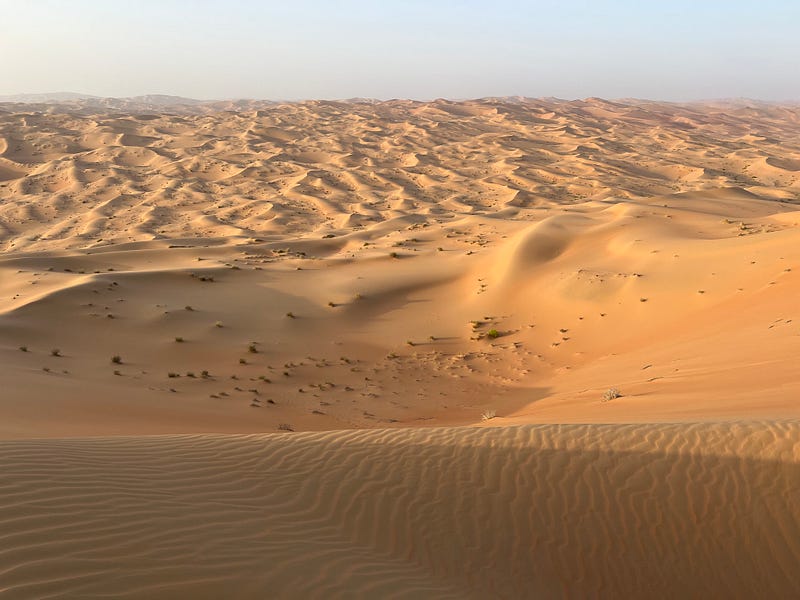
We did plenty of tourist things like “dune bash” in a Range Rover on the desert fringe and ride camels on a well-worn path to the oasis. But we also hiked into the desert and, like Bedouins, learned to find the way by reading ripples in the sand.
I damaged a knee on that hike and required arthroscopic surgery. At the hospital, they put me in room 13 to start a sedative.
“You’re joking,” I said to the nurse. “I’m going under the knife in an hour, and you put me in room 13?”
I’m not superstitious. I was just going for a laugh, or a chuckle, or a smile. But the line fell flat.
“This room is like all others,” she said. “You don’t like it?”
“No, no,” I said. “It’s fine. In the states the number 13 is considered so unlucky that there are buildings that skip 13 when numbering their floors. The elevator bank goes from 12 to 14.”
“How can you have 14 floors without a 13th floor?” she asked. “That’s just silly.”
“There is a 13th floor,” I explained. “They just call it the 14th floor.”
“So, 15 is 14 and 16 is 15, and so on,” the nurse said. “But 12 is 12?”
“You got it,” I said. “Now, when you are in a place like London, floor 3 is really floor 2 because they call floor 1 zero, like it doesn’t exist at all. Allah help you when you get to 13, which is really 12, but they call it 14.”
Even my head was spinning. As the sedative kicked in, it occurred to me that this all sounded a lot like the farcical explanation of cricket. Next thing I recall was waking up in room 13.
Tourists stream into Dubai from Europe, Asia, Australia, and New Zealand. But sightings of Americans on vacation are rare. We remain an intense curiosity. Uber drivers, especially, would hear me speak and immediately ask where I was from.
“New York,” I would say.
“Ooh. What do you think of Trump?” was a common response.
This killed whatever favorable mood I might have been in because political conversation is fraught with risk in a kingdom where any offensive statement could land you under surveillance or worse. In Trump’s case, there was no good answer.
One of Trump’s first acts as president had been to declare a ban on flights to the U.S. from Muslim nations, and I couldn’t be certain that he hadn’t ginned up some nickname offensive to the royals. Can’t you just see Trump calling the holy Grand Mosque a Sheikh Shack? On the other hand, Trump is wealthy and famous. His name is on valuable properties sprinkled throughout the region, a resume the elites surely find endearing. This was hot water. I changed the subject.
Events like 9–11 and other disturbing news emanating from the Middle East understandably clouds the West’s view of the people who live there. But the Middle Easterners I met in Dubai were welcoming and eager to share their culture, and they don’t like being profiled any more than a person of color in a traffic stop in the U.S. They are no more sympathetic to terrorists than we are to school shooters and pedophile priests.
We’ve all got cultural baggage. Even in London, where someone from the states might expect quick acceptance, I feel profiled — though, admittedly, in small ways. I asked our local butcher how best to prepare the veal he had just sold me.
“Oh, just put plenty of ketchup on it, mate,” he said in a brilliantly civil British tone.
It was funny. I smiled. But I left with the odd feeling he had just called me a stupid American. We do love our ketchup. Now I can’t wait to go back and tell him how wonderful his veal was, all smothered in Heinz.
Near the end of our stay, a Lebanese couple in Dubai — Omar and Sarah— invited us to join them and their family and friends for Iftar, the nightly feast that follows a day of fasting during Ramadan. I was certain my cultural baggage would show. But the invitation excited me and we quickly accepted. Kim and I were treated to a banquet of shawarma, Fattoush, Tabouleh, hummus, Baba ghanoush, baklava and more. Omar was so proud of the chicken he had cooked he refused my request for the recipe.
“If you like it, you’ll have to come back and see us again,” he said.
Omar and Sarah came of age during the Lebanese civil war in the 1980s. Running from armed conflict is part of their fabric. Omar fled Beirut to finish high school. Sarah left the city during The July War in 2006. They had met in Beirut before the war but found each other for good in Dubai. Both are successful. But their families in Beirut have suffered great financial loss as the Lebanese currency crashed in recent years. Today, Sarah’s father survives by selling the gold coins he had collected one by one over many years. Another Iftar guest was one of hundreds of living descendants of the King of Yemen who perished in yet another war.
These and other fascinating stories trickled out after dinner as the kids played inside and the adults sipped tea on the porch. I wanted more. Much more. But I was wary of being seen as the clueless American who later would be flamed by a London butcher and, lest we forget, imagined a Deliveroo driver might be an assassin. So I didn’t push.
I left the Iftar that night, and days later Dubai, impressed with the spirituality and sense of family I had experienced. I was also taken by the respect shown to elders in that part of the world, and to the disabled who are referred to with the infinitely kinder term “people of determination.”
But mostly I left with a greater appreciation for the common ground that people can find even amid vast and perplexing cultural differences. Now that’s research.
Dan is a former columnist at TIME. He still refuses to learn the rules of cricket. He is writing a memoir of his early career as a small-town newspaper reporter.


