
Rights Are Not a Finite Resource
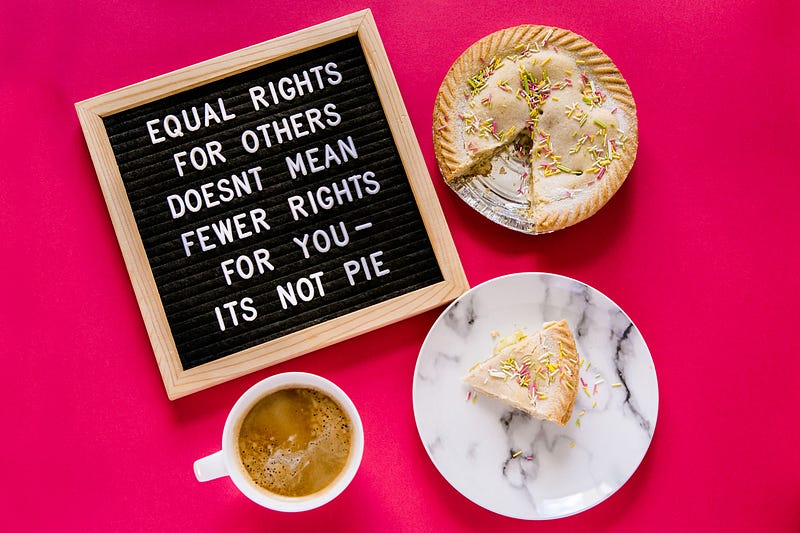
Giving someone more rights doesn’t take them away from anyone else.
Ever since Michael Brown was killed, I have been interested in racial equity. It’s not that I wasn’t before — I was raised in a liberal household where we were taught that everyone deserves rights, whether they are BIPOC, LGBTQIA+, or any other minority group. I’ve always felt that racism in America has been a bad thing. It just didn’t fully crystalize until Michael Brown.
I’ve been a supporter of the BLM movement and LGBTQIA+ rights for a long time, and I’ve watched the language change over the past several years. I’ve watched the change in language from “equality” to “equity,” and from “equity” to “justice,” and I’ve seen how that affects the narrative.
What never ceases to amaze me, however, is the constant fight against racial justice. It is very clear that BIPOC face horrific discrimination in America and that we need to do something to level the playing field. Why would anyone fight against something that helps their fellow man? Why would it matter if that fellow man was black?
Racism, explicitly or implicitly, is the answer, but the arguments that are made never cease to amaze me. One argument in particular is the premise that giving more rights to BIPOC somehow removes rights from white people, or otherwise handicaps white people in some horrible way.
Guys, rights aren’t a pie. Giving someone more rights doesn’t take rights away from you. Ensuring that everyone has the same rights and the same chances in life doesn’t take anything away from me, a white guy who had so much opportunity that a black or Hispanic man in my position didn’t.
However, white people are often terrified of what the “consequences” of racial justice might be. They make claims like “it will water down our schools” or “it will make it harder for high achievers to get good jobs.” Meanwhile, the number of potential high-achievers that are held back by the ZIP code they live in is likely ridiculously high because we insist on tying education to property values.
More often is the case that people are just afraid of how they’ll be treated if BIPOC suddenly had the power and white people didn’t. They’re afraid that they will treat us exactly how we treated them in the past. Suppressing our votes, taking away or blocking us from job and education opportunities, and generally treating us like second-class citizens is the bogeyman that these people use to fight racial justice.
That is, of course, nonsense. Rights aren’t a finite resource that gets divided up among people based on one quality or another. Everyone can have rights without taking any away from someone else. Giving disenfranchised people more rights doesn’t somehow magically remove rights from the people who benefitted from that disenfranchisement.
The point of the BLM movement, and every other social justice movement, is to remove barriers for people who have been suppressed. Removing those barriers for one group doesn’t magically throw them in the way of another group, and with a few rare exceptions, nobody wants that anyway. The point of BLM protests is to fight against oppression and injustice to create a more just, equitable world for everyone.
Modern American society is inequitable, unjust, and unbalanced in favor of white people, particularly older white men. These old white men are desperate to hold onto their power, and if that means making bogeymen out of a movement that seeks a more equitable, just society, then that’s what they’ll do.
However, their views are wrong and they know it, so they make bad-faith arguments against racial justice to insinuate that more rights for BIPOC equals fewer rights for white people. This is completely wrong, and we need to find a way to counter this damaging and divisive narrative.
I will end on this note: as much as I hate the politicization of the Pledge of Allegiance, I think it makes a good point about how America should be:
One nation, indivisible, with liberty and justice for all.
All does not mean some. All means all. Quit fighting it and live up to the promise that America could and should be.
If you liked this, please subscribe to my publication, Thing a Day. I publish something every day on a variety of topics, so you never know what you’re going to see!
If you’re not already a Medium member, I encourage you to subscribe. It’s just $5 per month (or $50 for a yearlong subscription), and you can read an unlimited number of my articles as well as unlimited articles from tens of thousands of Medium writers. Your subscription fees support the writers on this platform, and if you click this referral link or sign up through my email subscription below, part of your subscription fee will go toward supporting my writing and enabling me to continue publishing a Thing a Day.
Here are some other things I’ve written: