Not the Mother Who Raised Me
An adult child becomes the parent
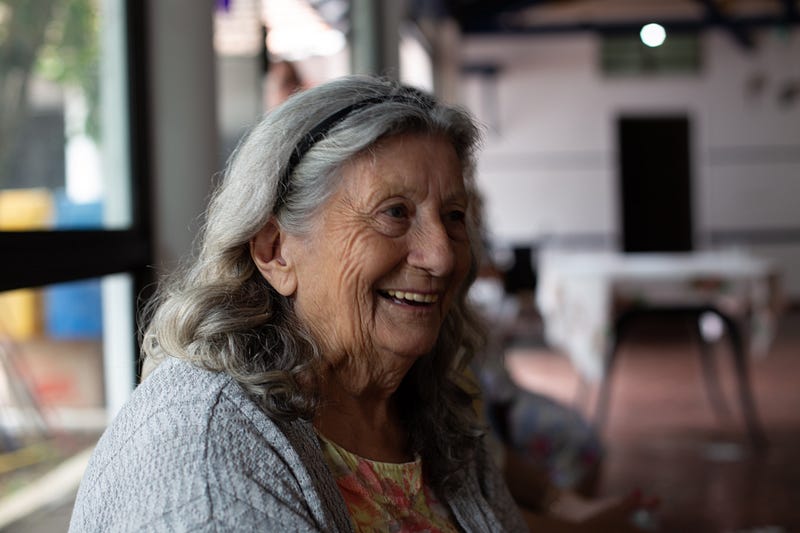
This is not the mother who raised me.
That woman was a quick-to-anger natural redhead with mood swings that would have made the Flying Wallendas a bit dizzy.
Still, she was bright, well-read, and conscientious to a fault: the house I grew up in was spotlessly clean, highly efficient, and full of books. Beyond her moodiness, Mom was supportive of my interests — which varied from stamp collecting to an obsession with all things Canadian to small roles in high school plays — and supportive of whatever I might come up with next.
Now being with my mother is an exercise in patience and protection. It is my job to see that nothing goes wrong, or at least as well as can be expected.
She approaches my car warily, bent on her mission and hunched over her walker. Shoulders meld into her curved neck, head downcast, her body a question mark. I want to tell her to straighten up, to stand tall — to her full 4’11” — to relax those shoulders and straighten her back as her physical therapist has instructed.
I’m stopping by her assisted-living facility during a pandemic-era trip back to Cleveland, taking her for a masked ride around town.
Bright red hair, unruly and mussed — out of character, another form of letting go — gold bracelets that jangle, threatening to slide off of her tiny wrists, a beige top and pants combo that might have fit years ago when she was 20 pounds heavier, and pencilled-in eyebrows that give her face a quizzical look.
The effect is heartbreaking, and I try not to look. Instead, I flick the radio to a sports-talk station (the news is too depressing, Trump and the pandemic a lethal one-two punch) and distract myself from the evidence that sits beside me: I am losing her. She is losing herself.
In the passenger seat, my mom slumps down, peering over the windshield and swimming in her too-large blouse. I try to spark conversation, to pull her back from the silence and the place she goes in that silence, staring into the abyss.
This is not the woman who raised me. The pieces have been rearranged, and some have gone missing. And yet, her essence is still there; she will always be my mother, and though I’m past 60, I will always be her son.
I am the responsible parent now, the Daddy, protector, trying to get it right, afraid I won’t. We are both cursed with anxious genes, though she is calmer now, living in the present — a skill I’m still trying to master.
I am the parent now.
When I see her slipping away, carried off by the tide, I am helpless, anchored to the shore, waving her back in — but the undertow is relentless, steady, unyielding.
I had a difficult mother who loved me the only way she knew how, with right and wrong formulas, shifting standards of behavior, algorithms only she could decipher. Now time, age, and the anesthesia and surgery that saved her life but took her short-term memory have smoothed her out, worn down the jagged edges. Now she is compliant, grateful, content to let me take the wheel.
She doesn’t worry about the past or the future; she’s challenged enough by today. Why can’t I follow her example before my own memory loss and obey Ram Dass’ dictum to ‘be here now’?
On my visits back to Cleveland, I miss my ‘old’ mother, the one who prattled on about people I hardly knew, who took her share of airtime. Now I have to fill those spaces, sit in the quiet, or listen to the blather of talk radio.
Fifty years, half a century streams by, picking up momentum. My mother and I are carried along on the current, heading toward the falls.
*Originally published on WBUR’s Cognoscenti website/newsletter, October 2, 2020.
Related pieces by Judah Leblang: Good Enough for Now, The View from Here