
Riding the Bernina Express: Europe’s Highest Alpine Crossing
Through 55 tunnels and across 196 bridges, this narrow-guage railroad elegantly ascends the Valposchiavo on the 37-mile journey from Tirano, Italy, to St. Moritz, Switzerland.
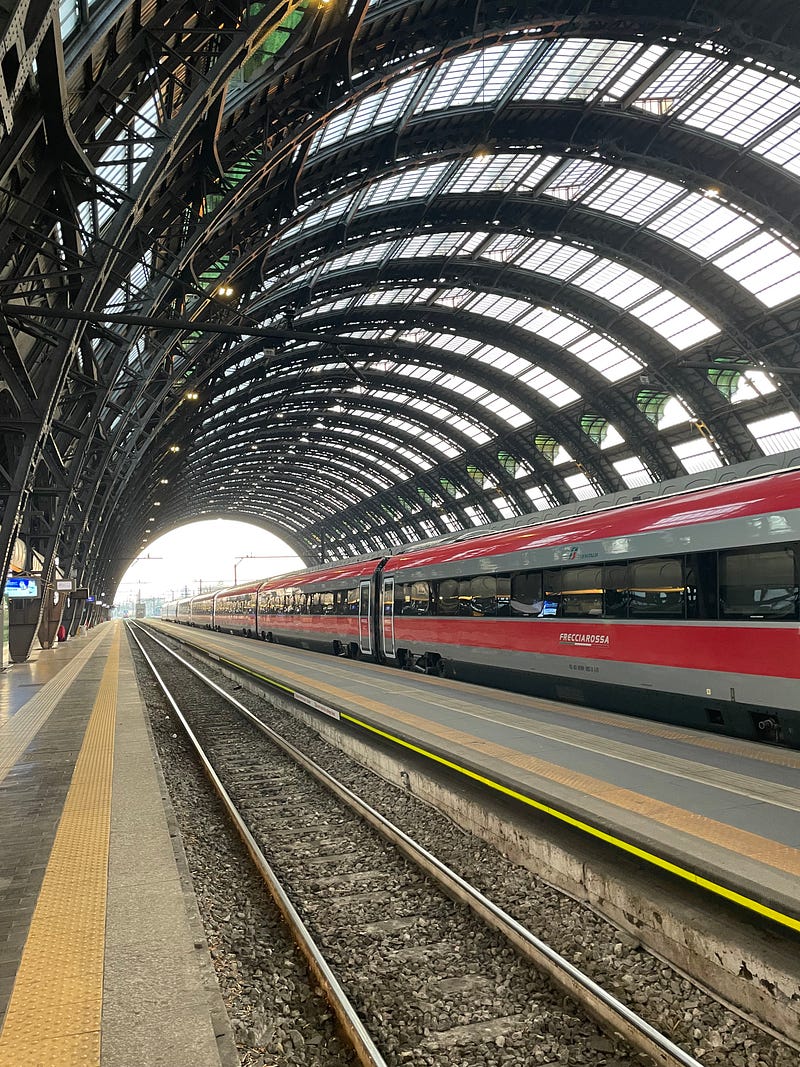
Just 40 minutes after my 6:40 am alarm, I had showered, packed, checked out of my hotel, and was in a northbound train pulling out of Milano Centrale — looking forward to my second Alpine crossing by rail in one week.
Even the morning after a 24-hour rail strike, I had much of the Trenord car to myself, able to move about as I admired the shore towns of Lake Como, framed by the Bergamo Alps.
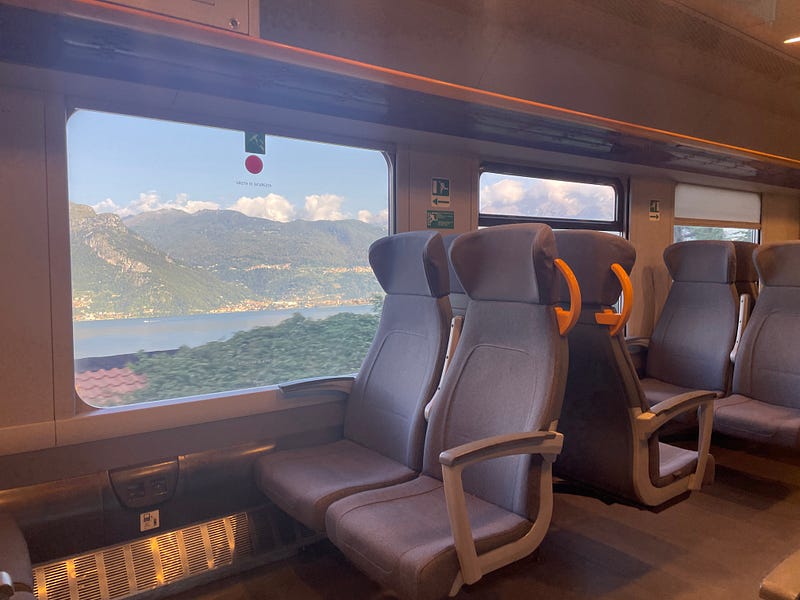
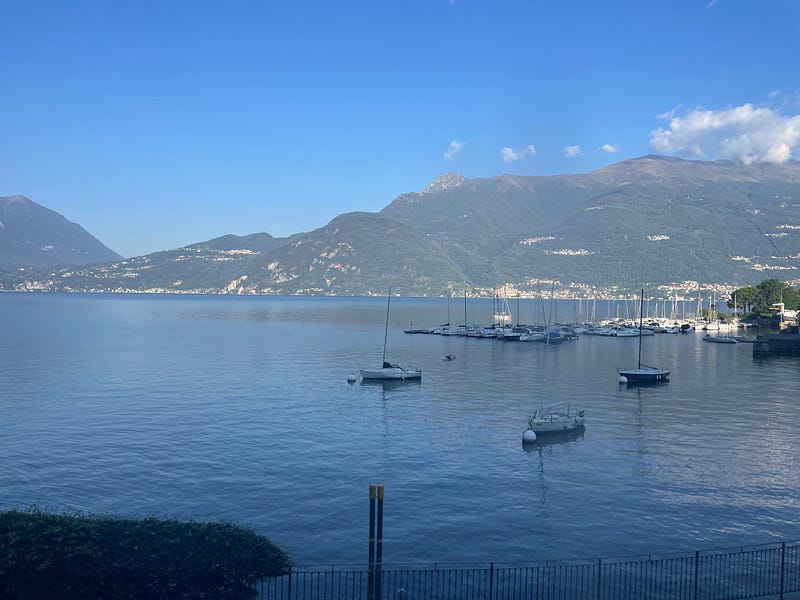
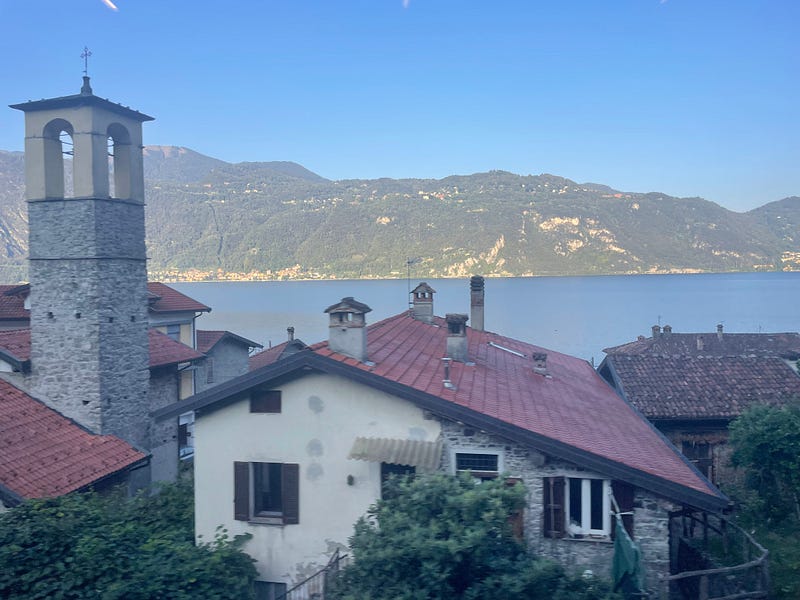
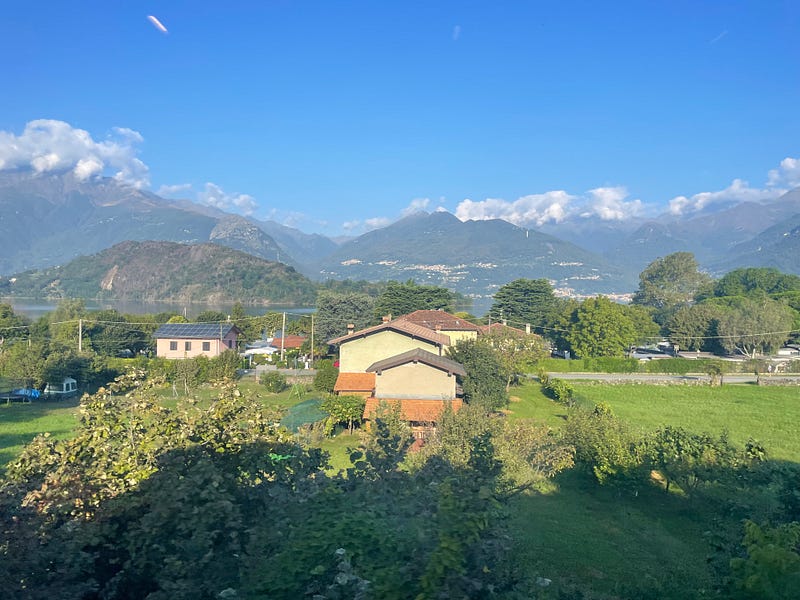
At the top of Lake Como, the train bears east, running parallel to the Adda River through the long Valtellina, which, in 1902, became home to the world’s first electrified main line railway.
Today, this region may be more known for food and wine than for the rail line on which I was currently traveling.
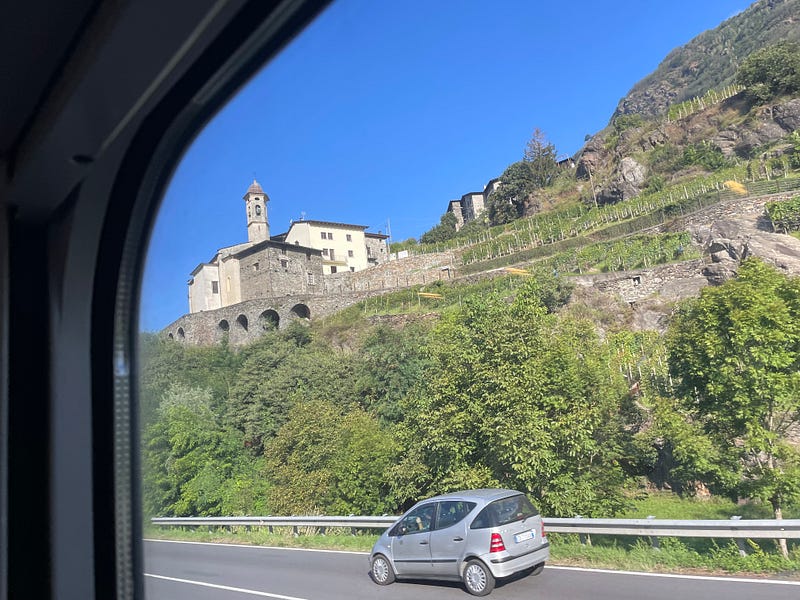
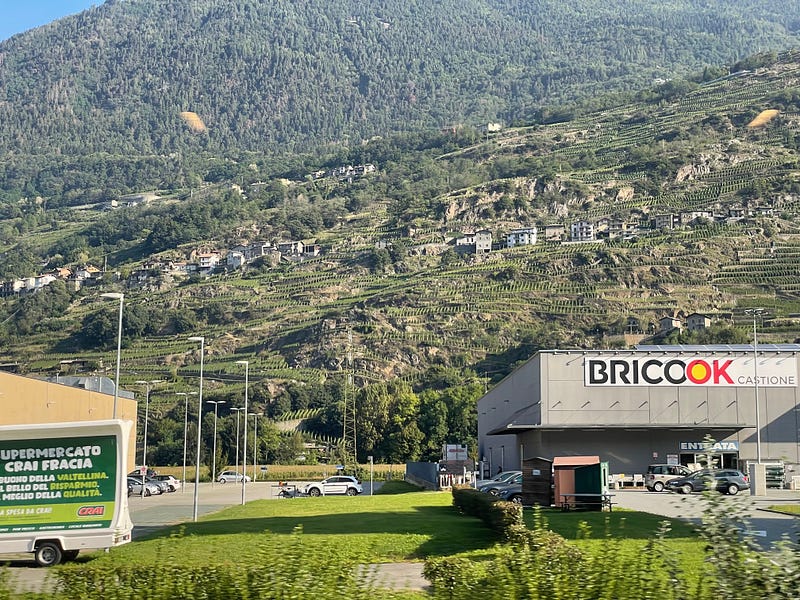
Looking high above the valley, I could see multiple terraces of vineyards, tiny narrow patterns crisscrossing the steep slopes. The wines these Nebbiolo grapes would eventually produce are — similar to the valley itself — largely unknown to the world, as approximately 80% of the wine produced here is consumed within a 100-mile radius.
At Sondrio, track work ahead meant that I had to step off the train and board a bus for the final 40 minutes to Tirano. There I grabbed a quick double espresso — Italian style, standing at a counter — and some Bernina Express souvenirs before boarding my 11 am train.
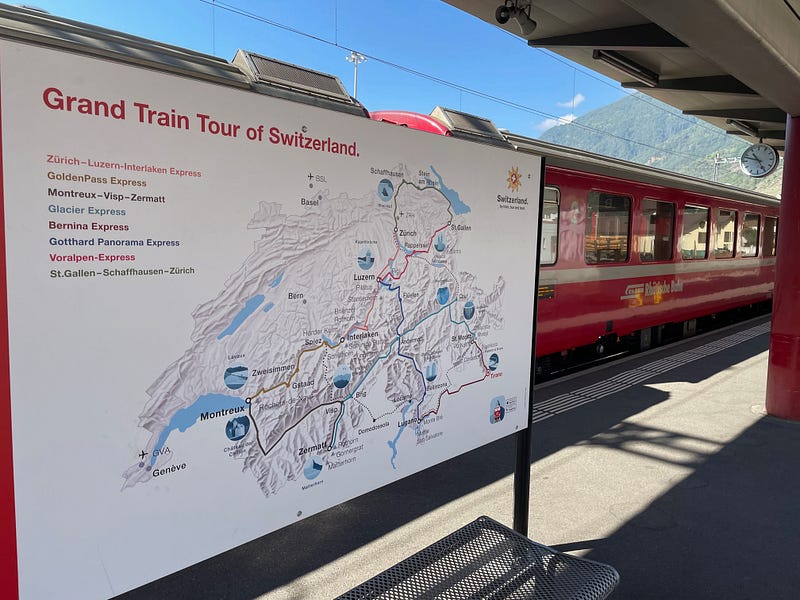
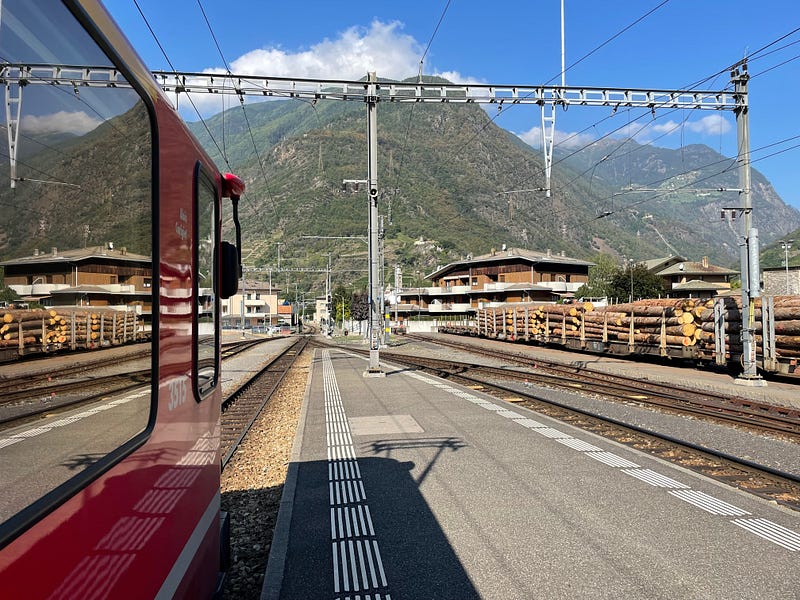
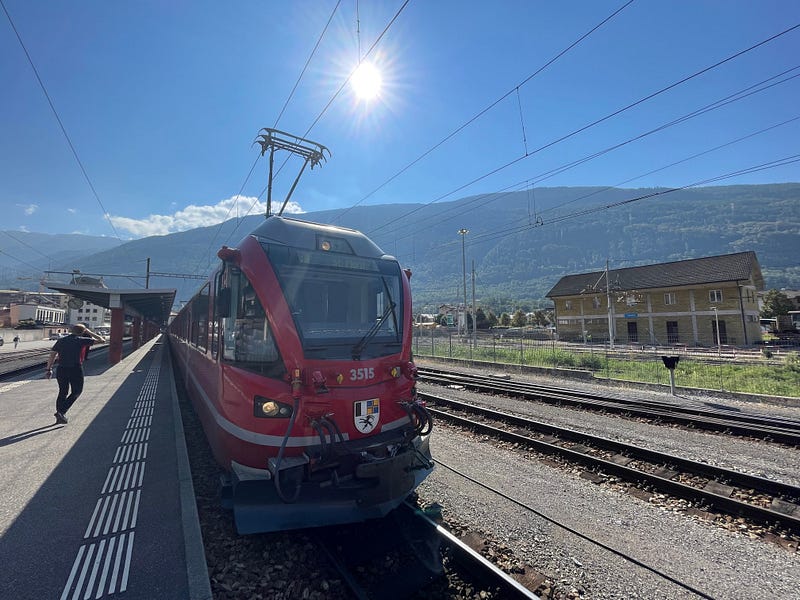
It was only then that I remembered having read what would become one of the most valuable tips of this journey: If you have a first-class ticket, which I did, go to the first rail car, and there is a good chance the driver will raise the curtains separating the passenger compartment from the navigation cab, giving a panoramic view.
Sure enough, as I settled into the space, the driver came aboard and said he would open up the shades soon after we pulled out of Tirano.
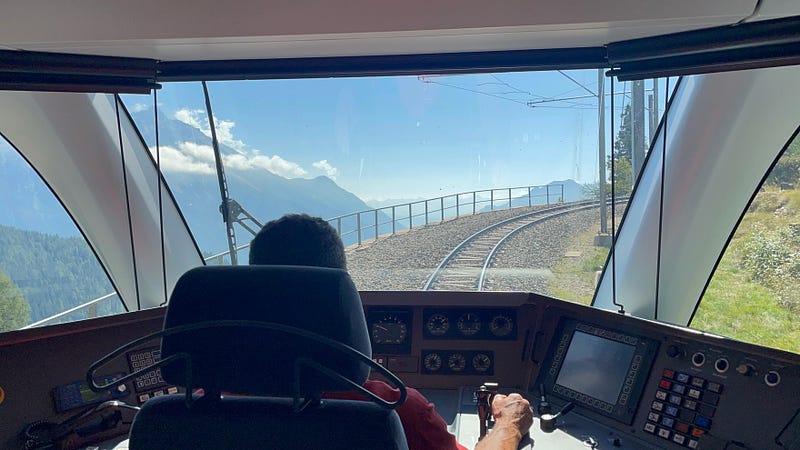
I shared the small first-class space with a retired couple from Australia who were in the middle of a six-week “bucket-list trip” that would include Dubai, the Amalfi Coast, Venice, a cruise on the Dalmatian coast — and this trip on the Bernina Express, up to St. Moritz and back in a day.
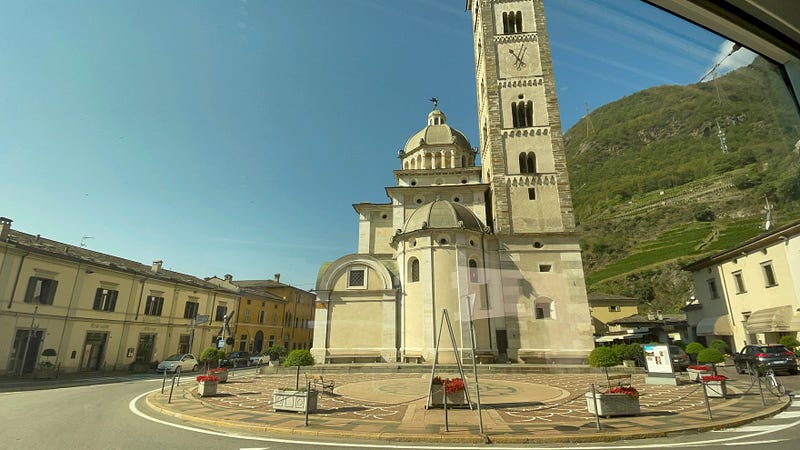
The Bernina Express runs along the streets of Tirano, elevation 1,407 feet, passing the 16th-century Santuario della Madonna di Tirano before its elegant ascent through the Alps.
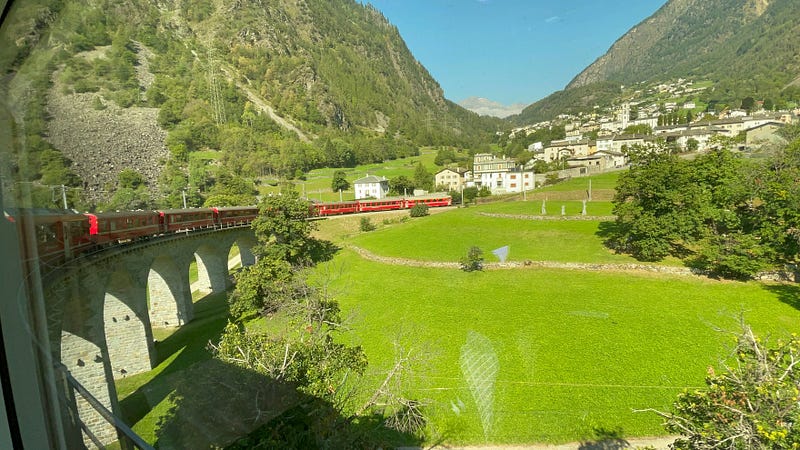
The first of many architectural and engineering marvels appeared right away, the nine-arched stone Brusio Spiral Viaduct. We ran under one of its 115-year-old arches, twisted in a 360-degree spiral and, before I knew it, we were climbing the bridge, gaining 32 feet in elevation over the course of 360 feet.
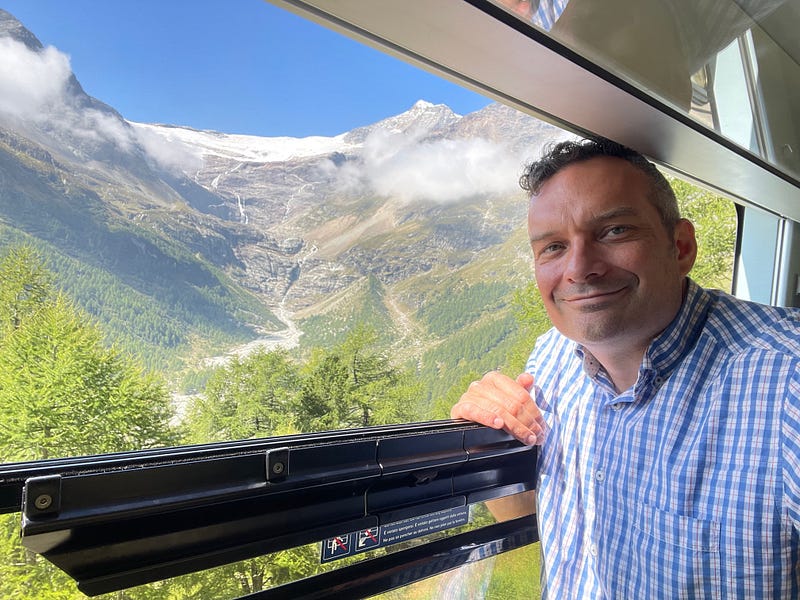
Being in the first car with the ability to open the windows gave us a great view of the back of the train as we twisted up and over the viaduct on our ascent above the Valposchiavo. (Later in the trip, I think the open windows mildly annoyed an older German couple, who folded their arms as if to say they were chilly — but being able to stick my head out the window and breathe in the Alpine air was a priceless experience. )
A few minutes later, we approached Miralago, elevation 3,163 feet, on the western shore of Lago de Poschiavo.
We had only been on the train 23 minutes, and we had already ascended more than 1,700 feet.
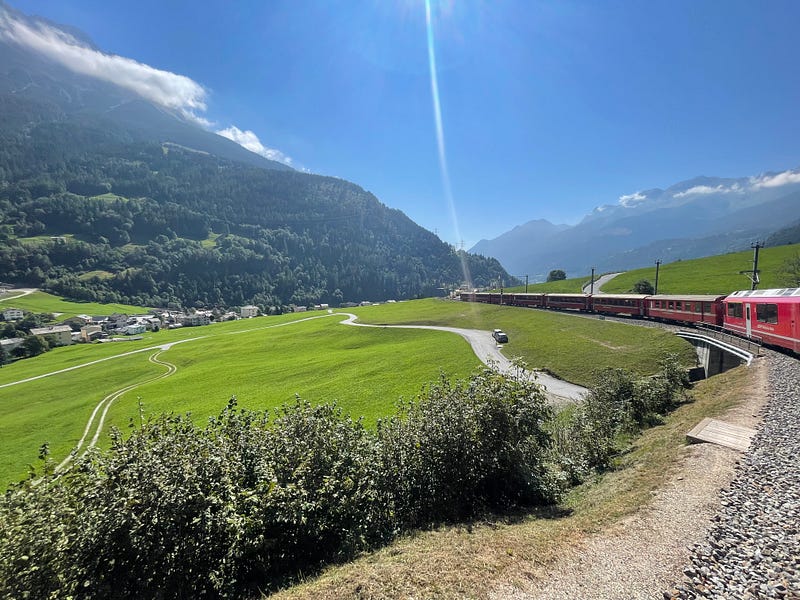
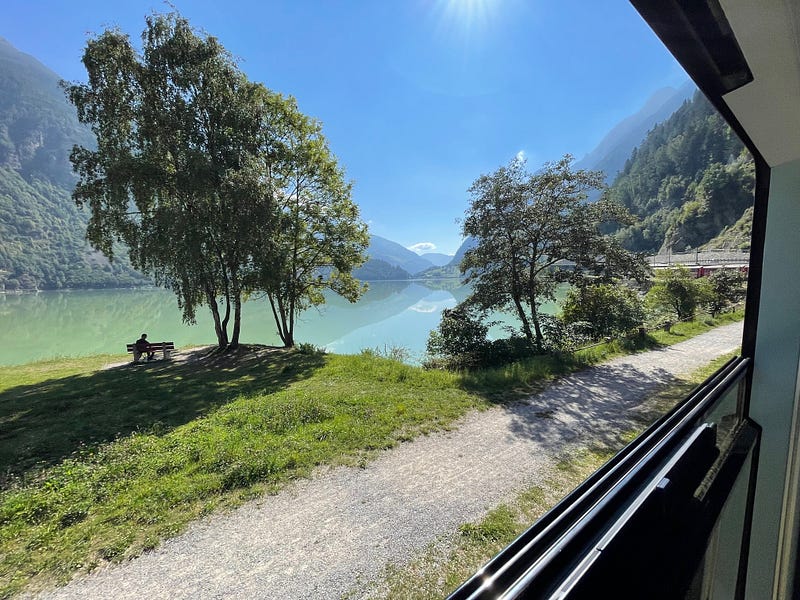
With the lake behind us, we began running along the Poschiavino River, as we approached the town of Poschiavo. This town of 3,516 people — and ten Swiss Heritage sites of national significance — is widely recommended as a stopover. While my rail pass afforded me the opportunity to step off and on as I pleased, I was eager to continue the journey to my destination, and then backtrack, unencumbered with baggage.
Soon we were no longer in the valley, but hugging the side of a mountain looking down on the town of San Carlo.
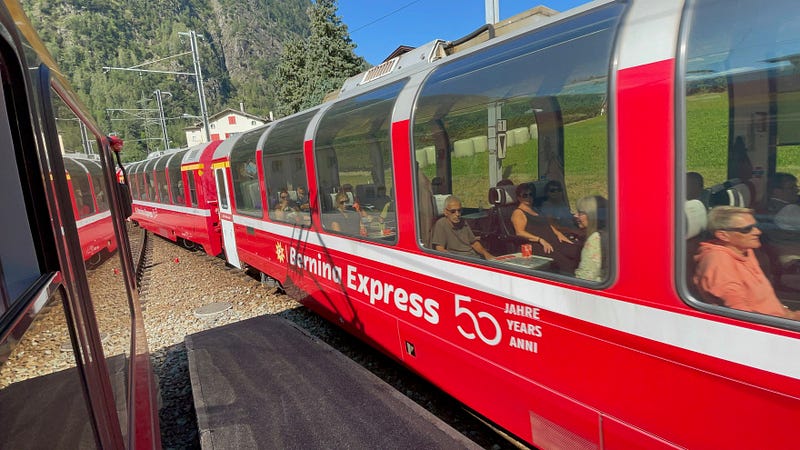
The Bernina Express is known for its panoramic windows that go above the sides of the train cars and bend into the ceilings.
Tony Hiss, longtime New Yorker writer and author of several books that inspired my own project on rail travel, recently penned a piece about this route for Railway Age, appropriately titled “Spectacular, and Then Some.” Hiss writes:
On the Bernina line, the windows are more like two-thirds of an American wraparound windshield turned 90 degrees to point at the sky, curved at the top to reach uninterruptedly into the roof. … The effect is like sitting inside a small, slender Gothic chapel that has become capable of motion.
And as Hiss points out, there is more to appreciate here than the sights. This line is an engineering marvel:
The track alignment embraces its steep mountain landscape rather than erasing or displacing it, celebrating, not severing, every contour change, and resting so lightly on the ground it seems to leave behind only a whisper of its presence instead of carving scars that don’t heal.
An hour and ten minutes into the journey, we reached Alp Grüm, 6,860 feet above sea level. We were now in German-speaking Switzerland, in a town not connected to a network of roads. From here, one can look down into the Valposchiavo, or up at the 2-mile-long Palü Glacier.
It was just past noon, and neither the Australian couple nor myself had eaten yet. I had left Milan in a hurry, and did not have a taste for a sweet pastry in Tirano. They had driven to Tirano and not given themselves enough time for breakfast, and no food was served on the train.
I was quite comfortable with just my double espresso, but they were eager to eat, and so they hopped off at Alp Grüm to dine at the restaurant adjacent to the train station overlooking the valley.
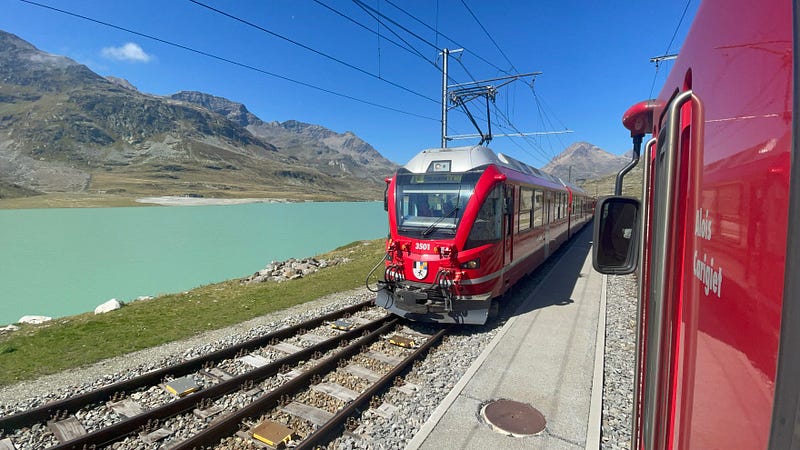
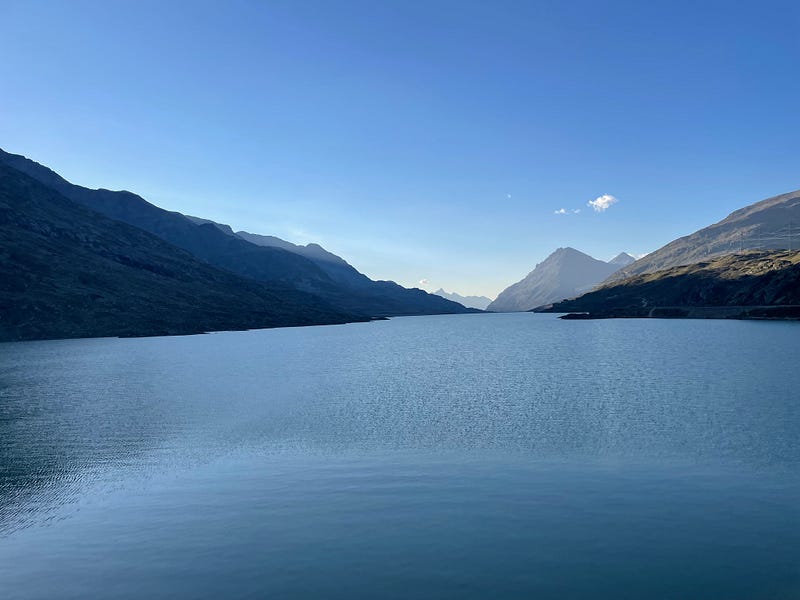
We then skirted the shore of Lago Bianco, a pale green reservoir nearly two miles long, en route to Ospizio Bernina, which, at 7,392 feet, is the highest train station in Europe, and the highest point on the Bernina Express line.
In 2 hours and 20 minutes, we had gained nearly 6,000 feet in elevation, on a train line built more than a century ago.
The landscape, while beautiful, was bleak, with sparse vegetation, and few signs of civilization. It was difficult to believe that we were just an hour away from the glitzy resort of St. Moritz.
Shortly after leaving Ospizio Bernina, we passed a marker noting that any water falling on one side would eventually make its way to the Mediterranean Sea while water falling on the other side would make its way to the Black Sea.
Beyond this point, the train ran alongside a roadway for the last nine miles to Pontresina — making me appreciate even more the previous stretches of rail with no roads in sight.
After checking in and dropping my bags at the Hotel Steinbock in Pontresina, I took the next train back to Ospizio Bernina. From there, I began walking south, along the Lago Bianco, following a mostly-well-marked dirt and gravel path for three miles toward Alp Grüm.
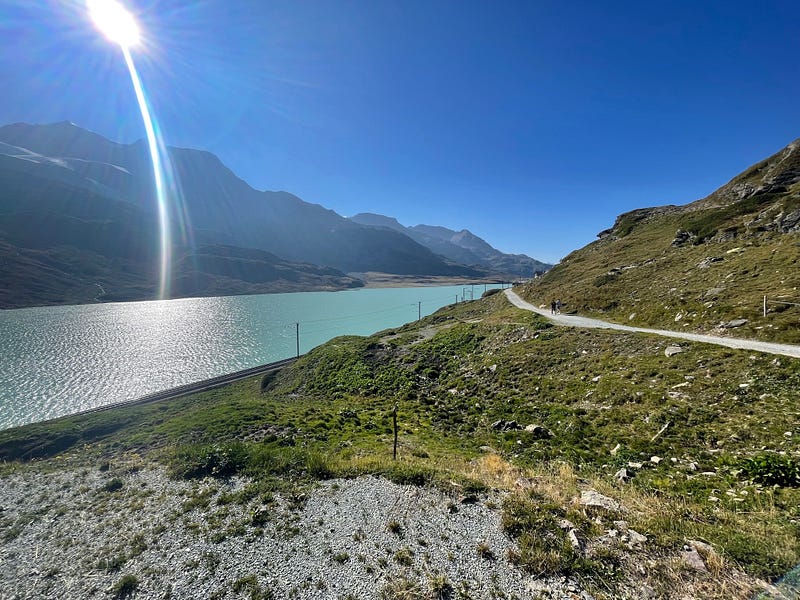
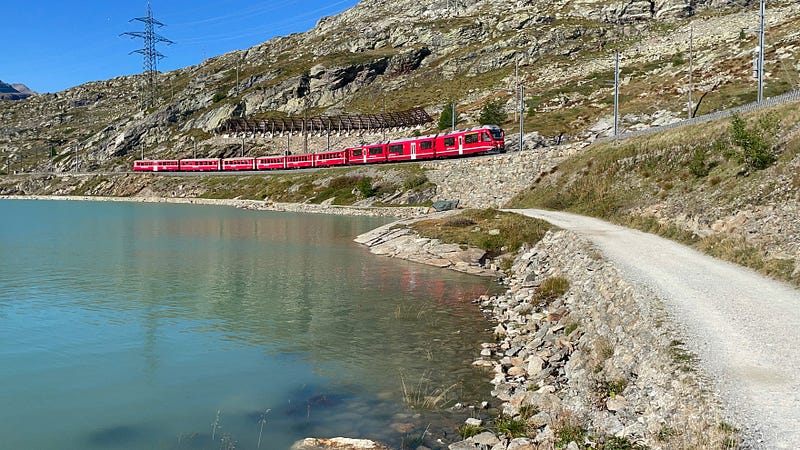
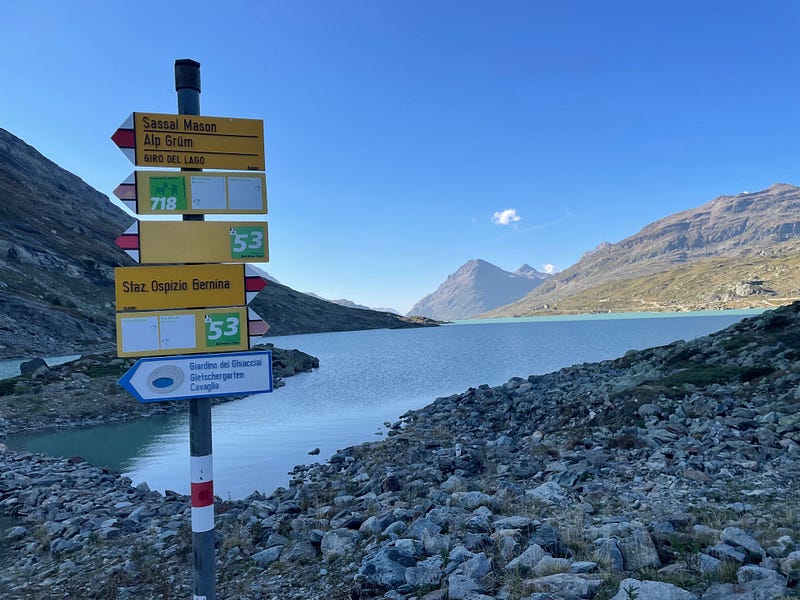
About every 10 to 20 minutes, I would pass a fellow walker or cyclist, a comforting assurance that I was not alone here in this barren, high-altitude mountain pass. A dam marked the end of the Lago Bianco, and signs continued to point me in the right direction, over some small hills, at one point coming face to face with a handful of mules.
The barrenness soon turned to forest. Not knowing what could be in the trees gave me a sense of unease, as did the realization that I was moving at a good clip at a much-higher altitude than I am used to, without any substantial time to adjust to the thinner air.
I checked Google maps frequently to confirm I was on the right track.
Thirty minutes to go.
Fifteen minutes to go.
And then.
A massive valley unfolded underneath me.
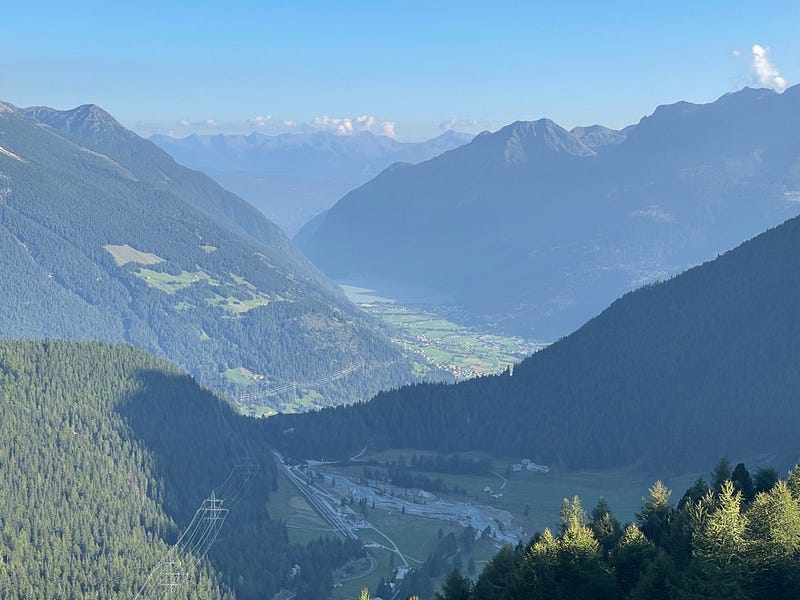
I looked over a rail, and I could see the entire Valposchiavo.
Before I could get to the Alp Grüm station — which a five-minute walk downhill — I found Casa Alpina Belvedere, a small hotel and restaurant overlooking the valley. People sat outside enjoying drinks on what appeared to be the edge of a cliff. I had a small beer, took several photos and videos, and continued that last few minutes downhill to the Alp Grüm station.
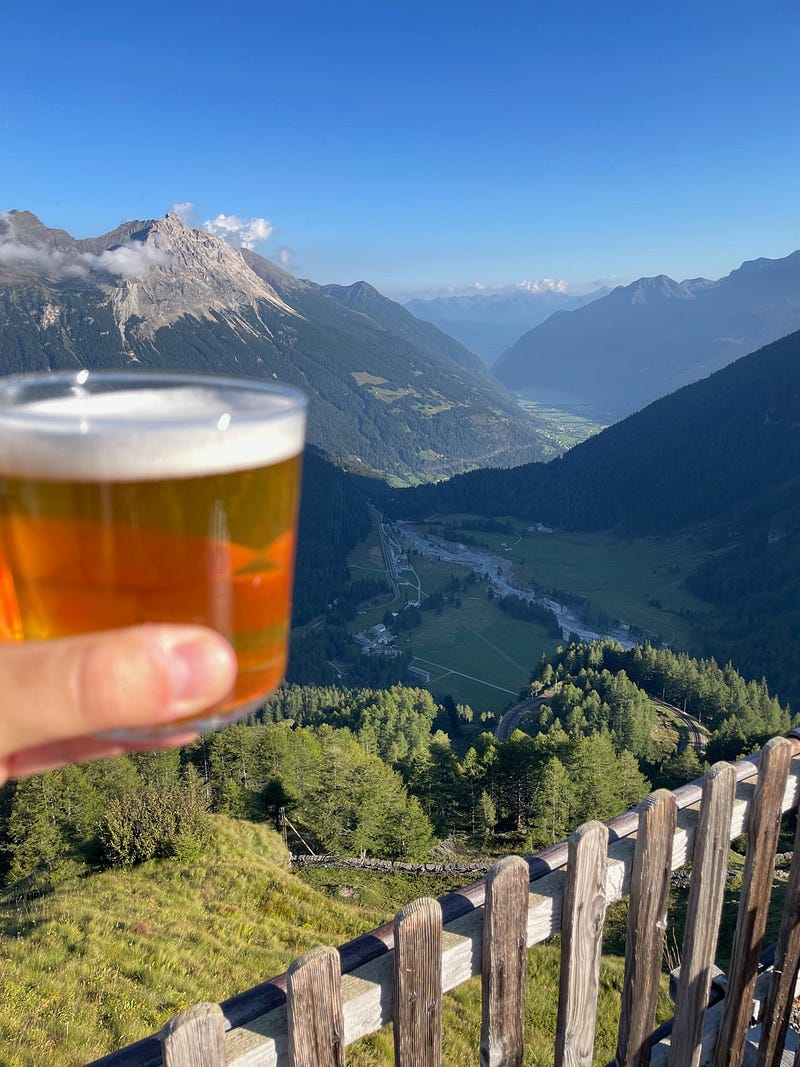
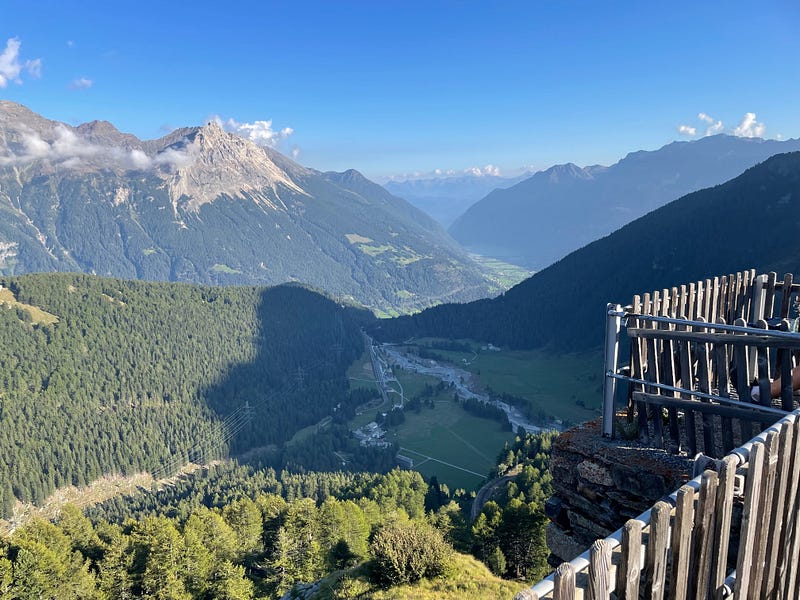
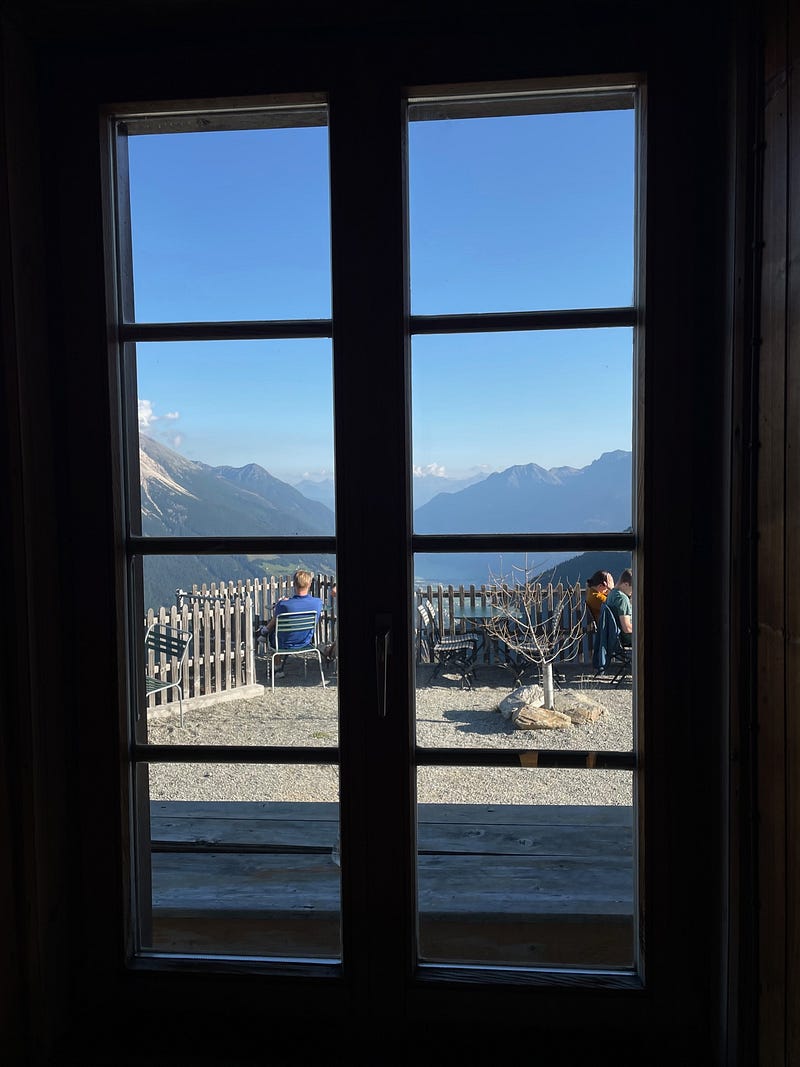
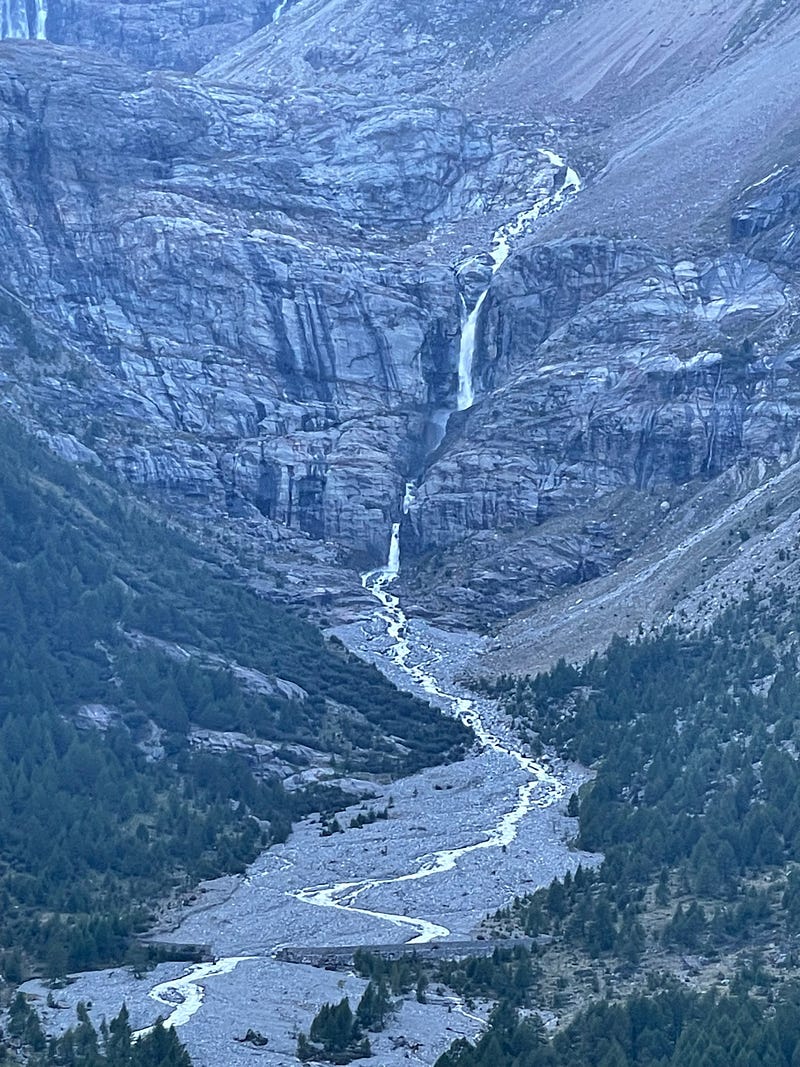
There I had one more beer while staring up at the Palü Glacier as the sun sank behind the mountain, offering an even clearer view of the waterfalls flowing from the glacier.
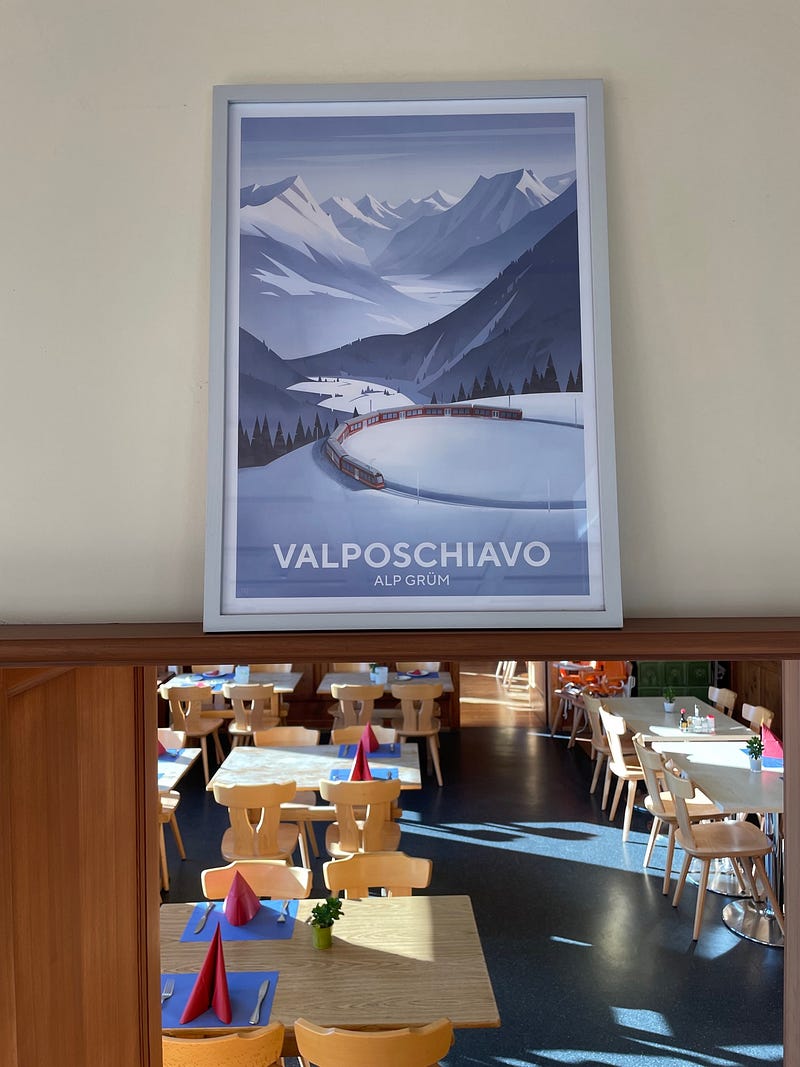
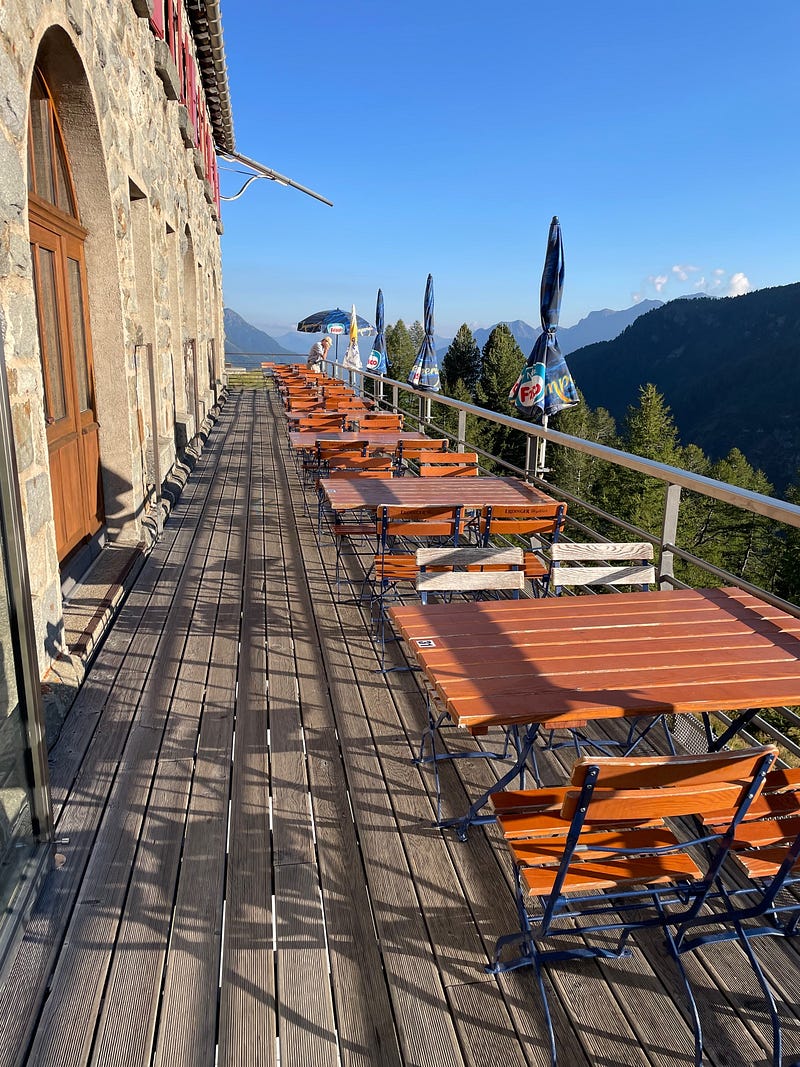
I rode back to Pontresina, again admiring the Lago Bianco and the Alps of the Bernina Pass, this time in twilight.
The next day, I would continue to St. Moritz, Chur and Zurich, with a slight bus detour to set foot in Lichtenstein — all on Swiss trains, but none as spectacular as the Bernina Express (although the route to Chur is gorgeous!).
With deep gratitude to those who built this railway more than a century ago — and all those who have written about it in the years since — I have to say the Bernina Express far exceeded my high expectations.
If you enjoy rail travel, I invite you to check out my site, slowspeedrail.com, or follow me on Instagram at @ihappentolikenewyork. And if you have a favorite rail story, I’d love to hear about it in a comment below.


