avatarMad Midori

Free AI web copilot to create summaries, insights and extended knowledge, download it at here

2559

Abstract

ll pumps, known as “horse head pumps” in the industry.</p><p id="1844" type="7">The four sculptures create a haunting scenery, reminding the observer of our reliance on oil and heavy machinery. It comes at a price: Environmental disasters from destroying ecosystems and spillage risks, as well as continuing climate change manifesting in rising temperatures and extreme weather events like floods.</p><figure id="0f49"><img src="https://cdn-images-1.readmedium.com/v2/resize:fit:800/1*sgHJFlBdhHU53ysdzuF3-w.jpeg"><figcaption>The four horsemen of “The Rising Tide” by James de Caires-Taylor in panorama view (photo by <a href="undefined">Mad Midori</a>)</figcaption></figure><p id="b169">While the artwork could remind us of the four horsemen of the apocalypse, it still shows hope. Two riders are older businessmen, clad in suits, appearing indifferent about the situation by crossing their arms or looking stoically to the sky, while their mutant machines extort the planet. The two other riders, however, are young people looking forward — their horses have stopped drilling for oil. Interestingly, the resting horses’ raised heads are not fully closed, but partly opened up by holes, nature shining through. Another subtle message — or are the pipelines still pumping, though?</p><blockquote id="30bb"><p>“Working in conservation, I am very concerned with all the associated effects of climate change and the state of peril our seas are in at the moment.“ (<a href="https://www.theguardian.com/artanddesign/2015/sep/02/underwater-sculptures-thames-london">Jason de Caires-Taylor</a>)</p></blockquote><p id="953b">Yet, there could be hope for our world, carried by the next generation. “There is a sign of optimism in the children, who are able to inflict change”, <a href="https://www.underwatersculpture.com/">the artist</a>, an awarded environmentalist, <a href="https://thetidalthames.com/2019/05/12/the-rising-tide/">said himself</a>.</p><h2 id="5636">“Ride, Ride Ranke” — a Norse childhood song reimagined</h2><p id="5fde">I was deeply impressed by the equestrian sculptures. Such a strong piece in a natural yet fragile setting, with a powerful message: We have to handle our environment with care, or otherwise, it might sink for good.</p><p id="c24c">At the same time, I felt a spirit of deceptive innocence, a dangerous idyll where everything seems perfect, so people can live in blissful ignorance. In a children’s world, too naive to worry. Memories of a children’s song popped into my mind: Tiny Me was riding on my parents’ knees, up and down,

Options

along with the rhymes they sang about a rider and his adventures.</p><p id="a9f9">Was there a Norwegian version, too, I wondered? Yes, there is: “Ride ride ranke” — which can be interpreted as “Ride, ride the horse/horsey.” Across Northern Europe, many different song versions exist and are shared from generation to generation. <a href="https://www.mamalisa.com/?t=es&amp;p=1758">In this one</a>, a carefree horseback-riding child is visiting family members. Older versions from 1871 and 1888, <a href="https://no.wikipedia.org/wiki/Ride_ride_ranke">mentioned here</a>, are more political though: A small junker rides to the royal court, but only meets two dogs. And when he wins his spurs, childhood is over.</p><figure id="1be5"><img src="https://cdn-images-1.readmedium.com/v2/resize:fit:800/1*O-3blT3bfyY99oUZ-C-X3A.jpeg"><figcaption><a href="https://en.wikipedia.org/wiki/no:Albert_Edelfelt">Albert Edelfelt’s</a> ”Rida Ranka ” shows Queen Blanka with her son Håkon on her lap. In the Norse children's song, the horse is called Blanka, too — referring to children riding their mother's knees. (From “<i>Albert Edelfelt 1854–1905”,</i> Douglas Productions, Helsinki 2004, pp. 65–67 via <a href="https://no.wikipedia.org/wiki/Ride_ride_ranke#/media/Fil:Drottning_Blanka,_m%C3%A5lning_av_Albert_Edelfelt_fr%C3%A5n_1877.jpg">no.wikipedia.org</a>, public domain)</figcaption></figure><p id="4e5e">Keeping the Norwegian children's song in mind, I saw the four sculptures of the oil-drilling horses, grazing at Norway’s shore, with new eyes.</p><p id="d559">The tide had already risen, covering the horse mutations’ pipelines slightly, with the blazing midday sun creating a picture of cynical harmony. A new song version slowly formed in my thoughts: A darker dystopian one, still rhyming innocently, but spilled with sarcasm and maybe a little bit of oil.</p><p id="87fd">It’s my poem you can read above.</p><p id="39f9">2023, by <a href="undefined">Mad Midori</a></p><div id="dbf0" class="link-block"> <a href="https://readmedium.com/gaijin-getting-lost-found-in-tokyo-953b25cea2b7"> <div> <div> <h2>Gaijin: Getting Lost & Found in Tokyo</h2> <div><h3>Haiku Chain</h3></div> <div><p>medium.com</p></div> </div> <div> <div style="background-image: url(https://miro.readmedium.com/v2/resize:fit:320/1*[email protected])"></div> </div> </div> </a> </div></article></body>

POETRY / ESSAY

Ride, Ride a Horse — In Rising Tides Up North

An innocent Norwegian childhood song reimagined by modern art warning about environmental disaster
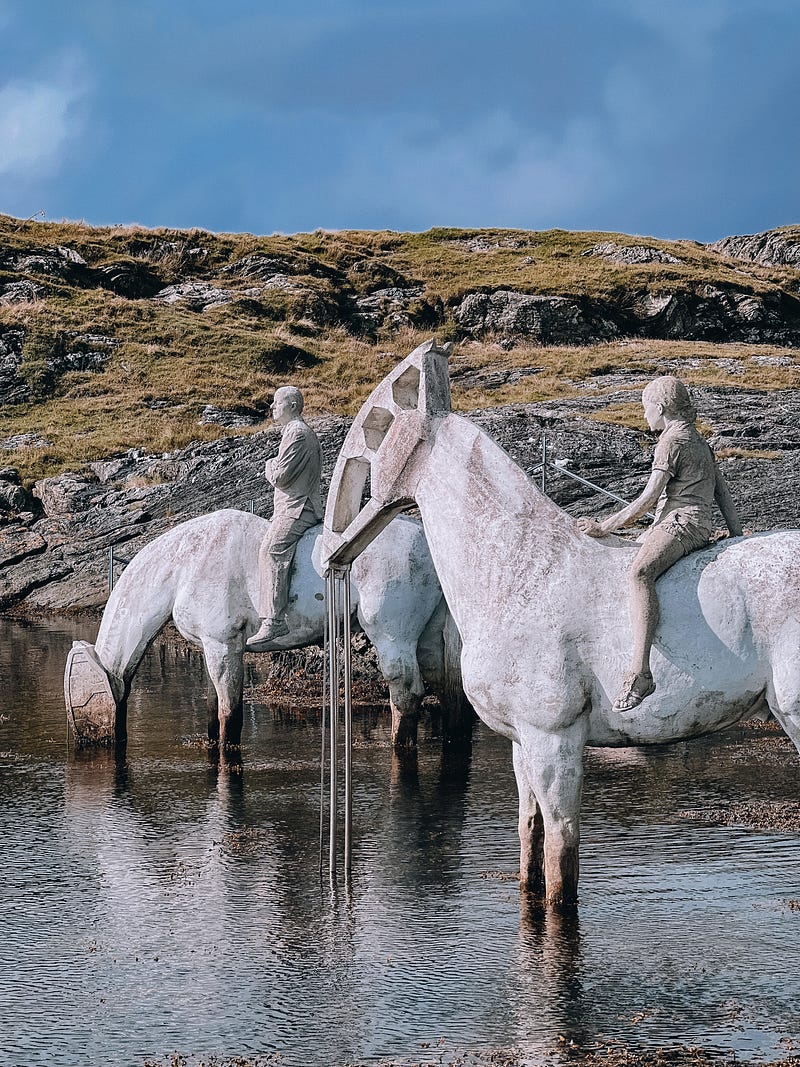
Two of the four horsemen of “The Rising Tide” — sculptural artwork by James de Caires-Taylor in Haugesund, Norway (photo by Mad Midori)

Ride, ride a horse, Blazing through fields, a green grass course. The millers grind, the farmers plow we reap from nature what we sow.

Ride, ride a horse, sun’s glistening, bearing old Norse wisdom to worship Mother Earth they taught you young about its worth.

Ride, ride a (trojan) horse, appearance changed, as did its force. Greed wants black gold, under the sea, built metal horses, against our plea.

Ride, ride a (drilling) horse, blind offshore monster, no remorse. Out of sight, little junkers ride, when they’ve won their spurs, innocence dies.

Discovering Norway through different art forms

Some weeks ago, I was traveling through Norway for the first time and soaked up the local culture like a sponge. Norwegians are quite pragmatic, efficient, and wealthy. The source of wealth, however, is not visible in the picture book-perfect panorama of fjords, mountains, and forests: Offshore oil and gas platforms in the North Sea. I was not aware of the fact that Norway is one of the largest oil and gas producers in the world!

“The Rising Tide” — sculptural art warning about climate change

I came across stunning sculptures in the coastal town of Haugesund on the Norwegian West Coast. Not a coincidence: Being a fan of contemporary art, I had looked out for and finally found “The Rising Tide”, a unique installation by underwater sculptor Jason de Caires-Taylor.

Four large horses made of stainless steel and concrete, slightly withered, are standing in shallow waters. Coming closer, I recognized the animals as mutations: Their equine bodies wore edgy, futuristic heads — oilwell pumps, known as “horse head pumps” in the industry.

The four sculptures create a haunting scenery, reminding the observer of our reliance on oil and heavy machinery. It comes at a price: Environmental disasters from destroying ecosystems and spillage risks, as well as continuing climate change manifesting in rising temperatures and extreme weather events like floods.
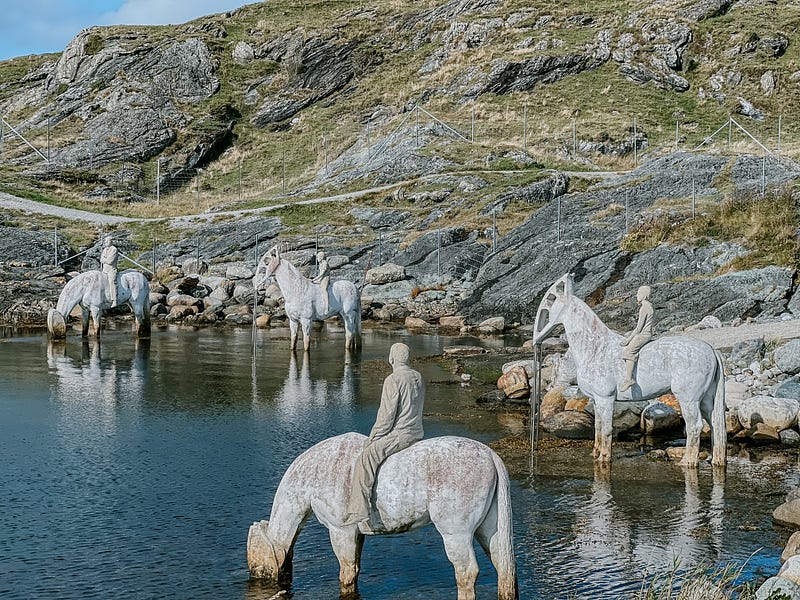
The four horsemen of “The Rising Tide” by James de Caires-Taylor in panorama view (photo by Mad Midori)

While the artwork could remind us of the four horsemen of the apocalypse, it still shows hope. Two riders are older businessmen, clad in suits, appearing indifferent about the situation by crossing their arms or looking stoically to the sky, while their mutant machines extort the planet. The two other riders, however, are young people looking forward — their horses have stopped drilling for oil. Interestingly, the resting horses’ raised heads are not fully closed, but partly opened up by holes, nature shining through. Another subtle message — or are the pipelines still pumping, though?

“Working in conservation, I am very concerned with all the associated effects of climate change and the state of peril our seas are in at the moment.“ (Jason de Caires-Taylor)

Yet, there could be hope for our world, carried by the next generation. “There is a sign of optimism in the children, who are able to inflict change”, the artist, an awarded environmentalist, said himself.

“Ride, Ride Ranke” — a Norse childhood song reimagined

I was deeply impressed by the equestrian sculptures. Such a strong piece in a natural yet fragile setting, with a powerful message: We have to handle our environment with care, or otherwise, it might sink for good.

At the same time, I felt a spirit of deceptive innocence, a dangerous idyll where everything seems perfect, so people can live in blissful ignorance. In a children’s world, too naive to worry. Memories of a children’s song popped into my mind: Tiny Me was riding on my parents’ knees, up and down, along with the rhymes they sang about a rider and his adventures.

Was there a Norwegian version, too, I wondered? Yes, there is: “Ride ride ranke” — which can be interpreted as “Ride, ride the horse/horsey.” Across Northern Europe, many different song versions exist and are shared from generation to generation. In this one, a carefree horseback-riding child is visiting family members. Older versions from 1871 and 1888, mentioned here, are more political though: A small junker rides to the royal court, but only meets two dogs. And when he wins his spurs, childhood is over.
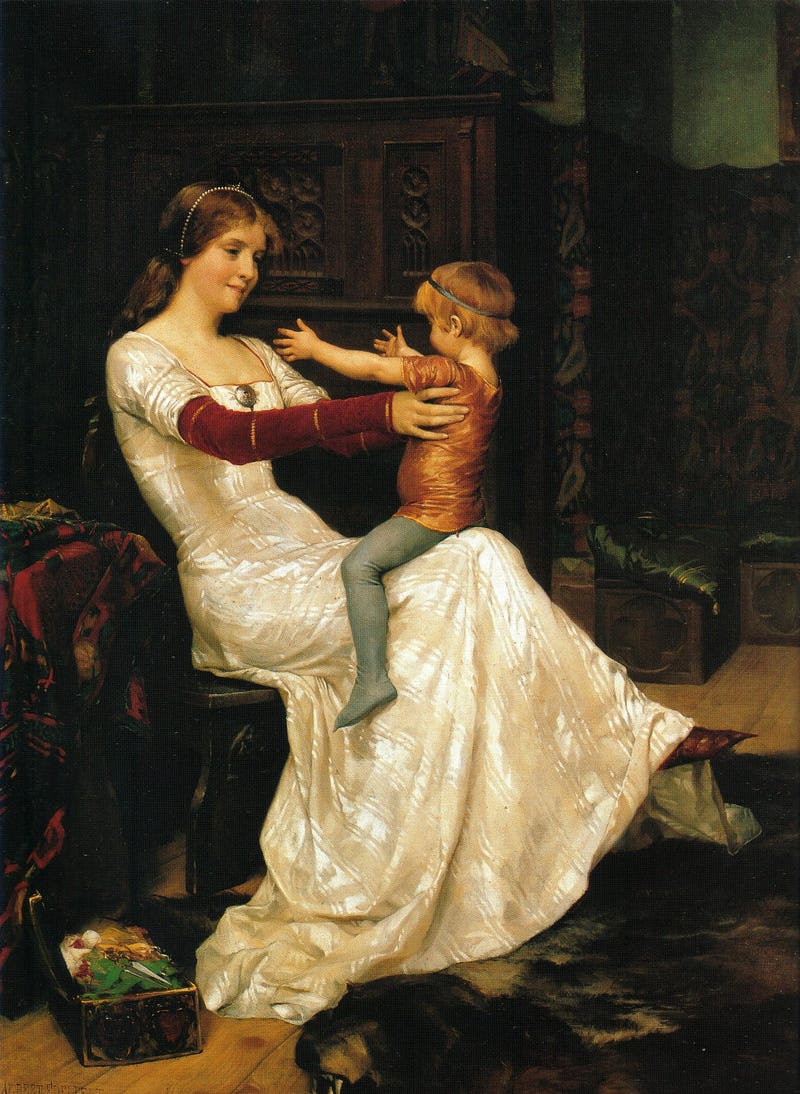
Albert Edelfelt’s ”Rida Ranka ” shows Queen Blanka with her son Håkon on her lap. In the Norse children's song, the horse is called Blanka, too — referring to children riding their mother's knees. (From “Albert Edelfelt 1854–1905”, Douglas Productions, Helsinki 2004, pp. 65–67 via no.wikipedia.org, public domain)

Keeping the Norwegian children's song in mind, I saw the four sculptures of the oil-drilling horses, grazing at Norway’s shore, with new eyes.

The tide had already risen, covering the horse mutations’ pipelines slightly, with the blazing midday sun creating a picture of cynical harmony. A new song version slowly formed in my thoughts: A darker dystopian one, still rhyming innocently, but spilled with sarcasm and maybe a little bit of oil.

It’s my poem you can read above.

2023, by Mad Midori

The Howling Owl
Poetry
Culture
Environment
Norway
Recommended from ReadMedium