
Richard Steven Valenzuela — The Kid Who Made Chicano Music Cool
To be labelled the godfather of Chicano rock music at 17 is quite something
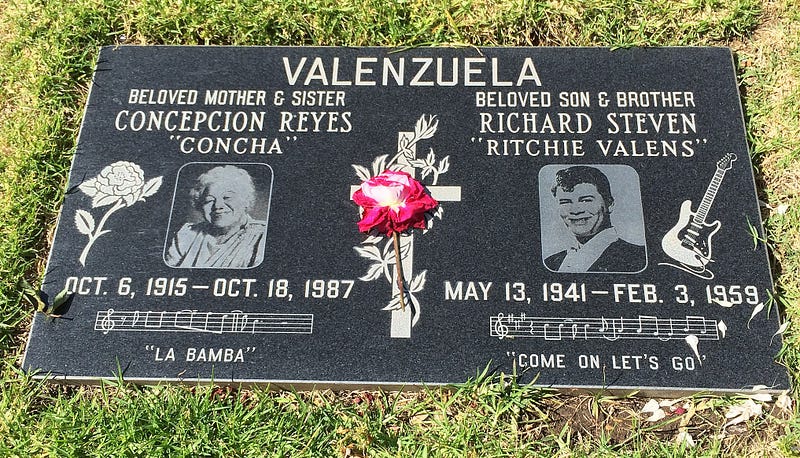
This month marks the 80th birthday of the late Ritchie Valens, yet his music is timeless.
My first reaction to hearing Ritchie Valens’ ‘La Bamba’, was that it made me smile and feel happy. I considered it another American rock classic, in the same league as those by Chuck Berry, Buddy Holly, Eddie Cochran and Elvis. I’d never seen a photo of him; had no idea of his ethnicity. Why would it matter? He rocked. Another thing: it’s sung in Spanish. Did I know what the words meant? No. It still rocked.
“Yo no soy marinero Yo no soy marinero, soy capitán Soy capitán, soy capitán”
I heard this song everywhere in the UK in the 1960s. Played at dances, in amusement arcades, on fairground rides, it seemed to be blasting out the radio all through that decade’s summers. Any self-respecting pub rock band had to include it in their set list.
Originally an 18th-century folk song from the Veracruz region on the Mexican Gulf Coast, it also refers to a dance performed mainly at weddings.
Although an obscure and possibly non-existent 1908 Mexican recording has been cited, the earliest certain recording is that by Alvaro Hernández Ortiz, credited as El Jarocho, which was released on the Victor label in Mexico in about 1939 (Victor 76102).
Ritchie was born Richard Steven Valenzuela on 13 May 1941 to Mexican parents living in Pacoima, a neighbourhood in the San Fernando Valley region of Los Angeles. It was, perhaps, a difficult childhood as his parents split up when he was only three.
The second of five children, Ritchie was brought up hearing traditional Mexican mariachi music, flamenco guitar, R&B, and jump blues, and he was encouraged by his father to take up guitar and trumpet. Later he taught himself to play drums. Though Ritchie was left-handed, he was so eager to learn the guitar that he mastered the traditional right-handed version of the instrument. Through family ups and downs, music was his solace.
By the time Ritchie was attending Pacoima Junior High he brought his guitar to school to sing and play songs to his friends. At sixteen he was invited to join a local band, ‘The Silhouettes’. When the guitarist left, Ritchie took on the role, and in October 1957 he made his performing debut.
In May 1958, Bob Keane, owner of Del-Fi-Records in Hollywood, was given a tip about a young performer from Pacoima known to the kids of the area, as ‘the Little Richard’ of San Fernando. After seeing Ritchie play a Saturday-morning matinée at a movie theatre, Keane invited him to audition at his home in the Silver Lake area of LA.
He had a small recording studio in his basement comprising an early stereo recorder, a two-track Ampex 601–2 portable and a pair of Neumann U-47 condenser mics. Just days after the audition, and his seventeenth birthday, Richie was signed to Del-Fi-Records.
By July 1958 ‘Come on Lets Go’, co-written by Ritchie and Keane, and the ‘B’ side, ‘Framed’, a Leiber and Stoller tune, were recorded, pressed and released. The record peaked at #42 on US Billboard chart, spending thirteen weeks in the Top 100.
Keane says he cut the surname to ‘Valens’ to widen his appeal beyond any obvious ethnic group and chose Ritchie to differentiate him from a bunch of Richards in the music business at that time.
Some of the finest musicians, who would later become members of the Wrecking Crew, were chosen to back Ritchie. They all had a jazz background. René Hall, Earl Palmer, and Ernie Freeman worked for the Ernie Fields Orchestra at one time or the other. These musicians were essential in creating the great US hits of the 1950s and 1960s, to create legendary pop, soul and R&B music.
Carol Kaye quote:
“Ritchie was kind of quiet, but you saw that determination in him to do what he wanted with music. He was nice-looking and with a very good vibe about him. I loved his singing, he could really sing and had talent similar to Sam Cooke, who I also recorded with that same period.”
By putting together Rene Hall on lead guitar and Ritchie Valens on electric rhythm, it created one of the coolest sounds in rock’n’roll history. With Earl Palmer on drums, Bill Pitman on six-string bass, Carol Kaye playing acoustic guitar, ‘La Bamba’ was, and remains pure genius. The six-string bass drives the song, and Hall flat-out rocks.
Ritchie wrote a song about his girlfriend, Donna Ludwig, not surprisingly entitled ‘Donna’, which entered the US Billboard chart on 15 December 1958, peaking at #2 on 23 February 1959. ‘La Bamba’ was it ‘B’ side.
Ritchie Valens never lived to see it make the Top Ten. He was killed in a plane crash eight months into his recording career, alongside Buddy Holly, ‘The Big Bopper’ J.P. Richardson, and the pilot Roger Petersen, shortly after take-off from Clear Lake, Iowa, 3 February 1959. As Don McLean was later to write, It was the day the music died.
For Ritchie Valens, his dream of fame and stardom came fast. He was a true overnight sensation. And then he was gone. But he packed a lot into those eight months, selling millions of records, touring Hawaii, and acting and singing in the movie, “Go Johnny Go”, alongside Chuck Berry, Jackie Wilson, and Eddie Cochran.
Twice he performed on Dick Clark’s ‘American Bandstand’ TV show; he played the Apollo Theatre, and was in Alan Freed’s week-long 1958 Christmas Rock & Roll Spectacular at Manhattan’s Loew’s State Theatre. Among the 17 acts were Bo Diddley, Chuck Berry, Eddie Cochran, Jackie Wilson, and the Everly Brothers.
Carol Kaye quote:
“I was really at a loss about Ritchie’s death….and even tho’ I still considered myself a jazz guitarist, not yet really part of the bigger commercial world, his death hit me very hard as it was a total loss of a good person, and a great talent.”
In the early 1960s in Los Angeles, a different music culture developed around Latino teenagers who were about to challenge the norm in American popular music.
Without this subculture, which the rest of America was barely conscious of, it is possible we would have no garage bands or punk, as we know them today. And the first big star, the person around whom that culture formed, was Ritchie Valens.
In his book, ‘The San Fernando Valley: America’s Suburb’, Kevin Roderick says:
“He was not only the first rock music star of Mexican ancestry, but also the first Chicano from Pacoima to achieve any status in white America. For a kid who spoke almost no Spanish, his fame unloosed an immense pride in the barrios. When Ritchie returned home in December 1958 he was hailed by some in the music press as the next Elvis.”
He did make a huge impact on the Hispanic audience in the wider United States, who saw one of their own become the first rock star. Others who followed include Chan Romero, Chris Montez, Trini Lopez, Sam the Sham and the Pharaohs, and Santana.
‘La Bamba’ reached #22 on the US Billboard chart in February 1959, and is included on Rolling Stone’s list of the “500 Greatest Songs of All Time” #354.
More than just another band from East LA, Los Lobos had their first #1 hit in 1987 with their version of ‘La Bamba’ for the movie of the same name, about the life of Ritchie Valens, with Lou Diamond Phillips playing the lead role.
I still play it. It still makes me smile. And it still rocks.