
Why rich Families are Having more Kids

How do we explain this phenomenon? In two Words: Income Inequality
Key Takeaways
- Historically, low-income women with lower levels of education have had more children than high income, highly educated women
- That trend is reversing as high income, highly educated women are having more children than ever before
- High-income women can better afford to pay for childcare, enabling them to have more children and work longer hours than low-income women
- Women with high income and education can also better afford to invest in their children’s education. This is leading to a highly educated younger generation as more children are born into rich families.
- A $15 (or higher) minimum wage leads to high-income women having fewer children and working less. This is because a higher minimum wage increases the cost of childcare, increasing the opportunity cost of having more children.
The Times They Are A Changin
Poor people have more kids than rich people. Anyone who has taken a labour economics class knows this to be true. At least it used to be true. According to a report from the St. Louis Federal Reserve. Rich, highly educated white women are having more kids than ever before.
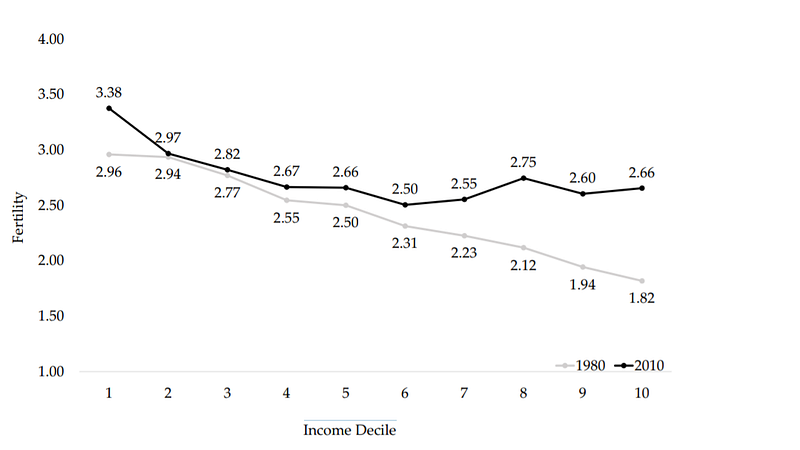
The chart below shows fertility (on the vertical axis) and income Decile (on the horizontal axis). A 10 on the Income Decile is the to 10% of wage earners and 1 would be the bottom 10%. in 1980, women in the top 10% of wage earners were having an average of 1.82 kids. By 2010 that number jumped to 2.66. Meanwhile, the reverse is true for women in the bottom 10% of wage earners who were having 3.38 kids on average in 1980 compared to 2.96 in 2010.
Bottom line: Poor people are having fewer kids than ever and rich people are having more kids than ever.
How Do We Explain This Phenomenon?
In two words: Income Inequality
- In 1985 the average weekly cost of childcare was around $84
- In 2017 it was $211
And yes, these numbers are adjusted for inflation.
The report from the St.Louis Federal Reserve concludes that as income rises it makes more sense for women to pay for childcare costs so that they can work longer hours. Working longer hours allows them to further increase their income and be able to financially afford to have more children.
If you made $5,000 a week and had to pay $211 for childcare, it would make financial sense for you to go back to work since childcare costs are only 4.2% of your income. Since you go back to work quickly and work longer hours you are more likely to advance higher in your career and earn more money. Now it’s easier for you to have a second kid.
If you made $500 a week and had to pay $211 for childcare things look a little different. Childcare costs are 42% of your income, it’s a much more difficult decision to go back to work. Is it worth it to give up nearly half your income and spend less time with your kids? More lower-income women reduce the hours they work making it more difficult to financially afford the second kid.
More Educated Younger Generation
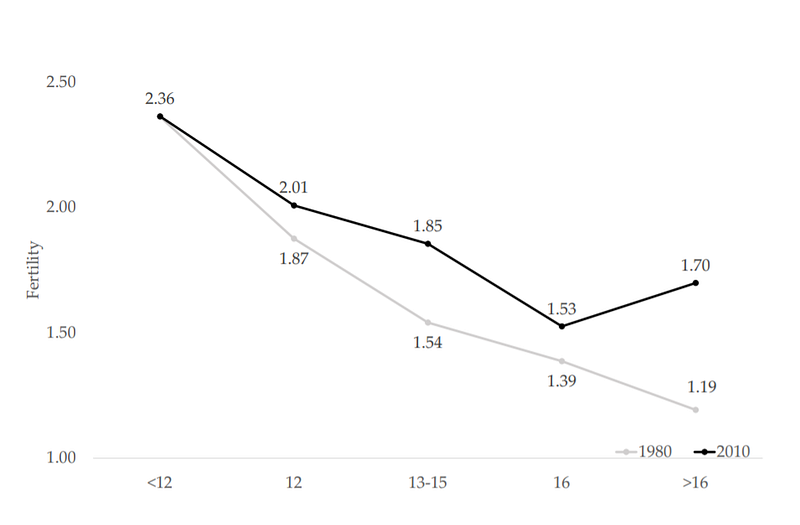
The chart below shows Women with a graduate degree (16 or more years of education) had an average of 1.19 kids in 1980, by 2010 that number jumped to 1.7.
A fascinating result of high income, highly educated women having more children is a more educated younger generation. Mothers with high levels of education are more likely to value education and are MUCH more able to afford to invest in their child’s education.
More kids being born to rich families means a highly educated younger generation.
Impacts of a $15 Minimum Wage
The Federal Reserve report models the impact of a $15 minimum wage on the fertility of high-income women. A rise in the minimum wage will raise the cost of childcare. The result is high-income women working fewer hours and having fewer children.
Bottom Line
If inequality continues to grow, rich women can more easily hire someone to help with childcare costs and go back to work. Rich women can have their family and a career, while poor women will have to choose.
Bonus: Need support to start taking action? Join the 30-day money challenge where you will be given a new action item to take every day for 30 days. You also get access to the private Facebook group of people who are in the same boat as you.
Click here to Sign up for the 30-day money challenge.
This article is for informational purposes only, it should not be considered Financial or Legal Advice. Not all information will be accurate. Consult a financial professional before making any major financial decisions.


