
Rich Classroom Discourse: Benefits for Student Learning
Communication & Reasoning in Mathematics
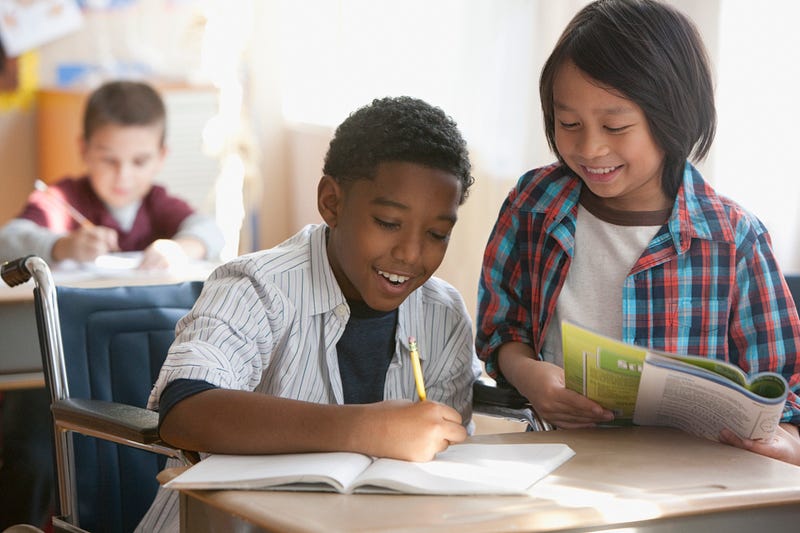
For many adults, and even many students, math class is a place where a teacher talks and students listen, responding only when called upon to answer a question. But by creating an environment in which rich classroom discourse can take place, educators help support student learning. To help educators take a close look at classroom discourse, Dr. Cathy Seeley, former mathematics teacher and State Director of Mathematics for Texas and 6–12 Advisor for our Reveal Math program, has put together a guide describing effective classroom discourse and methods to help develop mathematical thinking in students. You’ll find the full guide at the bottom of this blog. Continue reading for an overview of why classroom discourse is important and how students can benefit from the practice.
What is Discourse, and Why is it Important?
Generally, classroom discourse encompasses different types of written and spoken communication that happen in the classroom. Today, that definition goes even deeper to include representing, thinking, interpreting, expressing, reflecting, agreeing and disagreeing, and even debating and arguing. As teachers recognize the importance of constructive discussion and interaction in the math learning process, this model of classroom discourse is showing up more and more in classrooms across the nation. The full guide provides further details on why classroom discourse is so important to learning.
Practicing Reasoning and Expression
Rich classroom discourse offers students a way to express their ideas, reasoning, and thinking. Classroom discourse can be a central element of acquiring mathematical knowledge and understanding the nature of mathematics. As the notion that students need frequent and regular opportunities to express their thinking expands, it’s time to rethink the current teaching model. Today, we know that students can benefit from tackling challenging problems, with regular opportunities to express their thinking.
Refining Communication and Thinking Skills
Facilitating productive struggle allows students to wrestle with mathematical ideas and think about how to approach a problem. Their thinking may result in a solution, or it may set the stage for them to be open to hearing someone else’s strategy or solution, either another student’s or the teacher’s. The process of finding a path to an answer gives students the opportunity to communicate their thinking and reveal understandings or misunderstandings. When a student develops a strategy or approach based on sound mathematical understanding, communicating what he or she did can increase the likelihood that the student will be able to use or adapt that strategy in future situations. See the guide for more information about teaching processes (such as ‘You-We-I’ vs. ‘I-We-You’) and how these techniques and shifts can be beneficial in the classroom.
Serving and Empowering English Learners
A teacher’s first instinct may be to give English Learners problems with fewer words and more numbers. In actuality, English Learners benefit greatly from increased mathematical discourse because it provides the opportunity to engage in rich problems as they develop advanced language skills. Without such experiences, English Learners are likely to fall behind their English-proficient classmates. Reference the full guide for more information on helping students who are not proficient in English and how teachers can successfully and effectively utilize valuable discourse in the classroom.
About the Author

Dr. Cathy Seeley has been a mathematics teacher, K-12 district coordinator and K-12 State Director of Mathematics for Texas. She is the author of several books, including: Making Sense of Math (for teachers); Building a Math-Positive Culture (for leaders); Faster Isn’t Smarter-Messages About Math, Teaching and Learning in the 21st Century (2009/2015); and Smarter Than We Think-More Messages About Math, Teaching, and Learning in the 21st Century (2014).


