
Rexall’s remedy for the music blahs
Remembering a great record album sold only by prescription
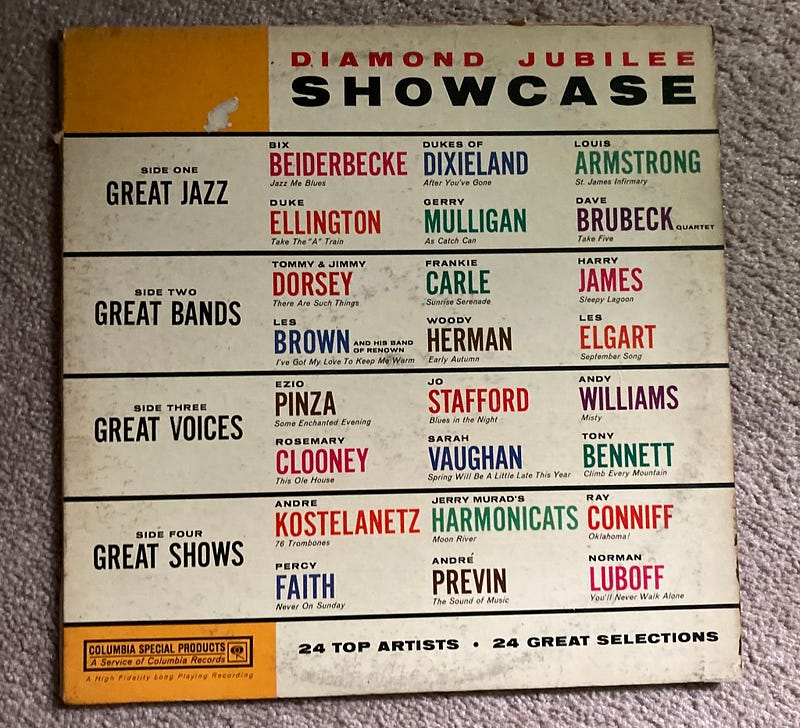
The most influential record album of my life hit stores in 1963, a very good year that brought The Freewheelin’ Bob Dylan, James Brown’s Live at the Apollo, Phil Spector’s A Christmas Gift for You and, if you had connections in England, Please Please Me, the debut LP of a funny looking four-piece band called the Beatles.
Each of those albums is dear to me, but none of them is the record that most changed my perspective on music.
Instead, it was a double LP my mom bought for $2 at the Rexall across the street from the bank where she worked. The drug store chain had commissioned and was selling Diamond Jubilee Showcase to commemorate its 60th anniversary.
My mom was probably most attracted to the “Great Voices” side of one of the discs, which featured vocal performances by Rosemary Clooney and Tony Bennett, among other 1940s and ’50s stalwarts, or the “Great Bands” side, which included tracks by the likes of the Dorsey brothers, Les Brown and Harry James, bandleaders she’d danced to in her teen years.
I found cuts to enjoy among those, too, but the side that knocked me out, that open my ears forever, was the “Great Jazz” side.
At that point in my life, the only jazz I was familiar with was Dixieland. We lived within driving distance to New Orleans, and Big Easy artists like clarinetist Pete Fountain were popular in my home town. That genre is represented on Showcase — the Dukes of Dixieland doing “After You’ve Gone.”
The revelations — to my young, untutored ears — were the side’s other five tracks, a mini-tour of America’s native music.
The side opened with “Jazz Me Blues,” a rollicking instrumental by a trumpet player I’d never heard of — he’d died in 1931at the age of 28 — but whom I would soon learn was legendary: Bix Beiderbecke.
Next, in chronological order, came the Dukes and then Louis Armstrong, “Satchmo,” a jazz legend whom I’d seen singing and inevitably sweating on TV and in movies. His rendition of “St. James Infirmary,” joined by Earl Hines on piano and Don Redman on alto sax, made me suddenly understand why he was a legend. To this day, I can hear it note for note without even putting the LP on a turntable.
An astonishing, almost six-minute version of “Take the ‘A’ Train” by Duke Ellington came next. I didn’t know then that the ‘A’ train was the subway up to Harlem, but I was dazzled by the gleaming, beaming fullness of Ellington’s orchestra and wonderful shifts and dynamics.
Then the Showcase moved into the modern era with the Gerry Mulligan Quartet doing on of his signature tunes, the fidgety, percolating “As Catch Can,” and closed with Dave Brubeck’s ground-breaking, 5/4 masterpiece “Take Five.”
I practically wore a hole in the “Great Jazz” side of the LP. It didn’t just give me hours and hours of listening pleasure, it led me eventually to seek out full albums by the artists and their sidemen and be more aware of and open to jazz old and new.
Amazingly, there are still copies of Diamond Jubilee Showcase floating around out there. Just a quick internet search will turn up copies for as little as $5. (There’s actually a second volume that I didn’t know existed until recently; its jazz side includes tracks by Sidney Bechet, Jack Teagarden and Miles Davis.)
I recommend it highly, not only for the jazz and easily a dozen more great performances but also for what the double LP reminds us about American music that’s being lost.
A Medium contributor I follow recently posted an essay complaining about how so much new music sucks. I clapped for his essay — and then commented something to the effect that there are thousands of records available in one form or another that will qualify as new to almost everybody.
The Diamond Jubilee Showcase was a relic on arrival. Rock ’n roll and R&B had been elbowing traditional pop off the Billboard chart since the mid-’50s, and with the Beatles-led “British Invasion” that began in 1964, even old-school superstars like Frank Sinatra would find themselves hard pressed to get mainstream airplay.
I was OK with that at the time: Roll over, Perry Como, and tell Andre Kostelanetz the news. I wanted my local DJ to play more Stones and Animals and Jefferson Airplane.
But as I got older and regained my youthful omnivorousness, I not only renewed and expanded my interest in jazz, but I developed a healthy new respect for American music makers who had been written off as trite or emotionally insufficient — or simply forgotten, buried by the sands of time.
The next time you’re struggling to find new music that speaks to you and gets your motor running, just remember how much music has been recorded just in this country in the past 100 years and how little of it you’ve heard.
Get to know Louis Armstrong better. And Louis Jordan. And Duke Ellington and Pee Wee King, Mildred Bailey and Frankie Laine, Sarah Vaughn and Vaughn Monroe, Jo Stafford, Billy Eckstine, Bob Wills, the Mills Brothers, the Andrews Sisters, the Ink Spots, the Sons of the Pioneers. . . .
The list is endless. Really.
*The author released his first album, Better Late, last year. It’s available for free listens at https://noelholston.bandcamp.com/album/better-late


