
Rewilding The American Boy
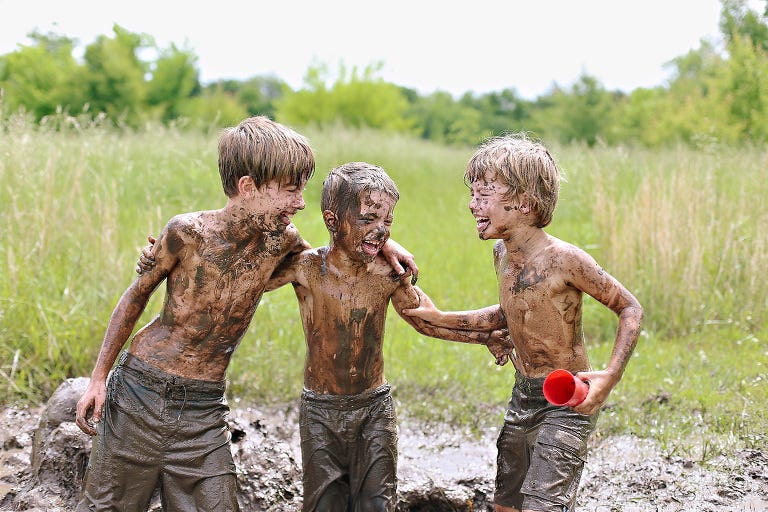
If there was ever a right time to raise strong boys, it is now.
I don’t mean boys who hide their feelings or assume a macho persona to conform to an outdated and useless notion of manhood. Nor am I referring to men who lack compassion and empathy. And I’m certainly not referring to the growing number of ‘strong men’ currently in positions of world power who hide their insecurities under a veneer of blustering bravado. Those men are just the cowards G.K. Chesterton referred to in this blistering quote:
“Brave men are vertebrates; they have their softness on the surface and their toughness in the middle. But these modern cowards are all crustaceans; their hardness is all on the cover and their softness is inside.”
It is precisely of brave men I’m talking about, instilled with the virtues of valor and stoicism.
A stoic man is one who endures hardship with an even temper and without complaint. A valiant man is one who displays great courage in the face of danger. The world, I insist, could use more stoic and courageous men right about now. Otherwise, as warned Martin Luther King Jr., a civilization that continues to produce soft-minded men will purchase its own spiritual death on the installment plan.
Today’s relative absence of war, and the almost-uninterrupted period of prosperity the world has experienced since the Great Depression has made us complacent, thinking good times will last forever, and that therefore, the innate fierceness in men that so often rescued the world in times of great danger is no longer needed.
Hard times create strong men; strong men create good times. Good times create weak men; weak men create hard times. — Michael Hopf, ‘Those Who Remain’
Well, here we are, faced with one of the hardest moments in modern history: The 2020 Coronavirus Pandemic.
You’d be wrong in thinking that the world will return to normal once this crisis ends, thereafter enjoying another century of unruffled peace and prosperity. The road ahead, I’m afraid, has greater challenges in store to human well-being and its ultimate survival as a species.
So how are we to prepare our boys to meet and overcome these challenges?
In traditional societies — under constant danger, food scarcity, and uncertainty — the elder males of the tribe were entrusted to initiate boys into men; a practice still common today in some corners of the world.
In her essay ‘On The Wildness of Children, Carol Black notes that “an ‘uneducated’ person in the highlands of Papua New Guinea can recognize seventy species of birds by their songs. An ‘illiterate’ shaman in the Amazon can identify hundreds of medicinal plants. An Aboriginal person from Australia carries in his memory a map of the land, encoded in song, that extends for a thousand miles.”
Around the time of puberty, boys in these cultures are taken away from their mothers and out of their village to undergo a series of harsh trials meant to forge them into men prepared to assume their rightful place as protectors and providers. These often-dangerous trials help boys develop the necessary character strengths essential for their own survival and the survival of their clan: hardiness, fierceness, valor, self-reliance, etc. Most importantly, they are exposed to danger in order to learn how to deal with danger.
In contrast, most boys in modern Western societies are coddled, over-protected, and sheltered, facing no greater discomfort than failing to reach the next level in their favorite video game. Only a handful, I suspect, would be able to find their way back home without a GPS.
A young animal kept too long in a cage would not be able to survive in the wild. Often, when you open the door to the cage, it will be afraid to go out; if it does go out, it won’t know what to do. The world has become unfamiliar, an alien place. This is what we have done to our children. — Carol Black
From ‘safe’ playgrounds, to quiet streets after school, to trigger warnings on college campuses designed to ‘protect’ our youth from words and ideas that might cause them discomfort or give offense, we are raising a generation of children who won’t know what to do once released from their ‘safe’ cages into the real world.
“The real world is filled with risks — financial, physical, emotional, social — and reasonable risks are essential for children’s healthy development,” says Joe Frost, an influential playground safety consultant. “At the core of our safety obsession,” adds Tim Gill, author of No Fear, “is the idea that children are too fragile or unintelligent to assess the risk of any given situation.”
In don’t believe they are too fragile or unintelligent; they’re simply no longer exposed to risk. “Exposure to healthy risk, particularly physical, enables children to experience fear and learn their strengths and limitations,” writes Kate Blincoe in The Guardian.
A free child outdoors will learn the flat stones the crayfish hide under, the still shady pools where the big trout rest, the rocky slopes where the wild berries grow. They will learn the patterns in the waves, which tree branches will bear their weight, which twigs will catch fire, which plants have thorns. — Carol Black
“How can I prepare my boy to take his place in the world in the face of an uncertain and volatile future?” asks Raven Gray in her blog post for the online journal ‘Awake.’ “How am I supposed to raise a conscious, connected, healthy, and resilient child in a world full of poison and pollution, disease and destruction, violence and intolerance?”
Raven says to have discovered a path forward: “Rewilding.”
“As a mother, this path of rewilding has become even more important. I’ve witnessed how our culture destroys childhood and I do not want my child pathologized, dumbed down and domesticated, nor socialized into an automaton that serves the industrial machine.
“I want him to find his own way, to be his wonderful, unique, crazy, creative, nature-connected self. I want him to learn a diverse set of skills, to be flexible and adaptable and to know how to survive in any situation. I want him to be happy and live a full and healthy life with a tribe of loving friends and family in a place where he belongs, doing what he loves. For these reasons, I am committed to rewilding my child. On a practical level, this means spending wild time in nature and teaching him the traditional skills and lifeways of our ancestors.
“We all know that children are the future. And as far as I can tell, the options for our future as a species are running out. But if we can rewild childhood and bring the knowledge of the old ways into the present, we might have a chance for a different outcome.”
The survival skills, flexibility and adaptability Raven wants for her son are the very traits which saved our species from near extinction due to an Ice Age about 190,000 years ago. Only ten thousand of us remained, mostly confined to the southernmost tip of Africa. Boys, however, can’t possibly develop these traits at soccer practice or while shuttered in their bedrooms playing video games.
Mothers, like Raven, especially single mothers, face a difficult but crucial task: to raise and prepare the future generation of men to tackle the growing challenges our world will face in the not-too-distant future. In this task, it is essential that the male elders in society assume their cultural responsibility and help these courageous women initiate their boys into valiant, fierce men.
Related articles:
Risk is Essential to Childhood, by Kate Blincoe
On The Wildness of Children, by Carol Black
Prescriptions to Play Outdoors
Recommended books:
Vitamin N (public library link), by Richard Louv, author of the New York Times best seller that defined nature-deficit disorder and launched the international children-and-nature movement. Vitamin N (for “Nature”) is a complete prescription for connecting with the power and joy of the natural world, with 500 activities for children and adults.
Sense of Wonder (public library link), by Rachel Carson. A Celebration of Nature for Parents and Children by the acclaimed conservationist and writer of ‘Silent Spring.’
Related article:
Jeffrey Erkelens is the creator of ‘The Hero in You,’ a book for boys (10–13) meant to guide them toward an evolved expression of manhood and help them develop the character strengths needed to become caring and passionate men of noble purpose. Sign up here to receive updates on the book’s upcoming publication.


