
Revolutionizing Industries: AI and Blockchain’s Combined Power
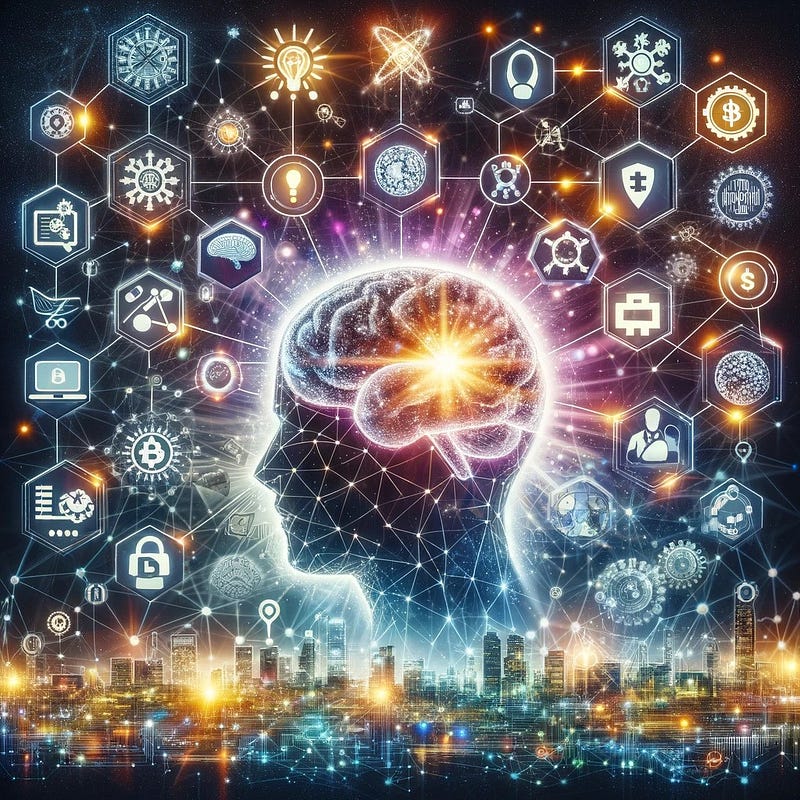
In an era defined by rapid technological advancement, two disruptive forces stand out for their potential to redefine the landscape of modern industries: Artificial Intelligence (AI) and Blockchain.
Individually, each technology boasts capabilities that can significantly enhance operational efficiency, security, and innovation. However, when integrated, AI and Blockchain hold the promise to revolutionize industries far beyond their current trajectory.
This article delves into the symbiotic power of AI and Blockchain, exploring how their combined strength is not just transforming but revolutionizing the way we conduct business, manage data, and secure transactions across various sectors. From financial services to healthcare and beyond, we uncover the transformative impact of these technologies working in tandem, ushering in a new era of digital innovation.
Unpacking AI and Blockchain
The integration of Artificial Intelligence (AI) and Blockchain represents a confluence of two of the most significant technological advances of our time. Each brings its own set of capabilities to the table, driving innovation and security across industries.
AI: Driving Intelligent Solutions
AI is the engine behind today’s most cutting-edge solutions, simulating human intelligence processes by machines, especially computer systems. Its capabilities extend from understanding human speech through natural language processing, recognizing patterns and making predictions with machine learning, to making decisions, solving complex problems, and even enhancing creativity. AI’s power lies in its ability to analyze vast amounts of data, learn from it, and make informed decisions or predictions, thereby driving efficiency, enhancing productivity, and opening new avenues for innovation and personalized services.
Blockchain: Ensuring Security and Transparency
Blockchain technology, on the other hand, is a decentralized ledger that records all transactions across a network. Its hallmark features include immutability, transparency, and security. Once a transaction is recorded on the blockchain, altering it is nearly impossible, ensuring an unparalleled level of data integrity. This decentralization means no single point of failure can compromise the system, offering a robust solution against fraud and cyberattacks. Furthermore, the transparent nature of blockchain allows all parties to view and verify transactions, fostering trust in business operations and data management.
Synergistic Impact on Various Sectors
Financial Services
In the financial services sector, the synergistic impact of AI and Blockchain is redefining security, efficiency, and personalization in ways previously unimaginable. This powerful combination is transforming everything from everyday banking transactions to complex financial operations.
Enhanced Security in Transactions
Blockchain provides an immutable, decentralized ledger for recording transactions, which significantly reduces the risk of fraud and cyberattacks. When combined with AI’s predictive analytics, financial institutions can preemptively identify and prevent fraudulent activities in real-time. AI algorithms analyze patterns in transaction data recorded on the blockchain to detect anomalies that may indicate fraudulent behavior, offering an added layer of security.
Fraud Detection and Risk Assessment
AI’s ability to process and analyze vast amounts of data at high speeds enables more sophisticated risk assessment models. These models, powered by data secured on the blockchain, allow financial institutions to accurately assess the risk profiles of their clients and tailor their services accordingly. The immutable record-keeping of blockchain ensures that the data used for these assessments is accurate and tamper-proof, enhancing the reliability of AI-generated insights.
Personalized Banking Services
The integration of AI and Blockchain facilitates the delivery of personalized banking services. AI algorithms analyze customer data recorded on the blockchain to understand individual preferences, behaviors, and needs. This analysis enables financial institutions to offer customized financial products and advice, improving customer satisfaction and loyalty. Blockchain ensures that all customer data used for personalization is securely managed, maintaining privacy and compliance with data protection regulations.
Healthcare
The healthcare industry stands to benefit immensely from the integration of AI and Blockchain, a synergy that promises to revolutionize patient data management, treatment personalization, and clinical research.
Secure Patient Data Management
Blockchain technology provides a secure, immutable framework for storing patient health records. By decentralizing the storage of data, blockchain ensures that patient information is not only protected against unauthorized access but also made available across various healthcare providers as needed, with patient consent. This level of security and interoperability significantly enhances the management and sharing of health records.
AI complements this by offering advanced data analysis capabilities. It can sift through vast amounts of healthcare data to identify trends, diagnose conditions more accurately, and even predict patient outcomes. When AI analyses are recorded on a blockchain, it not only adds a layer of trust to the data but also ensures that patient privacy is maintained through secure, permissioned access.
Predictive Analytics for Personalized Treatment
AI’s predictive analytics, powered by secure and comprehensive datasets from the blockchain, enable healthcare providers to tailor treatments to individual patients. By analyzing patterns in health records, AI can predict potential health issues before they become serious, allowing for preventative measures to be taken. Personalized treatment plans can be developed based on a patient’s unique health profile, improving outcomes and patient satisfaction.
Streamlined Clinical Trials
Blockchain and AI together streamline the management of clinical trials. Blockchain can securely manage patient consent, trial data, and results, ensuring integrity and compliance. AI can analyze this data to identify suitable candidates for trials, monitor outcomes in real-time, and even predict the efficacy of treatments. This not only speeds up the development of new drugs and treatments but also enhances the reliability of trial results.
Supply Chain Management
The integration of AI and Blockchain within supply chain management heralds a significant transformation, enhancing transparency, efficiency, and security throughout the supply chain. This synergy addresses critical challenges in the industry, from product traceability to counterfeiting and operational inefficiencies.
Improved Transparency and Traceability
Blockchain serves as an immutable ledger, providing a secure and transparent record of every transaction and movement within the supply chain. This visibility ensures that all stakeholders, from manufacturers to end consumers, can trace the journey of a product through its entire lifecycle. Such traceability is crucial for verifying the authenticity of products, particularly in sectors plagued by counterfeiting.
AI complements this by analyzing the data on the blockchain to optimize the flow of goods. By predicting demand patterns, identifying potential bottlenecks, and suggesting optimal routing, AI significantly enhances the efficiency of supply chains. Moreover, AI can automate the detection of discrepancies in the product journey, ensuring compliance and integrity.
Counterfeit Prevention
The combination of AI and Blockchain drastically reduces the risk of counterfeit products entering the supply chain. Blockchain’s transparent record-keeping allows for the verification of product origins and handling, making it nearly impossible for counterfeit goods to be introduced without detection. AI further aids by analyzing transaction patterns for signs of fraudulent activity, providing an additional layer of security.
Logistics Optimization
AI’s predictive capabilities enable smarter inventory management and demand forecasting, reducing waste and ensuring products are available where and when they’re needed. By leveraging blockchain to securely store and share data across the supply chain, AI algorithms can optimize logistics operations in real-time, reducing costs and improving delivery times.
Energy Sector
The energy sector stands at the brink of transformation with the integration of AI and Blockchain, a combination that promises to redefine energy generation, distribution, and consumption. This synergy brings about a new era of efficiency, transparency, and sustainability in energy management.
Efficient Energy Trading
Blockchain technology introduces a decentralized platform for energy trading, enabling peer-to-peer transactions without the need for intermediaries. This not only reduces transaction costs but also allows for more efficient distribution of energy, particularly from renewable sources. By recording transactions on a secure, immutable ledger, blockchain ensures transparency and trust among participants.
AI enhances this ecosystem by optimizing energy trading. Through predictive analytics, AI can forecast energy supply and demand, enabling more accurate pricing and efficient allocation of resources. AI algorithms can also identify the best times to buy or sell energy, maximizing profits for producers and savings for consumers.
Grid Management
The integration of AI and Blockchain revolutionizes grid management by introducing smart grids capable of self-regulation and optimization. Blockchain provides a secure and transparent way to record and validate transactions across the grid, facilitating the integration of renewable energy sources. AI contributes by analyzing data from the grid to predict energy demand, manage load distribution, and detect potential faults before they cause disruptions.
Sustainability Initiatives
The synergy between AI and Blockchain significantly contributes to sustainability in the energy sector. Blockchain’s transparent and secure record-keeping supports the certification of green energy sources, promoting the use of renewables. AI’s predictive capabilities enable more efficient use of energy, reducing waste and minimizing the environmental impact. Together, they provide a powerful tool for managing carbon footprints and advancing towards a more sustainable energy future.
Education
The integration of AI and Blockchain is setting the stage for profound changes in the education sector, offering innovative solutions for credential verification, personalized learning, and secure record-keeping. This synergistic impact is poised to enhance the accessibility, efficiency, and quality of education worldwide.
Credential Verification
Blockchain technology provides a secure and immutable ledger for storing educational credentials, such as degrees and certificates. This decentralized approach ensures that credentials are tamper-proof and easily verifiable, eliminating the risk of fraudulent claims and simplifying the process for employers and educational institutions. AI can further streamline credential verification by automating the validation process, quickly comparing credentials against blockchain records to confirm their authenticity.
Personalized Learning
AI’s ability to analyze vast amounts of data allows for the creation of personalized learning experiences. By understanding a student’s learning style, pace, and preferences, AI can tailor educational content to meet individual needs, enhancing engagement and improving outcomes. Blockchain supports this personalized approach by securely storing learners’ progress and preferences, enabling a consistent and customized learning journey across different platforms and institutions.
Secure Record-Keeping
Blockchain ensures the integrity and security of educational records, from enrollment data to academic progress and beyond. This secure record-keeping builds trust among students, educators, and institutions, facilitating the smooth transfer of credits and recognition of qualifications across borders. AI enhances this ecosystem by providing tools for analyzing educational data, identifying trends, and predicting future learning needs, enabling institutions to adapt and evolve their offerings in line with student demands and industry trends.
Overcoming Challenges Together
The integration of AI and Blockchain brings forth a new wave of technological advancements, yet it also presents unique challenges, including scalability, privacy, and regulatory hurdles. However, by working in tandem, these technologies have the potential to address and overcome these challenges together, paving the way for broader adoption and more effective applications across industries.
Addressing Scalability
One of the main challenges facing both AI and Blockchain is scalability. AI requires significant computational resources, especially for complex data analysis and machine learning tasks. Blockchain networks, particularly those utilizing proof-of-work consensus mechanisms, can suffer from slow transaction speeds and high energy consumption. However, the integration of AI can enhance blockchain scalability by optimizing network algorithms and introducing more efficient consensus mechanisms. Conversely, blockchain can provide a decentralized framework for sharing AI models and datasets, reducing the computational load on individual nodes and enabling more scalable AI solutions.
Enhancing Privacy
Privacy concerns arise with the collection and analysis of large datasets by AI, as well as the transparent nature of blockchain transactions. However, when combined, AI and Blockchain can offer innovative privacy solutions. Blockchain can secure data through encryption and ensure that only authorized parties have access to sensitive information, leveraging smart contracts for automated data access control. AI can enhance privacy by developing algorithms that anonymize data, ensuring that personal information is protected while still providing valuable insights.
Navigating Regulatory Challenges
The rapidly evolving landscapes of AI and Blockchain often outpace regulatory frameworks, leading to legal and compliance uncertainties. However, the combination of AI and Blockchain can assist in navigating these regulatory challenges. Blockchain provides a transparent and immutable record of AI decisions and data transactions, which can help in demonstrating compliance with regulatory requirements. AI, in turn, can be used to monitor and analyze blockchain transactions to ensure adherence to legal standards and automatically report compliance through smart contracts.
Conclusion
The revolutionary synergy of AI and Blockchain is proving to be a formidable force, driving innovation and transforming industries far beyond what was once thought possible. From enhancing the transparency and efficiency of supply chains to personalizing banking services, securing patient data, and optimizing energy distribution, the integration of these technologies addresses complex challenges while opening new avenues for growth, security, and sustainability.
As we’ve explored through various case studies, the combined power of AI and Blockchain not only solves existing problems but also pioneers novel solutions, setting new standards for operational excellence across sectors. While challenges such as scalability, privacy, and regulatory compliance remain, the ongoing evolution of AI and Blockchain technologies presents a promising pathway to overcoming these hurdles, heralding a future where industries operate with unprecedented efficiency, transparency, and trust.
To sum it up, the synergistic impact of AI and Blockchain represents a paradigm shift in how data is managed, decisions are made, and transactions are secured. As industries continue to harness the combined power of these technologies, we stand on the cusp of a new era of digital innovation, one that promises to reshape the global landscape and drive forward a more interconnected, intelligent, and secure world.
Next Steps:
If you are intrigued and would like to understand more about the convergence of these two technologies, Blockchain Smart Solutions offers a 2-hour online workshop, Integrating Blockchain and AI (Artificial Intelligence).
If you agree or disagree with the above opinion, please share your thoughts in the comments section.
Like This Story? Please share and recommend to others.
Like to read more? Click to check out our Medium profile or website’s blog section.
Feeling social? Connect with us via Facebook, LinkedIn, Twitter, and Instagram.


