
Revolutionizing Diagnostics
In April 2020, a team of researchers from the London School of Hygiene & Tropical Medicine (LSHTM), The registered charity Medical Detection Dogs, and Durham University, in the U.K., announced an attractive proposal.
The team wanted to explore the potential of using dogs to detect COVID-19 in people who may have developed the disease. The charity and the universities submitted a proposal for the clinical trial to the UK government.
The idea came from the fact that canines are very adept at picking up on subtle signs of illness due to their acute sense of smell.
“A dog’s incredible sense of smell is thanks to the complex structure of its nose, which contains over 300 million scent receptors, compared to 5 million in a human. This means they have an incredible ability to detect odours, and are the best biosensors known to man which combined with their ability to learn makes them perfect for detection dog.”
Preceding discoveries
Research has shown our canine friends can detect the odour of disease with high levels of accuracy. British charity Medical Detection Dogs and researchers found that dogs are capable of “sniffing out” infectious diseases like certain cancers and malaria.
Patients with diabetes also use dogs to detect when their blood sugar levels are dangerously high or low. The charity Hypo Hounds trains dogs to smell changes on their owner’s breath or in their sweat. The pets can even detect a problem earlier than a glucose monitor.
Countries other than the U.K are also carrying out similar research, including in France where trials began in Corsica to re-train rescue and fire brigade sniffer dogs to detect the coronavirus by teaching them to associate the smell of swabs taken from Covid-19 patients with their favourite toys.
Proposal accepted and funded by the UK Government
UK government has funded £500,000 on trial for training dogs to sniff out the coronavirus before symptoms appear in humans
The first stage of the research will have odour samples collected from coronavirus patients in London hospitals. Six specialist dogs will then undergo training to identify the virus from the samples.
Claire Guest, the co-founder and CEO of Medical Detection Dogs, said: “We are delighted that the government has given us the opportunity to demonstrate that dogs can play a role in the fight against Covid-19. They have the potential to help by quickly screening people, which could be vital in the future.We are sure our dogs will be able to find the odour of Covid-19 and we will then move into a second phase to test them in live situations, following which we hope to work with other agencies to train more dogs for deployment. We are incredibly proud that a dog’s nose could once again save many lives.”
The process
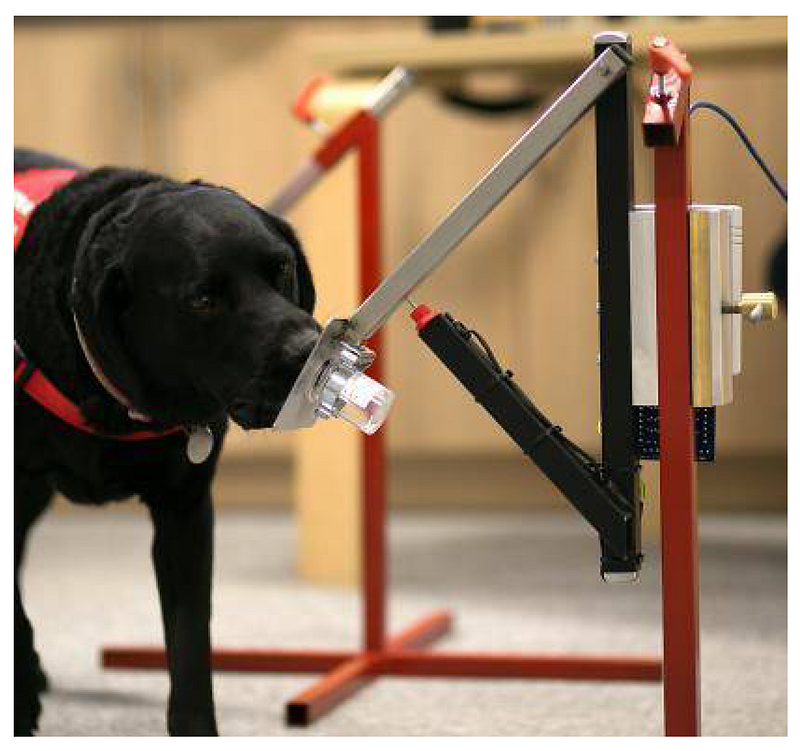
The odour samples of coronavirus are collected and put on to metal stands along with other scents from people who aren’t infected with the virus.
When the dog can tell the odour is from an infected person it is given a treat.
By being rewarded every time, the canine learns to associate that specific smell with a treat so it will sniff it out again.
The goal is to train the dogs to identify individuals who might have the virus but are asymptomatic thus reducing the burden on testing resources.
The potential impact of these dogs and their capacity to detect COVID-19 could be substantial, This study will harness the dog’s extraordinary ability to support the nation’s COVID-19 surveillance systems, with the goal of reducing community spread.
The COVID dogs are in early-stage training so are not yet working with COVID-19 samples.
Hope
It is hoped to have early data on whether COVID-19 has an odour that the dogs can detect within 2 to 3 weeks of samples arriving at the Medical Detection Dogs training centre and in the following 6 to 8 weeks they will establish the dogs’ sensitivity and specificity over large sample size.
It is expected to move from testing on samples to practical testing of the passive screening ability of dogs in no more than 3 months from the start of the project. They will be working with potential deployment partners shortly after that so that ‘in theatre’ testing can be done alongside those who would help scale up the capacity of detector dogs needed. This could mean detector dogs deployed in under 6 months.
This is definitely revolutionizing advancement in COVID detection but how it will affect Man's best friend is a totally different story.
Source: https://www.medicaldetectiondogs.org.uk/covid-19-dogs/