
Revolutionary Exhibition Texts at the Museum of Fine Arts, Boston
How much thought do you give to the wall labels when you go to a museum?
During a recent trip to the Museum of Fine Arts, Boston I spent just as much time looking at the wall labels as I did at the works of art — maybe even more in some places. The MFA has a world-class collection of artworks and historical artifacts but they also have a world-class team of curators, researchers, educators, communicators, exhibition designers, and more. Let’s look at a handful of exhibition texts that are clever, thought-provoking, and demonstrate some of the directions that exhibition design is heading towards.
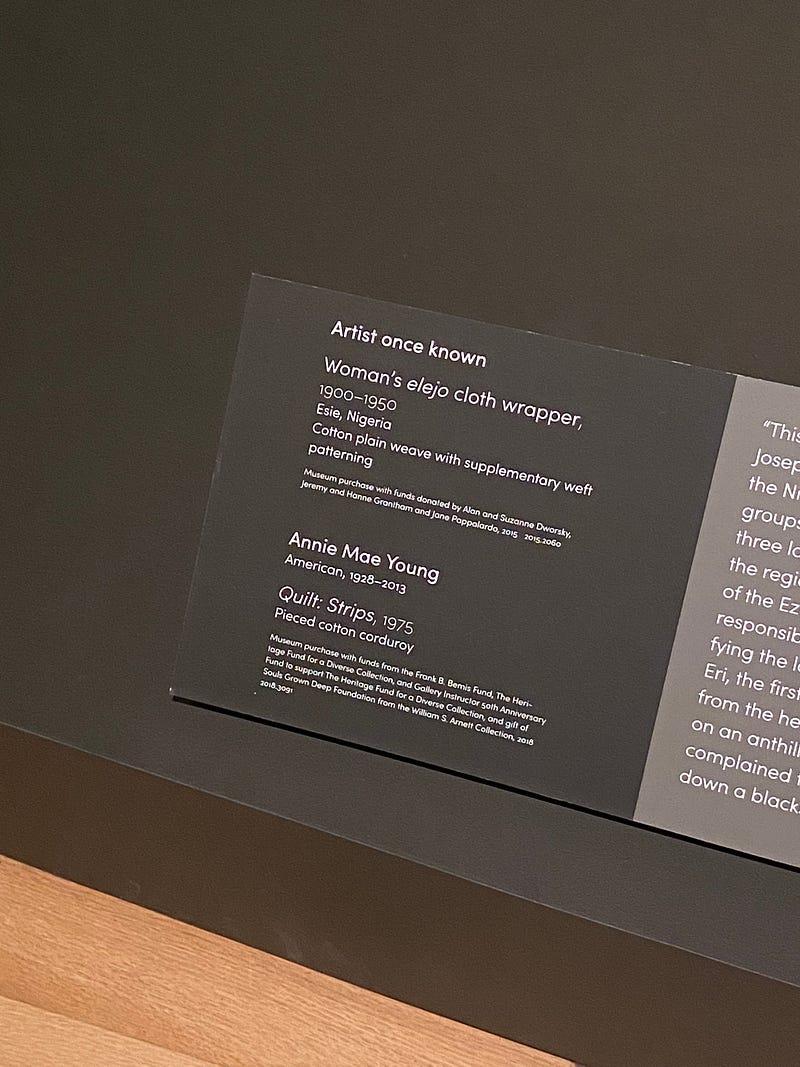
Artist Once Known: This label was in the exhibition New Light: Encounters and Connections, a special exhibition of artworks from all over the MFA placed into interesting cross-period dialogues. The word choice on the label of a 20th century elejo cloth wrapper from Nigeria reminds us that “anonymous” artists were people with their own lives, identities, priorities, families, and communities.
I am by no means advocating that all museums change their labels to say “Artist once known,” nor do I necessarily think that this was the curator’s intention. But in this case it was surprising enough to catch my eye and make me think about what kind of community this artist may have had, and what role their work would have had in that community. On a day when I read probably hundreds of wall labels, it was a refreshing change of pace.
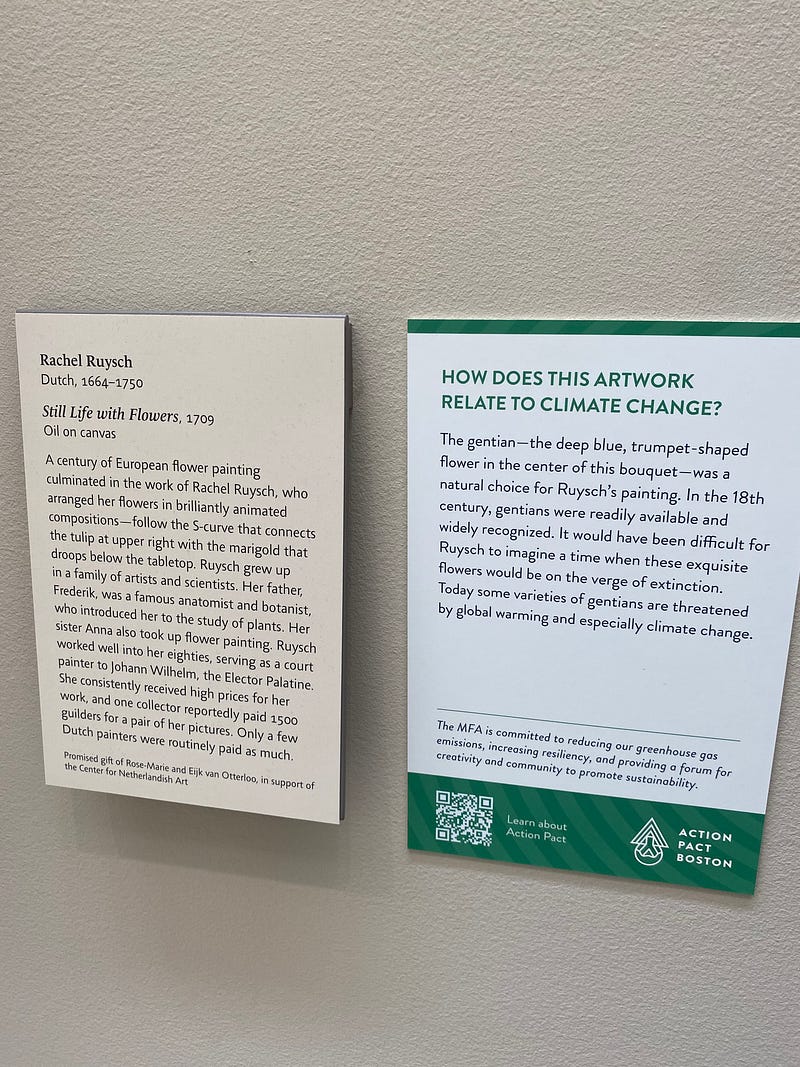
How does this artwork relate to climate change? This label accompanied Still Life with Flowers by Dutch painter Rachel Ruysch. During an era when the art world is increasingly under scrutiny for their complicity in climate change (whether that be from shipping artworks all around the world for special exhibitions, or accepting donations from fossil fuel companies), it is refreshing to see a museum make a statement about their values and intentions. It is also helpful for the museum to point out which of the flowers in the painting are on the verge of extinction, reminding the viewer of the different climates of the eighteenth century and today and perhaps drawing their attention to the artwork more closely.
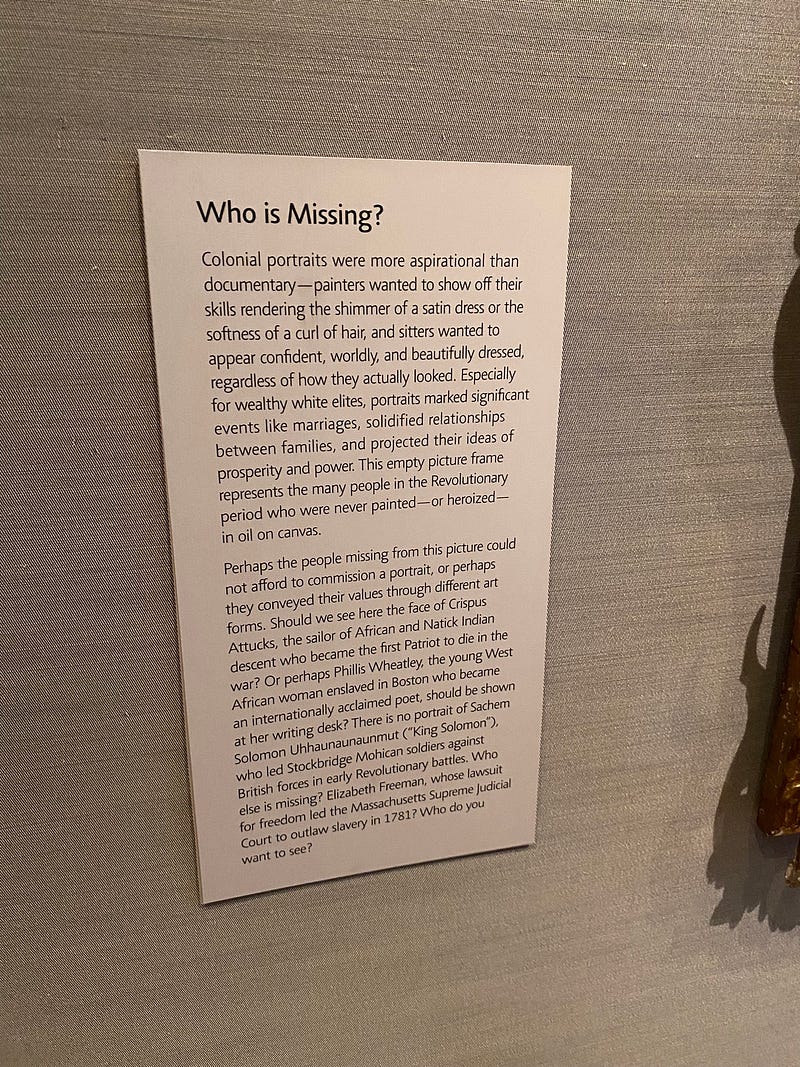
Who Is Missing? The Museum of Fine Art’s colonial portrait gallery contains an empty frame (oddly reminiscent of the empty frames at the nearby Isabella Stewart Gardner Museum, though obviously under much different circumstances) to commemorate those individuals not traditionally represented in portraiture. Since portraits have an enormous impact on how we perceive the “average” people of a particular time, it is useful to remind ourselves that they actually represent a fairly narrow class of person. The end of the label also lists a number of historical figures that the audience may be interested in learning more about, and I for one looked up some that I was less familiar with after reading this label. I am sure that I am not the only one.
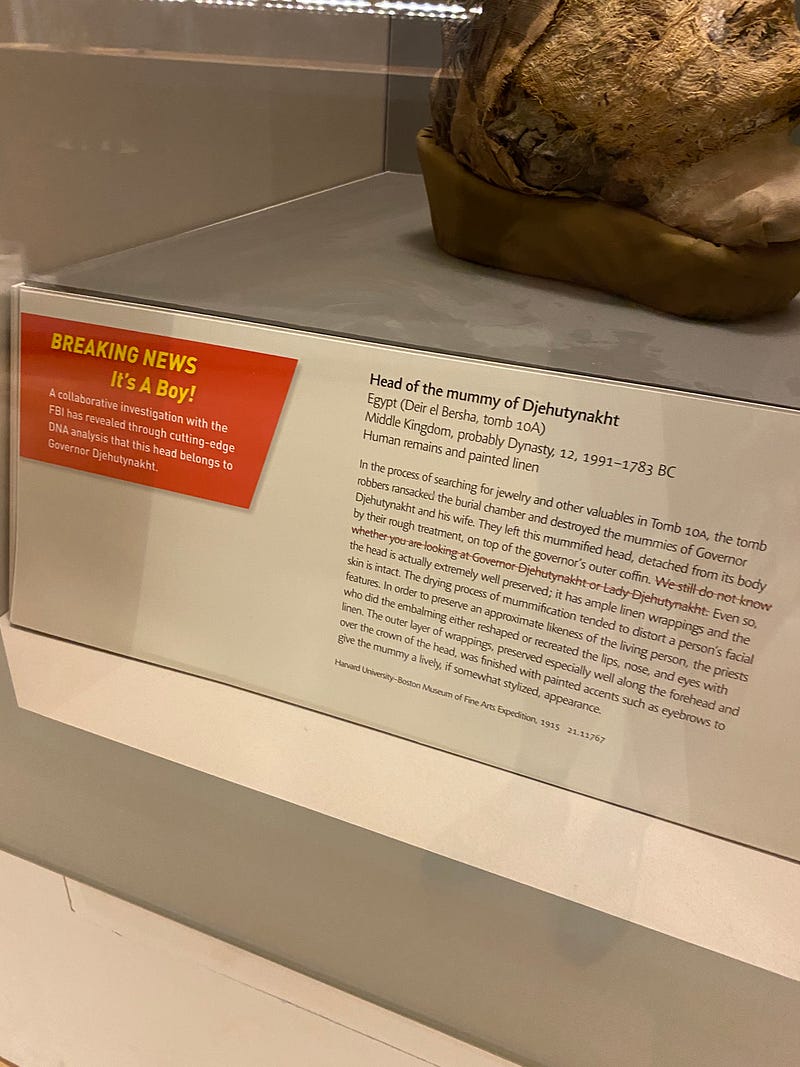
Breaking News: It’s a Boy! Displaying mummies in museums is far from uncontroversial, but it is undeniable that there is a lot we can learn from them. In this case rather than just replacing the label, the museum updated it with a new banner discussing the gender of the mummy and crossed out the previous line about how the mummy’s sex was uncertain. This approach of updating rather than replacing the label reminds the viewer that the world of historical research is constantly changing and that museums learn new things about their collections all the time.
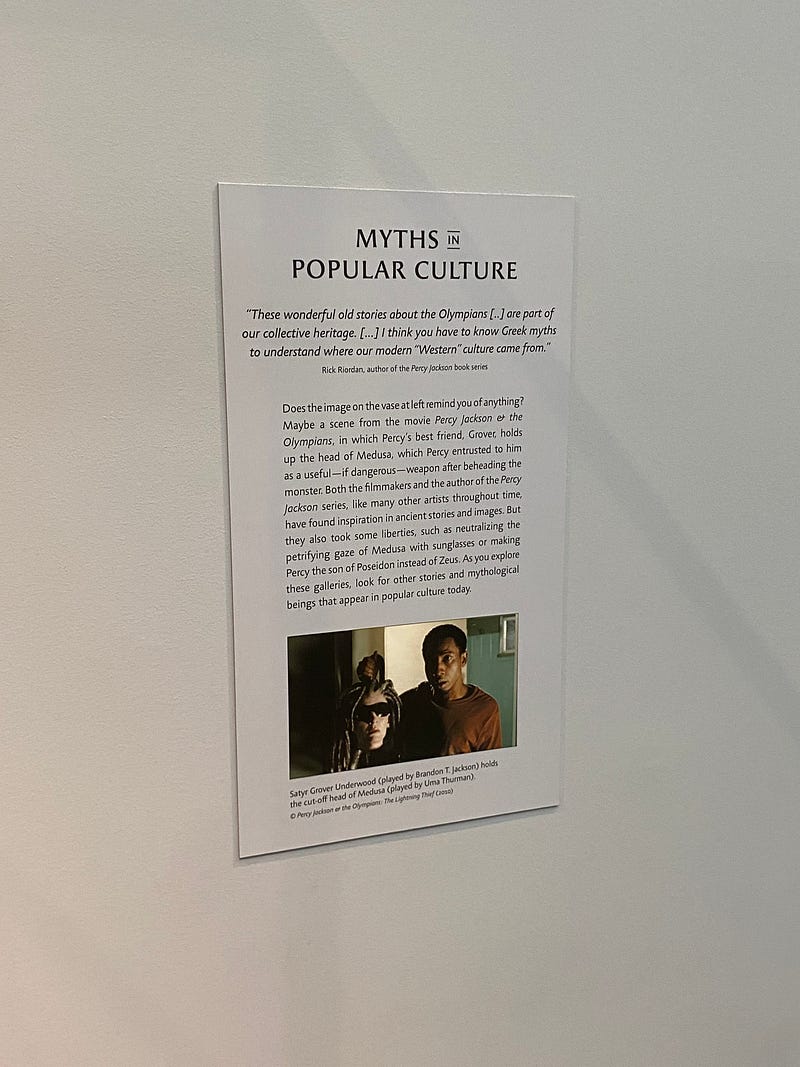
Myths in Popular Culture: Museum audiences are more likely to first encounter mythological stories through popular media than they are to encounter it through academic books. This label features a still frame from Percy Jackson & the Olympians, a film from 2010 featuring versions of Greek gods and goddesses. For visitors already familiar with the film (and accompanying book series) it can be helpful to connect real history with previous knowledge from the film, and for others it can be a helpful reminder of the enduring power of these stories.
Side note: A professor of mine in graduate school told me that there has been a huge difference in how he approaches teaching Christian paintings in the 2020s compared to at the start of his career in the 1980s. Since now most of his students are not raised Christians, they don’t know these stories by heart and he has to spend more time teaching them. It may someday be the case that we will have to explain Christian mythology through pop-culture comparison, the same as Greek mythology.
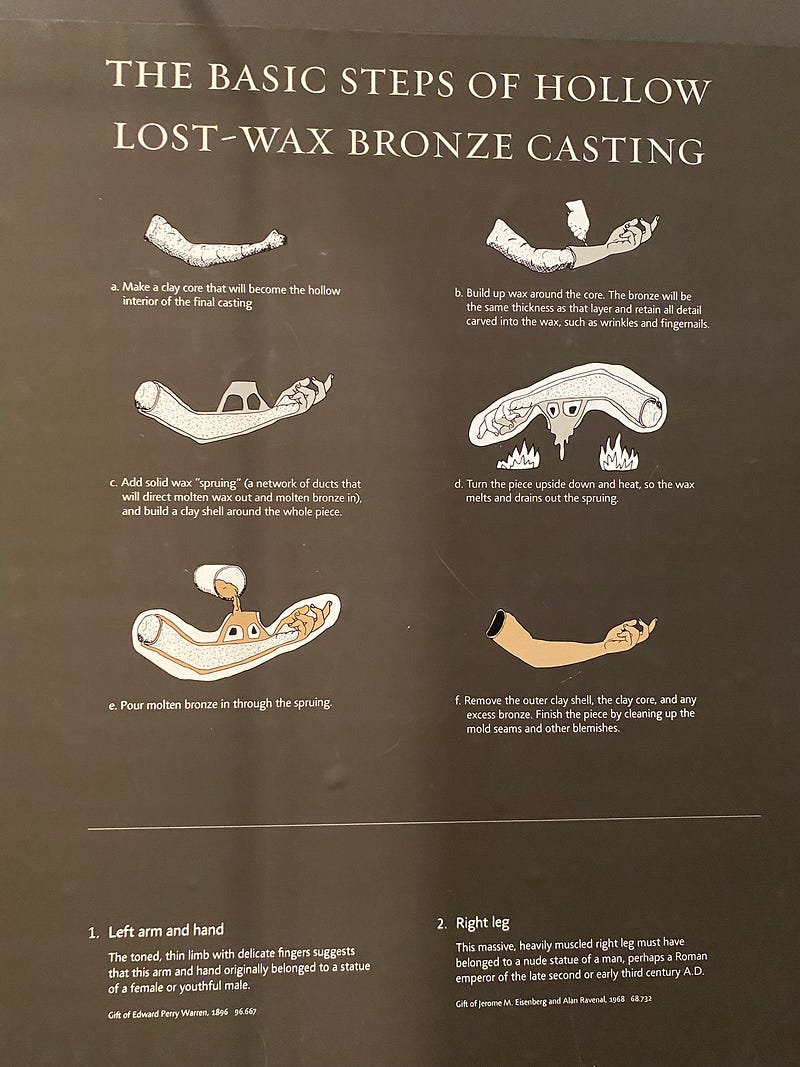
The Basic Steps of Hollow Lost-Wax Bronze Casting: In a museum setting with dozens of works of bronze sculpture, it can be difficult to imagine just how these marvelous works of art were created. This label explains the technique with helpful diagrams. It was certainly a more clear diagram than the one I received in my Greek Art History course in undergrad!
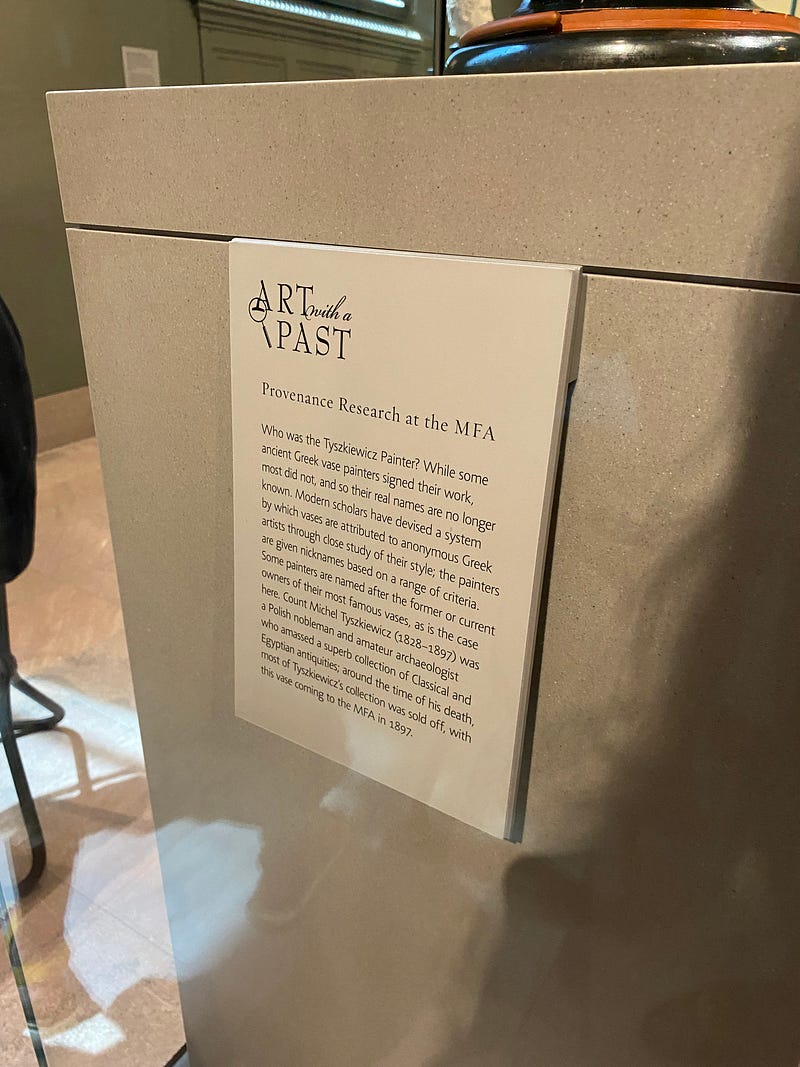
Art with a Past: Provenance Research at the MFA: Art provenance is a hot-button issue these days, especially with so much scrutiny on unscrupulous art dealers and the looting of antiquities. Just think about the uproar caused by the Greek government regarding the Parthenon marbles at the British Museum! In this label the MFA Boston discusses not just where the artwork came from, but also how it came to be in the museum’s collection. This sort of label is great for accountability, of course, but also hopefully will make visitors ask similar questions about how the other works entered the museum’s collection.
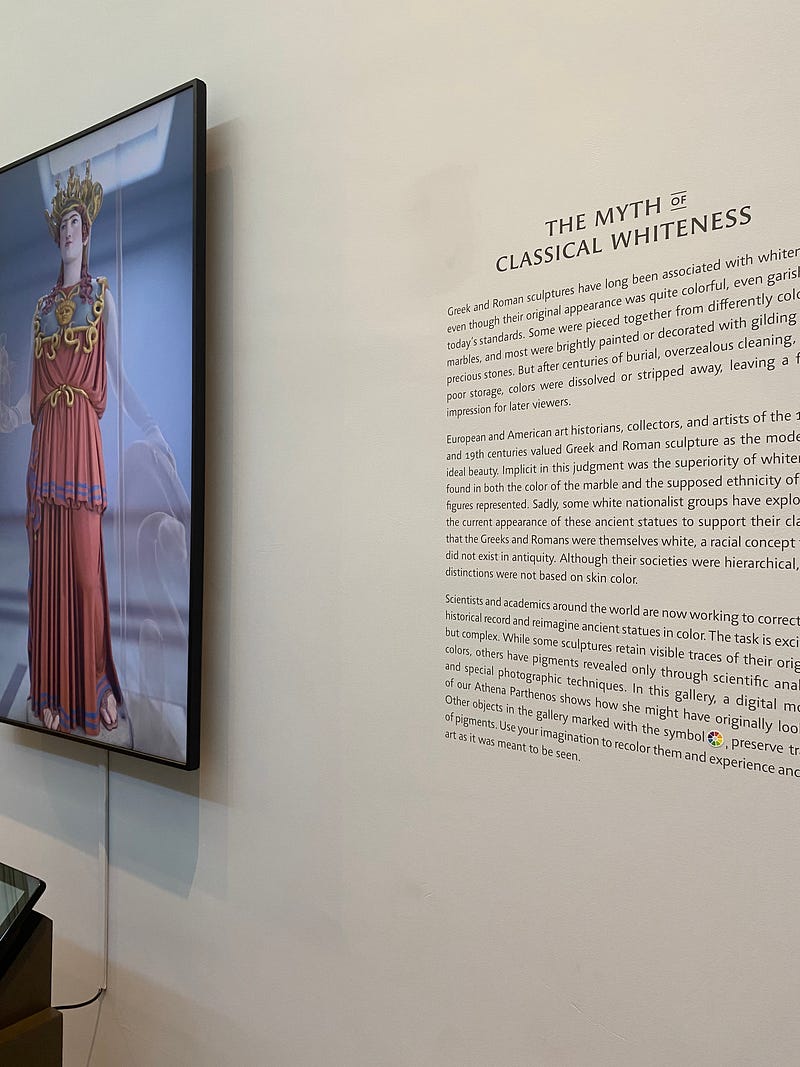
The Myth of Classical Whiteness: Many art lovers have no idea that the sculptures from Greece and Rome that are so beloved today were not always white marble — they were brightly painted! This label accompanied a marble sculpture of Athena Parthenos which has trace quantities of pigment. The screen to the left shows the sculpture with a model of how she may originally have been painted, while a smaller screen below that plays a video showing the process for determining the colors. The label also addresses where the myth of classical whiteness came from and its current political implications, especially as the idea of white marble sculptures has been visually co-opted by white supremacists.
These labels show interesting, thoughtful exhibition design meant to engage the audience, to teach, and to spark discussion. I certainly hope to see more in this vein in my local museums.