
Memoir
Revisiting the San Bernardino Valley College Cadaver
The starting point at which biographies end and fiction begins
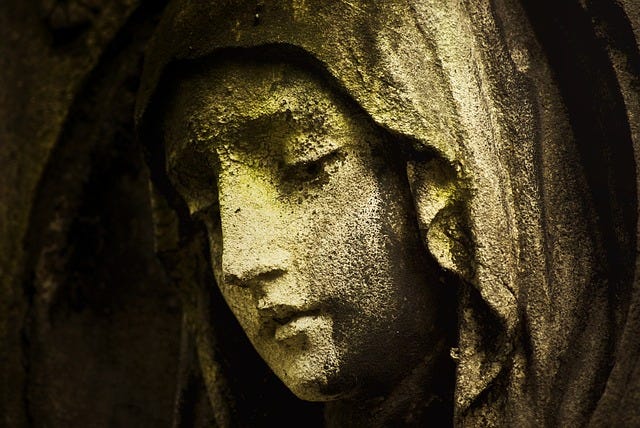
cw: this piece includes disturbing details about death.
Aside from a few beloved coffined family members and one carved cadaver on loan to San Bernardino Valley College biology class back in May of ’65, life has coddled me, her itinerant son, from more than a glimmer along the rim of that shadowy side. If she’d been less miserly, I’d have had something to learn from it all.
All I had were mere glimpses into the long ebony stretch that follows the last gasp and elaborate sigh.
Peering down onto the satin-framed, waxy features of my mother, lopped from life’s vine at a scant twenty-five years older than the baffled young man who stood there beside her coffin, over-aware of the line of mourners that strung behind him. The minister had called her Clara. The spoken name seemed odd. Those two syllables, Clair-ruh, did not synchronize with our shared history. His Clara was not one who had absorbed the poison of cancer’s barb, had let it wither her from within.
Yet Mother had. Mother did.
I think I have something to confess to you, Mother. Let me do it before I lose heart ….
You know … I can’t count how many times I’ve plunged my hands into the sacrosanct flow of biography and plucked out a handy little memory that I could then mold into the inner measurements of the story I needed to tell.
We all do it over here, Mother!
Even when we mask our fiction as memoir.
But you must let me confess before I weaken. I’m so embarrassed to tell you this, but you know … Mama, I can’t remember the color of your eyes. Why can’t I remember the color of your eyes? I know I’ve painted them brown in one story, blue in another, with such casual disregard. You know, it’s funny, really … I can recall how the skin around them went, over time, from firm to crinkly — I remember that — but the discs themselves are a bland gray fog in my mind. Where does truth reside? Mama, where?
I suppose I’ve grown to accept it — there is no more flagrant band of thieves than my step-family of writers! Take this as evidence: recently, I published a story of one small slice of my life in the 50s, and while the broad brush stroke of it was true, in a Van Gogh sort of way, that is, meaning the heart of it remained inviolate, certain laws of engagement demanded a whittling down and reshaping of parts from what was an uninterrupted piece, however flawed, of its raw history. I take responsibility for being that whittler.
This — as truly as I can remember it — is that actual scene, unenhanced:
At fifteen, alone with my mother in the kitchen, I broke her heart.
With knuckles pressed to my hips, and through an adolescent glare, I told her to butt out of my life.
I had just come back from a matinee showing of James Dean’s “Rebel Without a Cause” and she chose that moment, there in the kitchen, to confess that she was worried about me. She thought I had an inferiority complex when it came to girls. This shed worker, this potato sorter, this carrot topper, home for her lunch break, freckles of mud on her arms and forehead, her eyeglasses streaked, took a hurried drag from her Raleigh and then she told me that she feared I had an inferiority complex, that I was afraid of girls.
When I told her to butt out of my life, it was James Dean’s words that spewed from me. I wore his unzipped red nylon jacket, turned up at the collar, and leaned my frame toward her, and James Dean spoke those words with all the angst that was in him … but it was I who watched Mom’s face collapse. As James Dean’s words followed their loop in my brain, how I wished her arm would have blurred up from her side and her palm caught me squarely on my cheek!
But none of that happened.
Behind her smeared lenses, her eyes filled. She blinked two slow silver trails down either side of her nose. Pushing past me, she left through the back door of the adjoining laundry room, hauling a laundry basket of linens with her.
Through the kitchen window, I watched her snap a towel, drape it over the clothesline, attach clothespins at either end, and then reach for another towel. Once, she swept her fingertips under one lens, lifting that side of her frames comically so that if she hadn’t removed her fingers at that moment her glasses would have fallen.
And all of this … my confession and an attempt at making small corrections in the narrative of my memories came as a result of the broader memory of looking down into my mother’s casket on June 22, 1968.
Add roughly thirty years to the formula, and you’d find me puzzling, this time over the emaciated and wizened features of my father, in his casket, looking removed and distant from me, as though a historical link had been magically skipped and I was looking down instead on my grandfather — though roughly the same twenty-five years separated each father from each son. My dead father had aged and yet I remained as young as when I looked down on my mother.
While I will always cherish the living memories I have of my mother and father, and my words will never stop breathing life back into them, I’m offering you now this story of a college-housed cadaver, and I present it with a deep bow and special thanks to the State of California-funded Traveling Road Show. (This last part I tossed in when I felt the weight of the sentence getting thrown out of balance with the mention of the biology cadaver, and so I thought I’d inject a little humor.
I figured I’d yank that offending part out later, except that that wouldn’t solve the problem of the growing weight in the sentence. Besides, when a corpse outlives its welcome in one venue, it does need to be transported to the next. And there has to be some sort of government sanction and control over that. I mean, you can’t have all these corpses in their refrigerated vans crisscrossing each other throughout the state without the government acting at least in the capacity of a traffic cop. Anyway, the more I thought about sentences and syntax and weight, and the cause of the problem which was, after all, the cadaver, the more this personal story of that cadaver took on a life of its own.)
And so I must include it here.
My own singular memories, which are the greater part of “life” to me … right now, as my writer’s mind addresses them, appear to have also coddled me from even too close an inspection of the actual cadaver I need to write about. That is, I can remember standing alongside others in my class, staring down at the graying cadaver. And that’s about all. It’s hard for me to select now from what was true memory and keep that sacred and separate from my writer’s mind’s invention.
The brain’s function, it appears, is to despise gaps, so it rushes in to fill those gaps with plausible connections and transitions consistent with its owner’s experience and the deeper, sludgier movement of ancestral urgings. Well … that plays right into the writer’s hand, now doesn’t it? Our success as writers, fiction and nonfiction alike, depends on our deftness in manipulating what few scraps of actual memory we have into an apparently congruent reality.
That makes the best writers the most effective liars — and the greatest of the best are psychopaths, masters of the worldview of fictional reality, but removed from what is actual and casual and connected.
The cadaver’s gender was in view. I remember that. It is the clearest of the scraps of memory. But why wouldn’t it be? Don’t we all possess a hardwired need to know those sorts of things?
I’ll call her Mary. And with that, the seed of the lie embedded in the truth begins:
A one-foot square of Mary’s chest cavity had been opened, probably twenty years earlier at the start of her tour, the skin flap left to hang back from its seam and flatten to her side. (And even with that, my writer’s mind grapples with reality … and my fear of the reader. Would the skin flap have flattened to her side like that? What of the little mound of breastmeat — that once supple, but now toughened and shrunken protuberance — wouldn’t that spoil the symmetry of a perfectly square flap in my reader’s mind? Wouldn’t portions of the flap be rippled to accommodate the obstruction?)
I doubt that I wondered then, but I’m wondering now, did Mary possess any rudimentary sort of awareness, circa May 1965, maybe even a tingle of naughtiness, as her spiritual eyes peered up through sewn, leathered lids, up past the glass that encased her, up to the living eyes that ogled down at her, our thoughts behind our eyes feeling uncomfortably, I don’t know, impermanent, with some of us experiencing for the first time in that green-sapped moment the sharp realization of our own mortality?
I’m wondering: was Mary, now, fulfilling the purpose of her life? Daily? As her plexiglass sarcophagus is wheeled from San Bernardino Valley College to her state-funded bus, en route to Chaffey College in Rancho Cucamonga, there to expose herself to a fresh set of young eyes — the writer in me wonders about Mary. The writer in me can’t stop inventing ….
Who was she? That is obviously not a hypothetical question, for what mother, daughter, sister, even aunt, once or twice removed, would have sanctioned such a tour? The same with her male bloodline. Same with her spouse, if she had one. No, our Mary needed to have been without any connection to a loved one. Until this writer came along, no one knew her name. Or, if they did, no one was inclined to use it with any caring or affection. At least that was what the living Mary must have been feeling as this writer eavesdropped on her, lying atop her bed in the Shady Eight motel room in, let’s call it, Flagstaff Arizona.
I don’t know why I should feel such a strong need to assure you, the reader, that my eavesdropping was honorable. But it was. I watched her with about the same disinterest as I — or any of my companions would have — twenty years later, in San Bernardino Valley College. Mary had not been an alluring corpse in May of 1965. Nor was her live version in March of 1945, sprawled here on her back on the bed at the Shady Eight motel, in Flagstaff, Arizona, sucking in a full, gray lungful of smoke from her Chesterfield, dangling now between middle and index fingers of a limp very white hand and chipped nails.
I’m going to leave Mary here. This could have the makings of a decent story. I know it could, but it won’t be by me. I already know too much about her — and the only end her story could possibly have.