
Revisiting the Lost Art of Civil Discourse in a Polarized World
The echo chamber problem and the quest for diverse voices in a new Boost publication
In 1992, I campaigned for George H. W. Bush to win the presidency. Not legally, mind you, as I was in 5th grade, but my classroom had been assigned a project revolving around debate to demonstrate how the American democratic system worked. I chose Bush, not because I aligned with his values necessarily, but because I had grown up in Oklahoma—a deeply red state. But I also didn’t mind Bill Clinton or the scrappy independent in the race, Ross Perot. My teacher was the adamant Perot fan, and some of the kids in my class made the case for Clinton. In all, it was a fun project where we got to poke a little fun at each other and make a case for our candidates. When the actual election ended, and Bill Clinton was determined as the President of the United States on Election Day, no one was upset. Not even my parents. A little disappointed that our candidate didn’t win? Sure. But everyone went about their lives, certain the country would continue running itself, and that Clinton wanted to ensure American economics and prosperity.
Those days, essentially, are over.
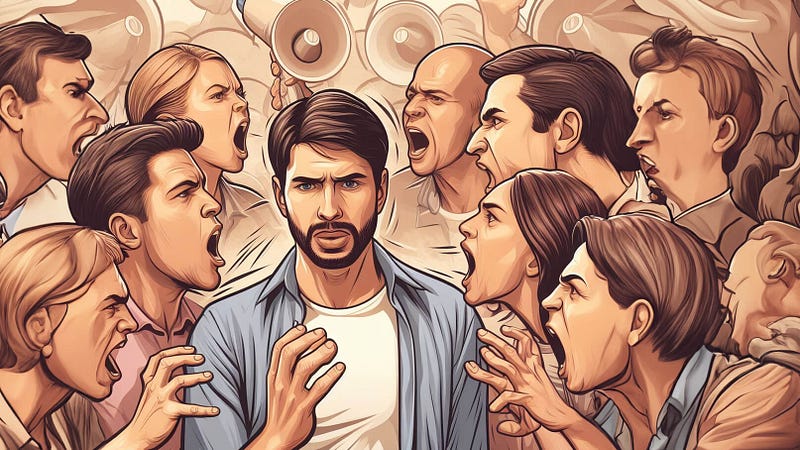
If I told you I loved Donald J. Trump or that Joe Biden hung the moon, the chances of a personal attack on my character would run high. I could be a bigot, sexist, socialist, or any manner of name-calling necessary to invalidate a viewpoint. If I told you I love guns, was pro-life, and was concerned about trans athletes in sports, I would invite the peanut gallery. Were I to tell you social programs are vital, LGBTQ individuals have inalienable rights, and that certain people groups are very much targeted and oppressed, then the opposite end of the peanut gallery would appear en force as well. Nuance, logic, and debate are merely tossed out the window for ideological demagoguery.
However, in times past, there were men like G.K. Chesterton — a writer, Christian apologist, literary critic, and philosopher — who had a close friendship with George Bernard Shaw — a secular humanist, fellow writer, polemicist, and political activist. The two would often engage in friendly, public debate despite having polar opposite views, never letting it come between their friendship.
So why don’t we have this type of discourse anymore?
The left-wing echo chamber and the rise of a new publication
It may — or may not — surprise you that some see Medium as a far left, liberal echo chamber. Given that they want to promote curiosity and explore multiple topics from nuanced and insightful writers, having any form of an echo chamber would be against their mission and values. Myself and another writer, the Argumentative Penguin, met with a Medium staff member to discuss our thoughts on whether we found this claim viable or factual.
We did.
Over the years, voices of dissent against groupthink or — gasp !— conservative writers were (at best) ignored or (at worst) reported for their content. You don’t win people to your point of view by shouting them down or name-calling, but it happened, and pushed opposite viewpoints off the platform or to the fringes. Christian writers (which anyone who knows my work knows I often discuss) have repeatedly approached Medium stating there appears to be a negative slant toward anything “Christian” written on the platform. In fairness to Medium and those writers, some of this is true as the algorithm tends to skew towards articles with a negative slant, but Medium has worked hard to promote insightful content that isn’t just “Christians are bigots and assholes.”
When myself and the Argumentative Penguin met to discuss what we found troubling on Medium, we discovered that we both value logic, reason, debate, candor, and kindness. Between the both of us, we hold backgrounds in mental health, education, geopolitics, the military, philosophy, and theology. We have differing viewpoints but find each other’s work insightful even if we vehemently disagree. Despite our differences, we’ve become concerned that certain rhetoric is taking a front and center stage on the platform that doesn’t allow insightful debate or — worse — helps people grow sicker together as they build tribes of despair.
Naturally, we could remain quiet, sulk around, and act like hypocrites as we did nothing to further insightful conversations with readers and writers. Or we could take up the challenge Medium asked us to consider — create a publication that values insightful content and debate in a respectful tone. Allow voices of dissent and differing opinions from thought leaders and gifted writers. We have chosen the latter and have since created The Panopticon—a nod to seeing things from all angles.
Who we’re looking for
The Panopticon will be invite-only and is also part of the Boost Program. We’re not looking for ideologically slanted writers (per se. We realize this will be inevitable), but authors who value nuance and aren’t easily offended by differing thought processes, views, or ideas outside their own. You’ll need to be able to write clearly and concisely. Grammatical rules are a must, and you should acquaint yourself with writing styles because we’re not looking to overhaul an article you’ve written.
If you don’t know how to tell stories or engage an audience, we’re probably not the place for you. Wanna rant? Not on this publication. Endorse pop psychology where everyone’s a narcissist and toxic? Sorry, not our flavor. Pander to a group? No thanks. We want people of different religions, sexuality, political beliefs, backgrounds, and style to take on hard topics but do so in a manner that makes you go, “huh.”
Will we inevitably piss people off? Without a doubt. I’m certain some might even be offended reading this, but as F. Scott Fitzgerald famously wrote: “The test of a first-rate intelligence is the ability to hold two opposing ideas in mind at the same time and still retain the ability to function. One should, for example, be able to see that things are hopeless yet be determined to make them otherwise.” To that end, this is our mission.
So, interested in becoming a writer for us? Tag us in an article or with the tag “Panopticon.” We’ll review your article, and if we think you’re a fit, you’ll get an invite, and we’ll contact you directly. If it’s really good? We’ll try and boost your article too.
We hope to inspire, encourage, and live out Medium’s values where we foster curiosity, go deep on good ideas, and allow fresh thinking to permeate our articles.
— The Argumentative Penguin & Benjamin Sledge