

Revisiting the Gateways
Are Major Cities Actually Immigrant Gateways?
There’s a strange of reasoning about immigrant, cities, and domestic migration that views the typical domestic-international linkage as being essentially that immigrants arrive in cities at high rates, then disperse elsewhere. Thus, cities of first arrival form “gateways” through which immigrants pass before entering the wider American population. This theory is particularly handy, as it is sometimes trotted out to explain why Los Angeles, Chicago, or New York City are, in fact, Really Awesome, but have low domestic net migration: it’s just all those immigrants we keep integrating on behalf of the rest of the nation! It’s a neat story.
While the idealized story of urban immigrant gateways may have been true in the past, at least as of 2009–2014, it is deeply flawed.
For exhibit A of the excessive reliance on a “gateway” view of immigrants and cities, you can look at the recent Brookings Institution report on the distribution of the foreign-born population.
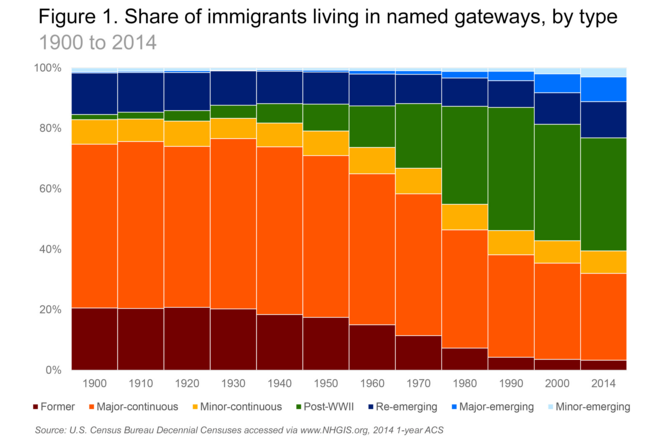
Audrey Singer in this report doesn’t just give us a lot of talk about “gateways,” but offers no less than 7 different types of gateways. You’d think, for all that, there would actually be some kind of investigation of whether immigrants really do actually pass through the gateway. Spoiler: no such research appears evident (if I’ve missed something from Brookings, please don’t hesitate to correct me!).
Okay. So we’ve got all these gateways. What’s the actual story in the data?

What Makes a Gateway?
High Immigration, High Domestic Outflows of Foreigners
By my calculation, when we restrict to cities with over 500,000 people, there are not in fact 57 immigrant “gateways” as Brookings claims. There are actually about 28 or so, depending on how exactly you define the relevant immigrant population. Stark drop, eh? So how can Brookings say there are tons of gateway cities, when I say there are so few?
The answer is we define gateways different. Brookings essentially says a gateway city is any city with fairly high immigration and a growing foreign-born population. But that’s absolutely ridiculous. To be a “gateway” we need high inflows of the foreign-born, and high outflows. In fact, a rapidly-growing foreign-born population could reflect that a city is not an effective gateway, if immigrants never move out of the city. The foreign-born population could also be impacted by domestic inflows and outflows, as well as differences in mortality rates. All of this is a way to say: the foreign-born share of the population is an awful way to determine if a city is in fact a “gateway.” That it is a very standard method widely used by many experts does not make it less egregiously irrational to use it as the relevant yardstick.
A city’s population becoming more foreign-dominated does not inherently make it a gateway.
The appropriate measure of a gateway city has two key components:
- A measure of immigrant arrivals
- A measure of immigration dispersion beyond the city
We should define a city as a “gateway” based on whether it is(1) of significant size, (2) receives lots of immigrants, and (3) disperses those immigrants to the nation on the whole. This is the “classic” case of the gateway city, as exemplified by many urban centers in the 19th and early 20th centuries. If researchers and commentators want to summon up an image of historical continuity between current migration patterns and the past (as is fairly clearly the goal, a goal I’m obviously in favor of), they need to define their terms in a meaningful way.
For my own estimates, I restrict myself to metro areas with over 500,000 total residents. That is what Brookings does too. That cover the “of significant size” base.
For my immigration or “arrivals” metric, I will use the annual average number of inflows by foreign-born non-U.S.-citizens from 2009–2014, divided by the average foreign-born population (both citizens and non-citizens). In my view, international arrivals of foreign-born U.S. citizens are not extremely interesting from an “integration” or “gateway” perspective because, heck, these people are already citizens! However, even naturalized foreign-born citizens seem relevant for the total foreign-born population, as they are likely to be culturally, relationally, and economically connected to non-citizens and non-citizen communities, ergo, they’re still relevant from an integration perspective. For a sense of scale, this number ranges from 6.9% in Durham-Chapel Hill, to 1% in Stockton, California. To make sure I’m not picking up tons of extraneous results, I boot out any cities for which non-citizen inflows are below 1/2 the average rate as a percent of total population (i.e. places where inflows are large compared to a very small foreign-born population), and also toss out any city with less than 0.1% (or especially negative) total net international migration, again, in order to make sure I’m not falsely labeling low-immigration cities as “gateways.”
For my outflows to the rest of the country or “dispersals” measure, it gets a bit tricky. There are so many options. Should we use the net flows? On face value, that makes sense, but when we think more, it falls apart: having high domestic inflows, i.e. higher net migration, doesn’t mean a place isn’t a gateway: there could still be high outflows, just not as high. So what we really want is just outflows of all the foreign-born, as a percent of the foreign-born population. But what kind of outflows do we want? All outflows? Interstate outflows? Only outflows beyond the metro area?
I go with all inter-county migrations. I know some people will disagree and suggest I should use all intermetro migrations or all interstate. But I suggest even within-metro intercounty moves are meaningful, as they (1) tend to be suburbanizing moves, which are themselves a kind of “separate polity” from the urban cores where immigrants often settle and (2) reflect major life transitions that may be associated with integration. For what it’s worth, swapping to all intermetro or extrametro moves doesn’t change the results all that much. My dispersals metric ranges from 8.9% in Durham-Chapel Hill to 1.9% in McAllen-Edinburg-Mission, Texas.
The low immigration cities I tossed out are as follows: Augusta, GA; Birmingham, AL; Boise City, ID; Charleston, SC; Chattanooga, TN; Daytona Beach, FL; Jackson, MS; Knoxville, TN; Little Rock, AR; Memphis, TN; Ogden, UT; Pittsburgh, PA; Spokane, WA; St. Louis, MO; Toledo, OH; Tulsa, OK; Winston-Salem, NC; and Youngstown, OH. That leaves me with 84 cities with over 500,000 residents that I cannot reject outright as candidates for “gateway” status.
Now for the record, Brookings does view some of these cities as “gateways.” Pittsburgh and St. Louis, for example, are “former gateways,” which actually sounds about right. But it seems a bit misleading, since, now, Pittsburgh and St. Louis have very low immigration. Today, they aren’t really any kind of gateway. They are “formerly,” which is to say, not gateway. So we ought to just stop calling them gateways. Nobody is coming through those gates anymore.

How Busy Is The Gate?
Absolute or Relative Standards of Gateway-ness
Now we get to the trickier part. How high must arrivals and dispersals be to classify as a “gateway”? If I was building a time series, I’d try to come up with some absolute threshold that, once it’s passed for both arrivals and dispersals, it would trigger gateway classification. Like, “Once arrivals pass 5% of the foreign-born and dispersals pass 6%, it’s a gateway.” But I’m not building a time series for these 84 cities. Nope. You can’t make me. Well, unless Brookings is interested and would like to carry on this conversations. Then maybe. The folks at Brookings did do a time series in their original paper, but it’s not a time series of arrival and dispersal rates, which could be cobbled together to some extent, certainly at least on a decadal basis. Rather, it’s a time series of the foreign-born share of the population. As I’ve explained above, this is no good. A time series of the foreign-born share of the population tells you absolutely nothing on its own about whether a city is truly a “gateway.”
Okay. So I can’t do an absolute standard. What about a relative standard? What if I said, “any city in the top 1/3 of arrivals and dispersals is a gateway city”? That’s appealing, but hold on, that’s also cheating. That’s just me defining a ratio of how many cities will be declared gateways. Maybe the threshold for 1/3 doesn’t make any sense. Maybe there’s a more reasonable threshold. The graph below shows the arrival rate for each city:
There’s no clear break, but it seems like after somewhere around 4%, things arrival rates rise fairly rapidly. There’s a bit of a “below 4%” and “above 4%” grouping to be made. We could also just take one standard deviation above the average, which is about 4.9%. I’ll look at both just for good measure.
Let’s use the same technique for dispersals.
There’s really no natural break here. The standard deviation mark is at 6.3%. Let’s also set a lower bar at 5%, just for good measure.
Okay. Let’s finally get to the results.

There Are Either 6 or 19 Gateways
Better Standards Reduce the Gateway Tally
The table below shows the complete list of cities for which arrivals and departures exceed the lower threshold required. There are only 19 such cities. Only 6 of them get over the 1-standard-deviation threshold for both measures.
As you can see, the really big gateways are Durham-Chapel Hill; Columbia, SC; Cincinnati; Madison; Baton Rouge; and Des Moines. This is not the list you probably expected. Obviously, universities are playing a large role here. And that’s no surprise. The modern labor migrant is unlikely to migrate again upon arrival: H1-B restrictions or low-skilled labor don’t make further advancement easy. But arriving as a student is much more likely to enable further advancement. Furthermore, students are forming a larger and larger share of total immigration. Ergo:
The key American gateway cities of the 21st century are university cities.
Rounding out the list from the lower-threshold measures are mostly other cities you probably didn’t expect: Colorado Springs, Albany, Nashville, Syracuse, Scranton, Indianapolis, Louisville. Probably the only city here you did expect was Boston.
I’ve also included how Brookings classifies these cities for their gateway measures. As you can see, they’re mostly non-gateway cities, allegedly low-immigration. Now it’s true they do have somewhat smaller foreign-born populations on the whole, but, again, if what we’re measuring is whether a city is a gateway, the total foreign-born population literally does not matter. I suppose could make some restriction and say that arrivals and dispersals must be at least some fixed number, but that wouldn’t make a huge difference either. All of my gateway cities have at least 1,500 arrivals per year except Scranton (which barely made my cut anyways), and all have at least 1,500 dispersals too. Maybe that’s too small to be significant; I could see that argument as reasonable.
But that’s not what Brookings claims. Many of the cities that they flag as non-gateway cities are in fact more precisely identified as “low immigration metro areas.” Which is ludicrous. They’re not low-immigration, they’re low population. But still over the 500,000 mark Brookings identified.
I’m not sure what’s going on with Brookings’ method here. But it seems to me that there are cities that probably should have made even Brookings’ statistical cut, that in fact didn’t. Perhaps I’ve missed somewhere that they had some absolute requirement that immigration exceed a fixed number rather than a fixed rate.
Demanding that arrivals exceed a certain number is foolish, and leads to a systematic statistical bias connected to the relative share of immigrants arriving in large urban areas. Such a fixed number would lead to a declining number of “gateways” even if total immigration rose, if those immigrants migrated to smaller-population cities, as is currently happening. That’s why we must use the rate of arrivals: because it is a statistically unbiased measure with regards to the urbanization preferences of immigrants, which are demonstrably unstable.

Gateways Are Uncommon
We Need a Better Vocabulary of Immigrant Dispersion
Immigrants are less likely to migrate domestically than natives. It’s not clear if this has always been the case, but it certainly is now. As such, outflows of immigrants from “gateways” are not a good explanation for outflows from places like New York City and Los Angeles: immigrants actually leave those areas, in many cases, at lower rates than natives.
Moreover, the entire “gateway” phenomenon is far rarer than generally thought. There are probably no more than two dozen actual gateways, when you define the term in the way most reasonable and historically aware readers would. Most immigration doesn’t occur in a “gated” fashion, but rather is fairly direct. There can be follow-on migration, but it’s not necessarily the rule.
More to the point, there’s virtually no correlation between the net domestic migration of the foreign-born and the rate of immigration. Higher immigration rates for a metro area are associated with both higher outflows and higher inflows. In other words, cities of high immigration and large foreign-born populations tend to be dynamic hubs of immigrant migration, rather than gateways. We should envision high-international-inflow cities them not as checkpoints migrants pass through, but as a kind of focal point of international and domestic migration networks. People come and go at high rates, nationally and nationally. Indeed, I also find cities with high immigration rates also have high emigration rates. Ta-da! In other words, even these “gateways” aren’t as simple as we might think they are for international migration, let alone domestic.
Rather than coming up with 7 different types of gateway, the entire discussion about the geographic distribution of immigrants would be better served by more clear-cut and clearly-defined categories. There are some gateway cities. There are also cities with large foreign populations that aren’t gateways. There are lots of types of non-gateway-cities. There are also different types of gateways: educationally-focused versus non-educationally-focused seem to stand out as obvious categories.
The Brookings Institution has done valuable work tracking the historic evolution of the distribution of the foreign-born population. But they seem to be missing the mark on how they describe that distribution, and at least a few key dynamics within the country.

See my previous post, offering a detailed, interactive history of immigration.
See that time I had a beef with Pew’s immigration forecasts.
See my previous work on the linkages between domestic and international migration.
If you like this post and want to see more research like it, I’d love for you to share it on Twitter or Facebook. Or, just as valuable for me, you can click the recommend button at the bottom of the page. Thanks!
Follow me on Twitter to keep up with what I’m writing and reading. Follow my Medium Collection at In a State of Migration if you want updates when I write new posts. And if you’re writing about migration too, feel free to submit a post to the collection!
I’m a graduate of the George Washington University’s Elliott School with an MA in International Trade and Investment Policy, and an economist at USDA’s Foreign Agricultural Service. I like to learn about migration, the cotton industry, airplanes, trade policy, space, Africa, and faith. I’m married to a kickass Kentucky woman named Ruth.
My posts are not endorsed by and do not in any way represent the opinions of the United States government or any branch, department, agency, or division of it. My writing represents exclusively my own opinions. I did not receive any financial support or remuneration from any party for this research. More’s the pity.


