
Revisiting ‘Redburn’ by Herman Melville
There’s an obvious gay subtext to the adventures of Wellingborough Redburn and his fellow sailors.
(Note: A slightly different version of this article first appeared on my own personal blog on July 27, 2014.)
I first read Redburn: His First Voyage by Herman Melville many years ago. At that time, I had never read Moby-Dick (I did not attend much college, so I was never forced to read certain books without my consent). My strategy was to read Redburn first before tackling the great white whale.
Perhaps it was a good strategy, because I found Redburn an intriguing and compelling read, and devoured it in just a few sittings.
I had picked up this old 1950s paperback edition from Anchor Books, with a gorgeous cover by Edward Gorey.
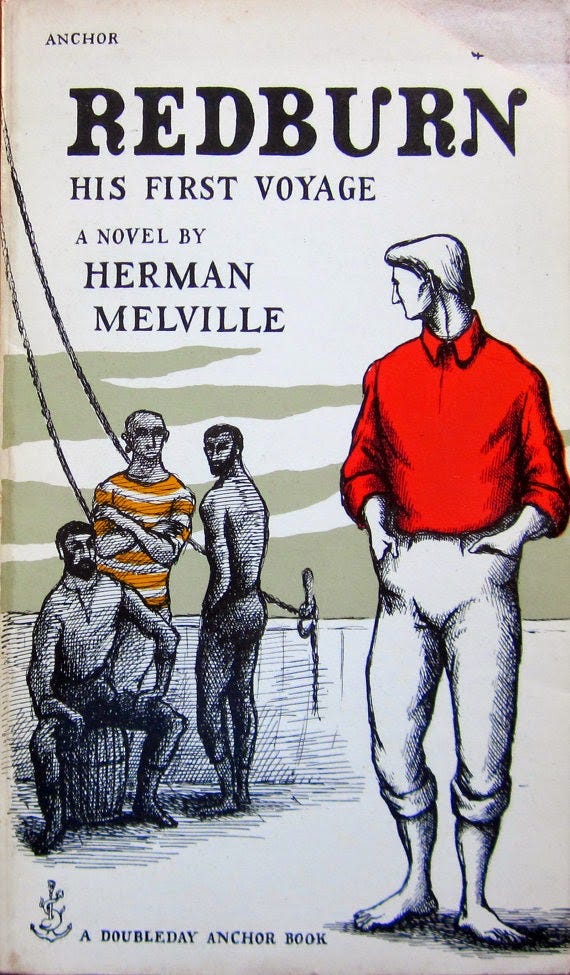
It was a memorable read, although it was topped easily by my reading Moby-Dick a year later (Moby-Dick now being one of my favorite books of all time, for sure). But I’m grateful to Edward Gorey for the sexy cover, which made me buy the book in the first place . . . and grateful to myself for rationalizing it as part of my strategy to read Moby-Dick without fear.
I think it worked. It eliminated the intimidation factor, so that I sailed straight into Moby-Dick with an open heart. In 2014, I reread Redburn for the second time, and it’s amazing how it holds up — as wonderful now as when I was younger.
I absolutely adore this book, telling of a novice sailor’s very first voyage, from New York to Liverpool (and with an exotic side journey to London) and back.
Melville said he wrote it “for the money” and rattled it off very quickly to help him feed his family; he considered it to be “trash” and had very low regard for the finished product.
Which only goes to show what poor judges authors can be of their own work.
Redburn is a real gem, totally unique, generous, open, and empathetic in its portraits of the sailors and others who young Wellingborough Redburn meets along the way. Even the evil sailor Jackson is drawn sympathetically, so that we understand as far as the narrator can what Jackson is about, even if we fail to comprehend why any human being could have such a foul nature.
There is the obvious gay subtext to Redburn’s friendly relations with the effeminate dandy Harry Bolton, as well as his rapturous adoration of Carlo, the young Italian steerage passenger of exceeding beauty and charm.
The realistic depictions of the horrors of an emigrant vessel, loaded to the brim with destitute Irish emigrants on the return voyage from Liverpool to New York, makes one realize that in the early 19th century, many emigrant vessels were barely more humane than a slave ship. For those of us whose Irish ancestors came over about this time (1830’s or so), it’s quite eye-opening to consider the extreme hardships of such a voyage.
For lucky Wellingborough Redburn, the whole thing is an amazing adventure that helps usher him from boyhood to manhood and allows him to witness the very best and very worst of human nature in the microcosm of a humble merchant sailing vessel.
Redburn is a great novel, no matter what Melville thought. It’s no Moby-Dick — but then neither is anything else in this universe.
Have you read Redburn? If so, what did you think of it? Have you read Moby-Dick or anything else of Melville’s? Feel free to comment below. Happy reading!


