
Revisiting “Both” Definitions of Bisexuality
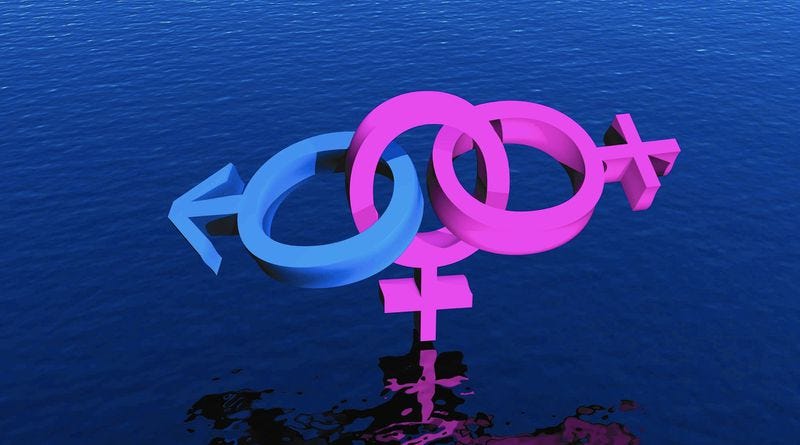
It’s no secret: the word “bisexual,” announcing that one enjoys both sexual options our heterosexist society presents to its citizens, has been under fire ever since it gained use as an identity label. One reason is that two ways used to describe it, especially throughout previous decades (though less common today), are “attraction to both genders” and “attraction to both sexes.”
There are two primary reasons people dislike the above definitions: they either believe that
- not enough genders/sexes are included (these phrases clearly imply that only two exist) or
- too many genders/sexes are included (under the premise that people can or should only desire one; these people would be unsatisfied with any definition of bisexuality).
A definition similar to these two, though not as staunchly closed-off, is “attraction to men and women,” which receives flack for more-or-less the same reasons (keeping in mind that simply listing these genders does not imply that they’re the only ones in existence; we’ll revisit this definition too).
Keeping in mind that bisexuality has never been inherently limited in any way and bisexuals have been saying this for decades, we can also acknowledge that “both genders” and “both sexes” are clearly binary and antiquated. However, many people also seem to argue that these definitions, due to their wording, mean that bisexuals who use(d) them are (or were) incapable of attraction to certain groups of people. They also imply that bisexuality had to “open up” to include more people that it previously didn’t.
These claims are incredibly debatable, to say the least, and typically require a certain mindset (which doesn’t actually apply to all bisexuals) to work.
The Exclusion Problem
Many people who subscribe to reason 1 consider the phrase, “both genders/sexes,” to be inherently exclusionary of transgender, nonbinary, and intersex people as a whole. Although I will not at all say that “both genders/sexes” is all-encompassing, as a nonbinary person, I slightly beg to differ from the idea that they’re always as restrictive as it otherwise looks at first glance. We’ll look at each claim of exclusion on its own.
“Both” is the dual form of “all,” meaning that someone who likes “both” groups likes all the groups they’re aware of, personally recognize, or otherwise given to choose from. If you like all the options given to you, even if you only have two, it can sometimes also be safe to say that you might also like a mixture of them. “Both” does not automatically suggest a polarity.
As a simple example, if someone’s asked whether they enjoy dubstep or drum-and-bass and they say “both,” there’s a decent chance they might enjoy the subgenre of drumstep as well, whether they consider it a new kind of music, just a blend, or feel like individual songs don’t differ much from what they already understand to be dubstep or drum-and-bass. It doesn’t mean that the person in question only likes dubstep and drum-and-bass, let alone that they think those are the only two legitimate forms of music.
If everyone on Earth theoretically fell into two categories, then attraction to people of both categories leads to the capability to be attracted to anyone, which is why the description of bisexuality many find restrictive today was once revolutionary — and why bisexuals are stereotyped as indiscriminate in their sexual desires and willing to fuck anything.
“Both Sexes”
As a disclaimer, I disagree with the very concept of sex categorization, but we’ll put that aside for argument’s sake.
When sexual orientation was first constructed, the vast majority of society subscribed to the ideas that 1) there are only two sexes, 2) sex is biological and immutable and 3) sex and gender were inherently interchangeable, the latter stemming from the former (i.e., if you were considered to be “born male,” you were a man and vice versa). We can see this influence of sex in the orientation terms themselves — the “-sexual” prefix that sits behind “homo,” “hetero,” and “bi” stems from the Latin “sexus,” referencing the concept of physical sex. Here we get terminology such as “same-sex attraction/marriage” and people insisting that lesbians can knowingly enter relationships with transgender men because we’re “female.”
While these ideas still prevail for most people, our ideas of gender and sexuality have shifted over the past few decades due to feminist and LGBTQ movements. Now, some people theorize gender and sex as cleanly distinguishable without the necessity for matching, such that one can simultaneously have a “female” gender but a “male” body. There are two (conflicting) reasons others disagree with this: it’s seen as either 1) validating transgender people or 2) delegitimizing and misgendering them.
Let’s say that, theoretically, that the following theories — “sex is immutable, biological, and independent from gender” and “sexual orientation is solely defined by sex” — are true. Under this model, sex is also constructed as a binary, thus bisexuality can only be defined as “attraction to both sexes (i.e., ‘males’ and ‘females’).” Some people sense another problem, though: “What about intersex people? Do(n’t) they prove that there are not only two sexes? If someone is only attracted to ‘males’ and/or ‘females,’ then do(n’t) they exclude intersex people from their dating pool?”
Male, Female, Intersex?
These questions posit intersex people as a third category mutually exclusive with “male” or “female.” However, if someone only believes in two sexes, that wouldn’t mean intersex folks are left out of them because, by this logic, no body trait, no matter how divergent from expectations, would make someone neither “male” nor “female.” A belief in binary sex doesn’t inherently say “only these two hyperspecific body types are real,” but rather “every sex characteristic a person can have can — must — be sorted into these two groups.” Both are obviously flawed ways of looking at it, but I digress.
Intersex variations are usually conceptualized as combining typical traits of “both sexes” into one body, not entirely distinct sex categories mutually exclusive with the two traditional ones. In a spectrum model of physical sex, people with these variations are in-between two extremes, not outside them. Ergo, someone who understands themselves as “exclusively attracted to ‘fe/males’” could still express attraction towards an intersex person so long as they primarily have “female” sex characteristics (even perisex [i.e., not intersex] ‘females,’ cover a wide range of body types), and a bisexual can conceptualize themselves as being attracted to people on any point of the sex spectrum. Plus, a number of intersex variations are not externally noticeable to perisex individuals to begin with. Not even all intersex people know they’re intersex.
Male, Female, Transgender?
Adding gender to the mix, either sex, if we stick with two, can have any gender identity, female or not. When it comes to transness, if one subscribes to sex categorization, they typically conceptualize a transgender person’s sex as either the one they were assigned at birth (e.g., a transgender man would be considered female), or the one matching their gender (e.g., a transgender man would be considered male). (Some people have theorized transitioning transgender people as inherently intersex, but this is discouraged as “intersex” specifically concerns being born with traits divergent from the “male” and “female” sex categories.)
Either view automatically includes transgender people in the “both sexes” definition because transness does not create a third sex category. We can say the same for nonbinarity, even if the problem arises that someone who identifies as neither male nor female will never have a sex that matches their gender. Then again, in this hypothetical situation where two and only two sex categories exist and are understood, this may not matter.
One could argue that, outside of the overly simplistic, increasingly antiquated, and cissexist way of looking at physical sex characteristics, “both sexes” is, in some ways, actually all-inclusive in practice.
All that said, it’s more established today that sexuality is about gender rather than any notion of physical sex, so let’s get back to that.
“Both Genders”
Just like “both sexes,” “both genders” includes intersex and transgender men and women because “transgender” and “intersex” are not separate gender categories. Transgender and intersex men are men; transgender and intersex women are women.
But what about unaligned nonbinary individuals, who don’t identify with either gender? Well, this gets slightly complicated. A number of genderless people don’t consider their lack of gender to be a gender in itself, and people can find unaligned nonbinary people attractive regardless of their sexual identity, so some genderless people may not be too bothered by “both genders.” Still, most other unaligned nonbinary people, genderless or not, have an issue with this phrasing as they (rightfully) feel blatantly alienated from it. Here, we can see the limitations of saying “both genders” as it indeed neglects other gender identities, thus proving (perhaps oddly) more exclusive than “both sexes.”
But does every bisexual who defines their identity as “attraction to both genders” explicitly exclude and deny the existence of unaligned nonbinary identities? Not necessarily.
Nonbinarity, to most people, is still a very new concept and have just been introduced to it. Many are, unfortunately, simply unaware that gender identities exist outside of the binary system (or the newer two-pole gender spectrum). To be exclusionary of other genders, however, they’d have to know about them first and make the active decision to shove them out of their dating pool.
At the risk of a wonky and possibly cliché analogy, imagine that you’ve only known two color categories in your life thus far: red and green. You’ve classified every color you saw as one or the other, but you find both colors pleasing. Later on, you find out that there are way more color categories than you thought, and colors you categorized for years as red or green weren’t actually either. If you always liked both, would it make sense to suddenly decide that colors that you’ve always enjoyed — since you already liked all the colors you perceived — are now ugly because of their new names?
Someone describing their sexuality as attraction to “both genders” because they’re simply unaware of nonbinary people doesn’t mean they’d never date one if introduced to the concept of nonbinary identities later on. Until the nineties or so, words explicitly describing Western nonbinary gender experiences (e.g., “genderqueer”) didn’t really appear in the public lexicon.
Most people at this time either didn’t know about them or used other words to describe people beyond the binary (e.g., “third sex,” sometimes “drag queen”). To act like bisexuals without knowledge of nonbinary people explicitly leave them out of their dating pool would be like saying someone who’s never heard of a certain actor denies their existence entirely. It’s very possible that some people who otherwise uses the “both genders” definition on themselves, if simply informed of nonbinarity, would switch to a more open phrasing like “similar and different genders” or “regardless of gender.”
Is “Attraction to Men and Women” Inherently Exclusionary or Binary?
Although a number of folks deem this description of bisexuality inadequate in the same way they do for “both” definitions, I don’t find “attraction to men and women” is necessarily binary or exclusionary at all — it’s important to note that “X and Y” is much different than “only X and Y” (the latter of which obviously being closed off). We’re talking about the former.
Saying “I’m attracted to men” doesn’t automatically mean “I’m a gay man” as the man in question hasn’t been stated whether this attraction is actually limited to men. We can also acknowledge that lesbians can be attracted to unaligned nonbinary folks without needing to define lesbianism as “attraction to women and nonbinary people who are not male-aligned” since attraction to certain nonbinary people is implicitly included in all sexualities (plus, some lesbians date women who are also men, so not even that definition is universal).
If we can acknowledge that male gayness (most commonly defined as “exclusively attracted to men”) and lesbianism (most commonly defined as “exclusively attracted to women”) can still include unaligned nonbinary people without explicitly mentioning them, why do people treat “(not necessarily exclusively) attracted to men and women” so differently?
While none of this is to say that more explicitly inclusive definitions of bisexuality are unnecessary — I always encourage people to use more explicitly open descriptions such as “attraction to all genders” or “attraction where gender is not a boundary,” and in an ideal world we can all agree on such phrases — I personally believe that “attraction to men and women” is the only one that can truly encompass everyone who realistically should be considered bisexual that leaves no room for loopholes (e.g., someone claiming bisexuality because they’re “attracted to women and nonbinary people but not men”).
It’s the one I most often use to conceptualize my sexuality (I also think in terms of “attraction where gender is not a dealbreaker,” but since I have a gender preference I usually default to the former) because that’s the attraction society focuses on politically (no one’s going to call me a switch-hitter for dating an agender person), and I highly doubt anyone is going “wow, genderfluid people are so sexy” or “my type of neutrois person is one who looks like X and acts like Y” unless they either share that identity or are a chaser.
Final Words
The phrases “both genders” and “both sexes” are blatantly indicative of (to different degrees) antiquated views regarding sexuality and gender; this piece is not a defense for them or an advocation for people to continue their use. We should undoubtedly keep moving past this language — which is what many bisexual communities have been doing for a while.
However, while these definitions are obviously troublesome, they were based on a previous lack of knowledge and understanding of the world rather than an explicit intention to exclude people. We can criticize them without implying that the label they were meant for is (or ever was) bound to it or that attraction to transgender or intersex people didn’t exist before people put it into exact words.
The language we use to describe feelings does not limit them. Insisting that people must move past the label “bisexual” to encompass more people in their attraction due to these definitions — which have been decreasing in usage for a while, anyway, especially by most LGBTQ organizations — even if they’ve always understood their bisexual attraction as inclusive of everyone is ignorant and insulting to both the history and current realities of bisexual communities and people.