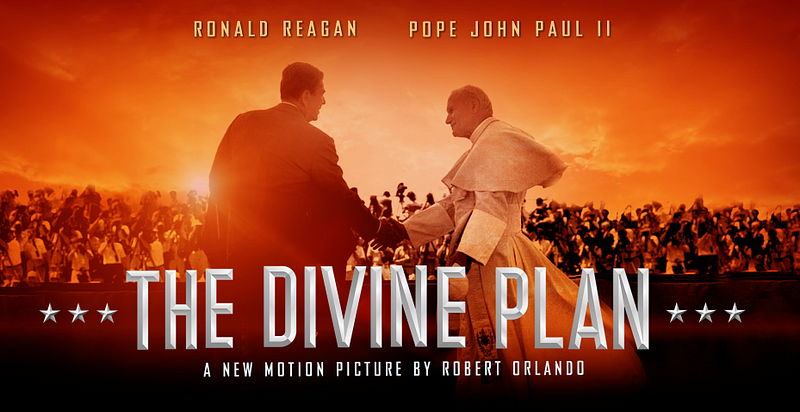
Review: The Divine Plan
Life is like a play: We’re actors and God is the Director. We grow closer to God— and each other — by playing many roles, from minor cameos to our moment in the big spotlight. Eventually, we comprehend a bigger story — God’s Plan.
In The Divine Plan, we meet two universally known actors and leaders, Ronald Reagan and St. John Paul the Great, who each play a number of roles. Then God calls them to star in a modern passion play. And an encore.
Like Christ Himself, both men were humbled, exalted and attacked (publicly pounded by bullets instead of nails) in the public squares of 1981 Washington and Rome. After coming incredibly close to dying, both Reagan and John Paul were (in multiple ways) resurrected to transform the world.
After their crowning achievement, winning the Cold War, both men suffered again, often before our eyes, teaching their many followers how to die with dignity and grace. The documentary features compelling graphic art with analysis from some of the most prominent experts on history, religion and politics.
Forty years ago, Ronald Reagan, planning his 1980 run for the White House, watched the news of millions of Poles gathered to see the 1979 return of the world’s first Polish Pope to his native Poland.
“(John Paul) brought so many people together while dictatorships isolate people,’’ author Anne Applebaum concludes in the new film. “Millions saw they weren’t alone, that believers actually outnumbered the communist dictators and minds began to change.”
Seeing the Poland trip play out on the network news, Reagan turned to foreign policy advisor Richard Allen and exclaimed, “Dick, that’s it. The pope! The pope is the key!’’
In 1979, a time when the world thought the Soviet Union and the Iron Curtain were permanent realities, Reagan told Allen he had a four-word plan: “We win. They lose.’’ Reagan and John Paul saw the people of Poland were the linchpin holding the global communist system together. Disconnect that pin, and the wheels would fall right off the vehicle and it would crash. Communist nations fell — or were radically jolted — around the globe.
Asked how this dream could possibly work, Reagan would later explain: “It’s only going to happen because of the people’s desire to know God.’’
Father Michael Gaitley calls St. John Paul’s dramatic life and the stories he is interconnected with, “The Second Greatest Story Ever Told,” after the Bible. The JPII and Reagan story is a modern version of the Bible told in “The Divine Plan,’’ which fittingly debuts on November 6, the 30th anniversary of the fall of the Berlin Wall they destroyed.
Bishop Barron says in the film that the pope saw his own assassination attempt “according to the template of the cross and resurrection of Jesus. Did it give him a heightened sense of his mission to struggle against what he saw quite correctly as the supreme evil in the world at this time? I’d say yes, absolutely. And that brings him close to Ronald Reagan.”
Director Robert Orlando, a veteran filmmaker with an extensive Catholic theological education, sees this story as a “theo-drama,” or salvation as drama. In this drama, God and God’s Divine Plan motivated everything Reagan and John Paul did and the story of their lives. Contrast that God-centered theo-drama with life’s more common ego-dramas, where our feelings and actions are so often ruled by the needs of our own egos and feelings.
“The Divine Plan, to me, was almost a metaphor for one’s life, trying to find out what your destiny is and how to find God’s role in your destiny, not just sitting in the politics or economics,” Orlando said. “There’s something about being decent that’s universal and it comes through story.’’
Orlando collaborated with famed Reagan biographer Paul Kengor, who has explored these themes in several books starting with “God and Ronald Reagan” in 2004, “The Crusader” in 2007 and “A Pope and a President” in 2017.
The Divine Plan film is complimented by an excellent book released in June 2019, “The Divine: John Paul, Ronald Reagan and the Dramatic End of the Cold War.”
“What we like about this story is that in the modern politicized, polarized environment where everybody’s sick of politics, that here you have a genuinely nice story of two people that most people like. This was a good story, a good cause that had a good ending.’’
Fear gave way to faith. Reagan and John Paul shared regular letters, met in person, established official diplomatic relations (and ongoing working relationships) between the Vatican and the United States and shared classified intelligence including the secret finding that the Soviets were behind the attempt to kill the pope.
“Both of these men shared the conclusion that communism could be defeated,’’ Papal biographer George Weigel explains in the film.
Bishop Barron adds: “They both saw it, they both understood it.’’
Neither took credit since both believed it was God’s Plan, that they had been shot and survived, six weeks apart in 1981, because God had a Divine Plan to defeat evil without firing a shot. Reagan saw in 1979 that the pope, was “the real power in Poland.’’ He often referenced “DP’’ for the Divine Plan.
The two best friends, former actors and great communicators, both shared views of the world. Reagan said “Every person is a res sacra, a sacred reality’’ while John Paul said “Every person is a unique and unrepeatable gift of God.’’
John Paul, who called Mikhail Gorbachev the “Providential Man,’’ himself explained, “I didn’t cause this to happen. The tree was already rotting. I just gave it a good shake and the rotten apples fell.’’
The film also recalls a conversation between Reagan and Solidarity candidates running in the June 1989 elections against the communists. When asked for his campaign advice, Reagan answered, “Listen to your conscience because that is where God speaks to you.”
The film also explains how John Paul’s aide, Cardinal Stanisław Dziwisz, caught the pope when he was shot and celebrated Reagan and John Paul in a June 27, 2011 Mass where he explained: “The world is a battlefield of good and evil, truth and falsehood. Each of us faces a choice… Today we recall two great men who stood before this very choice and how their decision shaped the world in which we live.’’
The Divine Plan debuts nationwide November 6. Order Tickets.