
Review: ‘Scrapper’ Is a Comedy-Drama with Charm
Charlotte Regan’s debut feature is a touching and bitter-sweet story of a father lost and found
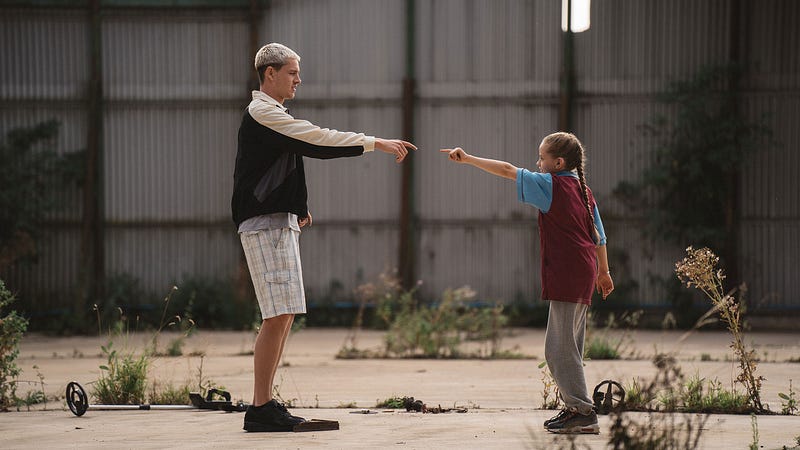
Scrapper begins with quiet domesticity. We’re introduced to 12 year old Georgie (newcomer Lola Campbell) as she cleans her council house. Immediately, one is reminded of the British tradition of cinematic realism, particularly of the more poetic realist films of the last twenty or so years which largely stemmed from Lynne Ramsay’s early works.
The second that Georgie leaves her flat, Sean Baker’s excellent 2017 film The Florida Project is brought to mind by the brightly coloured exteriors to the otherwise uniform buildings designed for the working class. Both films are about children with absent parents and the environments which they grow up with, and both utilise the perspective of their leading child to tell their stories. Thinking of this film in connection with The Florida Project proved to be a useful approach.
Scrapper follows Georgie, a young girl who has recently faced the brutal loss of her mother. She is looking after the house and living completely alone, tricking social workers by telling them that she is temporarily living with her ‘Uncle Winston Churchill’. To maintain this lie, Georgie and her best friend Ali (Alin Uzun) steal bikes to pay the rent (as the glorious Turn the Page by The Streets blasts in the background) and use vocal recordings of a local shop worker to reply to phone calls from social services checking in on her.
That is until, out of the blue, Georgie’s dad Jason (Harris Dickinson, of Triangle of Sadness and The King’s Man) appears, throwing his possessions over the back garden fence along with a small bunch of red roses. He has returned from living in Ibiza with his friends to try to raise Georgie, willingly facing the responsibilities which he left behind 12 years before.
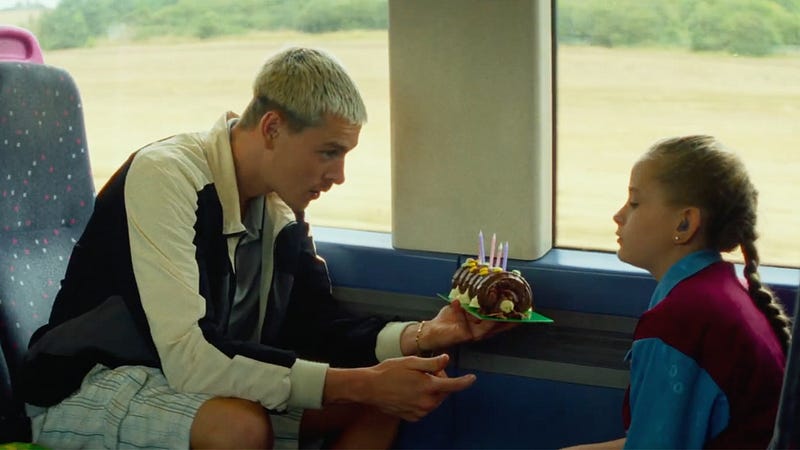
The film is largely a success. There’s a charm to it that is hard to describe, gathered together by the passionate performances and the use of Georgie’s innocent perspective to give a lightness to what would otherwise prove a dour watch. Charlotte Regan mixes social realism with the kind of quirky comedic approach that usually turns my stomach, but she makes it work in Scrapper for the most part. Scenes of fantasy, often described by the characters, are interjected throughout the film to show the escapism that Georgie relies on following the loss of her mother. These don’t always fully work, sometimes proving too much of a tonal leap for the film to handle, but when that leap does work it leads to some impactful sequences.
The performances from the leading trio are all very strong. Lola Campbell does well as Georgie, able to communicate the young girl’s pain but also capture her sense of humour with some great comedic timing. It helps massively that she has such good chemistry with her co-star Harris Dickinson, who captures a similar sense of bittersweetness. There is a reality to these characters, but they try to hide their troubles beneath humour and escapism. Many of the film’s scenes are quite joyful and energetic, with a quiet sorrow in the subtext. When that sorrow breaks through to the forefront, the film becomes more impactful, but its willingness to save that melancholy for specific moments serves it well.

Not all of the jokes in Scrapper land particularly well. Its faux-documentary sequences which show supporting characters are great… its gags about talking spiders less so. The film’s visual metaphors also lack subtlety and creativity — showing an emotional divide between two characters by having them positioned on separate sides of a caged wall is abundantly obvious imagery and simply isn’t interesting. What works much more is the small look at how important digital media has become to memory — Georgie is constantly looking at pictures of her mother on her phone in search of comfort. It’s a minor detail, but its inclusion adds to the authenticity of the film.
Scrapper is at its absolute best when focused keenly on Jason’s growth into becoming a father, having missed the first 12 years of his daughter’s life. The film doesn’t reach the emotional highs that one would hope for, and is a little too obviously comparable to films like A Monster Calls and The Florida Project, but it is worth your time as a viewer. It is funny, moving and very well acted, with a lightness to its tone that makes its emotional punches at least memorable. Its representation of working class Britain is far from realistic, even from the more innocent perspective of a 12 year old girl, but this can be forgiven seeing as it isn’t the film’s focal point — this is a film about grief and parenthood. Harris Dickinson is the stand out element — he is a star primed to explode in popularity.
For more from me on film, see the list below:
Alternatively, if you want to support my writing, you can donate using Ko-fi.


