
Review: Hologic’s Genius 3D Mammography
No more uncomfortable than the older, 2D mammogram technology.
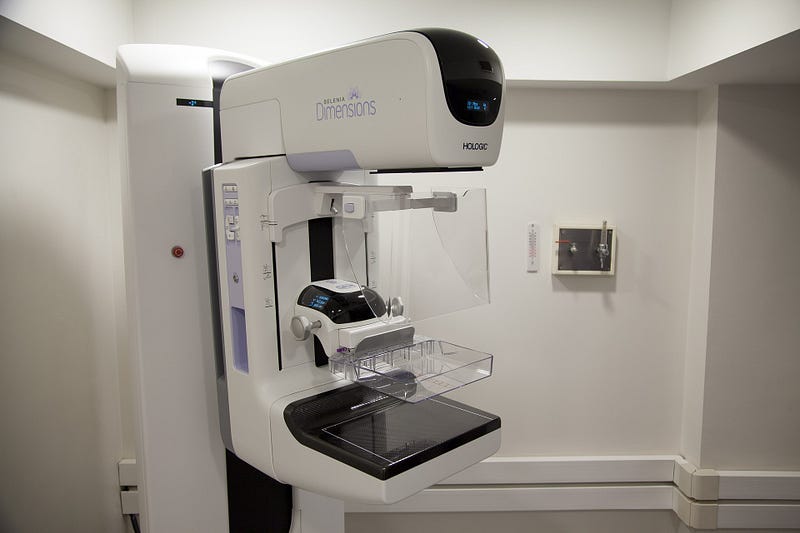
The author has not received any incentives or payment from anyone related to the 3D Mammography technology discussed here.
Earlier today I experienced my first 3D mammogram. Having had many 2D mammograms over the course of my life, I feel qualified to compare the experiences.
A mammogram is an X-ray picture of the breast. Doctors use a mammogram to look for early signs of breast cancer. Regular mammograms are the best tests doctors have to find breast cancer early, sometimes up to three years before it can be felt. What is a Mammogram? Centers for Disease Control.
Multiple studies have compared 3D and 2D mammograms. They discovered more cancers are found by the newer technology. It also has fewer false positives.
The new machines aren’t yet available everywhere. Insurance companies do cover the newer test as the FDA has approved it as a standard of care.
Three-dimensional (3D) mammography (also called digital breast tomosynthesis, digital tomosynthesis, or just tomosynthesis) creates a 3D picture of the breast using X-rays. Several low-dose images from different angles around the breast are used to create the 3D picture. 3D Mammograms More Effective Than 2D Mammograms in Women 65 and Older
Let’s get to the nitty-gritty. How did the experience compare?
Due to a family history of breast cancer, I had my baseline mammogram at 35. I heard the phrase “dense tissue” for the first time. It was 1998 and 2D mammograms were state of the art.

I took a long look at the machine. I could see the plates that were, theoretically, going to squeeze my breasts. I looked down at my breasts. I couldn’t imagine how this was going to work.
The technician asked if this was my first mammogram.
“Yes,” I remember gulping, “I am not a full A cup. I don’t know how …”
She laughed, “I’ve never found one I couldn’t get in there. Trust me.”
She was right. She got them in there. It hurt. A lot. Much more than I expected, because the machine stuck each time she hit the release button. I had to have each scan done multiple times. It was awful.
The good news was once the evil machine released my flesh, the pain released as well. I remember going home and pouring a very large glass of wine.
Between the ages of 35 and 55, I have had a lot of mammograms. They were never comfortable, but they never hurt as bad as that first experience. All those tests were the 2D version. All except the one I had this morning.

I do not carry the mutations to my BRCA 1 and 2 genes. I had the testing done a few years ago. My family history of breast cancer still influences my doctor’s scanning recommendations. Once a year I have a mammogram. Every six months afterward, I have an MRI of my breasts.
This year, my gynecologist suggested I go with the 3D version of the scan. I was a little nervous, not knowing what would be different, but agreed. To add a nice little reminder of my age, a bone density scan was scheduled for the same morning.
The experience was more positive than many I have had in the past. The position of my body during the scan was the same. Thankfully, the squishing portion of the appointment was similar to the 2D version.
Each scan takes a few seconds longer. To be honest, I only know it took longer because the literature I read said it did. My perception was that it was similar.
The same rules apply. No powders, lotions, deodorant or scents on your breasts or underarms. You are asked to remove all clothing from the waist up and given a robe or other covering.
I picked up literature at the appointment. It says Genius 3D Mammography detects 41% more invasive breast cancers. False positives are reduced by up to 40%.
Breast cancers detected early have an almost 100% survival rate. Skipping your mammogram could, quite literally, be endangering your life.
I think the 3D mammograms are worth the extra few seconds of discomfort. I am giving it a thumbs up.

If you liked this, you may like:


