
Revenge — Forgiveness Is The Best Revenge:
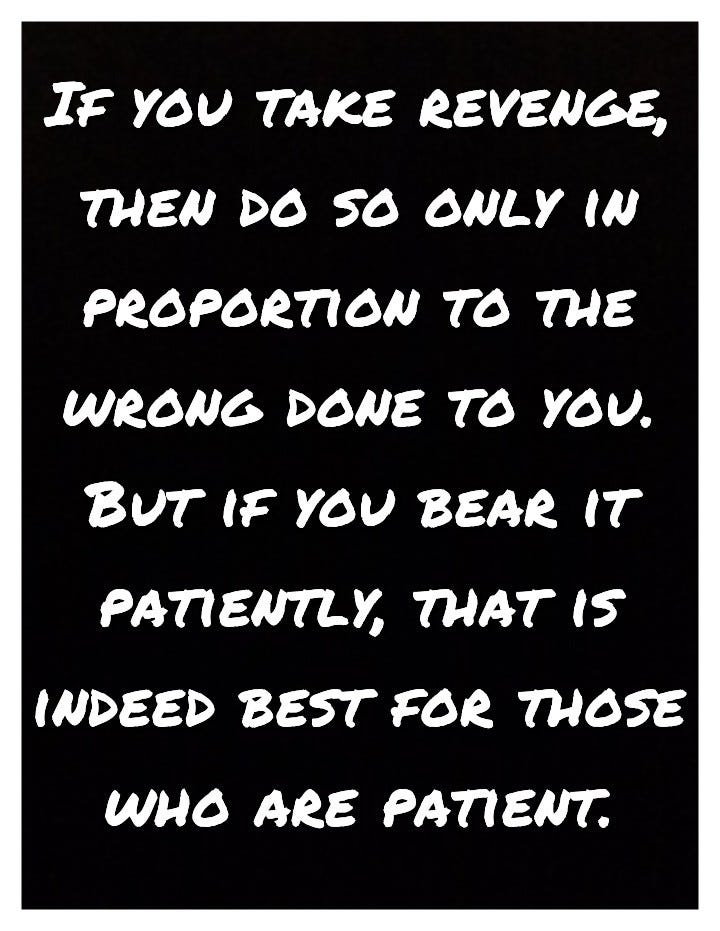
Revenge is committing a harmful action against a person or group in response to a grievance, be it real or perceived.
Forgiveness is more powerful than Revenge. Vengeance only begets Vengeance. it is a destructive cycle. But when you forgive, you inspire change in both yourself and the other — Forgiveness is the sweetest Revenge. Forgive all who have offended you, not for them, but for Allah & for yourself. The weak can never forgive. Forgiveness is the attribute of the strong.
Which Is Better Revenge Or Forgiveness?
For people who wrote a letter expressing Forgiveness, the researchers Found that their levels of self-humanity were higher than people who wrote a revenge letter. Additionally, those who Forgave reported lower inclination toward self-harm. In other words, Forgiving has benefits for those of us who have been hurt.
The desire to get revenge is a natural instinct and a normal response when someone wrongs you. No one wants to Feel like they let a culprit “get away with it”.
Our natural sense of self-protection compels us to act in order to avoid eeling vulnerable as if there is nothing we can do to right the wrong. However, Forgiving someone doesn’t make you a pushover, and it’s not about letting the other person “off the hook” — Instead, Forgiveness is about overcoming your anger and quelching your desire to punish the other person.
Two wrongs don’t make a right, but it makes me Feel better — Not true. Contemplating about how to “get pay back” has a negative impact on your physical, mental, and emotional health.
Studies show that Focusing on Revenge Increases Stress,Inhibits Mental functions, and weakens the immune system; the negative emotions that you harbor do more harm to yourself than the person who offended you.
Conversely, Practicing Forgiveness has been linked to lower blood pressure, reduced fatigue, and an improved quality of sleep.
Being a forgiving person doesn’t suggest or imply being foolish; as the saying goes, forgive but don’t forget. By letting go of grudges or ill will you are simply refusing to react in a destructive way; but, that doesn’t mean subjecting yourself to further mistreatment. You can forgive someone and still call the police, testify in court, or love them from a distance.
The problem for many of us is that sometimes we claim to forgive a person, but deep down the anger or resentment lingers.
In the Holy Qur’an Allah (swt) says, “We will take revenge” or “We take revenge”. Allah taking Revenge means His punishing Evil doers. It is permissible and necessary to say that Allah will take revenge. It is necessary to communicate the Fact that people will not get away with the evils they have perpetrated.
One of the 99 Beautiful Names of Allah (swt)is al-Muntaqim, which means the One who takes revenge. He is the Owner of Vengeance. (Sûrat-u Âl-i ‘Imrân, 4; Sûrat-ul-Mâida, 95; Sûrat-u Ibrâhîm, 47; Sûrat-uz-Zumar, 37)
He also says, “We took vengeance” (Sûrat-ul-A’râf, 136; Sûrat-ul-Hijr, 79; Sûrat-uz-Zukhruf:25, 55).
The matter Allah (swt)taking vengeance, which appear in the Quran and religious books, means His punishing the guilty. He will get the rights of the oppressed people from their oppressors. He will take revenge on and punish the betrayers who drag humans into Jahannam (Hell). He will also take His own rights from whomever He wishes.
Some related ahâdîth are as Follows: Allah(swt) awliyâ among the public are the people of hunger and thirst. Allahu(swt) takes revenge on and makes Jannat [Paradise] harâm for those who cause them distress. [Ibni Najjar]
(Fear Allah! If a Believer does injustice to another Believer, Allah(swt) will definitely take the revenge of the oppressed person on his oppressor on the Day of Resurrection.)
He who disobeys his parents and who wanders with the unjust is an evil doer. Allah(swt)declares, “We undoubtedly take revenge on evil doers.” [Tabarânî]
“And those who, when an oppressive wrong is done to them, take revenge”.
(Al-Shura 42:39)
Imam Ibn Rajab al-Hanbali said, commenting on this verse:
With regard to the phrase — “And those who, when an oppressive wrong is done to them, take revenge” – this does not contradict the idea of Forgiveness, because taking revenge may mean demonstrating the ability to take revenge, then one may Forgive after that, in which case Forgiveness will come in a better context.
Al-Nakha’i said concerning this verse: They do not like to be humiliated, so if they are in a position to settle the score, then they will Forgive.
Mujaahid said: They did not like For the Believer to let himself be humiliated, which would lead the evildoers to Feel contempt for him — If the Believer is wronged, then he should show that he is able to take revenge, then he should Forgive after that.
Hence Forgiveness is not good in all cases, rather it may be blameworthy if it results in humiliation of the Muslim or encourages the aggressor even further.
Allah has referred to that in the verse: “But whoever forgives and makes reconciliation, his reward is with Allaah” (Al-Shoora 42:40)
Here Allah states that Forgiveness is only good if it is done for the sake of reconciliation; if it leads to bad consequences then it is not good.
Hence the Muslim should look at which serves the greater interest – Forgiveness or seeking revenge – and act accordingly. This will vary according to circumstances and the people involved.
What Imam Ahmad said about Forgiving everyone who causes harm except for an innovator (mubtadi’) is in accordance with this, because he thought that Forgiving the Followers of bid’ah would have bad consequences, which is that the people would be encouraged to Follow innovation. So he stated clearly that — Innovators were not to be Forgiven, as a way of putting people off from those Innovations.
“Muhammad is the Messenger of Allah. And those who are with him are severe against disbelievers, and merciful among themselves. You see them bowing and falling down prostrate (in prayer), seeking Bounty from Allaah and (His) Good Pleasure. The mark of them (i.e. of their Faith) is on their Faces (Foreheads) from the traces of prostration (during prayers).
This is their description in the Tawraat (Torah). But their description in the Injeel (Gospel) is like a (sown) seed which sends forth its shoot, then makes it strong, and becomes thick and it stands straight on its stem, delighting the sowers, that He may enrage the disbelievers with them. Allaah has promised those among them who believe (i.e. all those who follow Islamic Monotheism, the religion of Prophet Muhammad till the Day of Resurrection) and do righteous good deeds, forgiveness and a mighty reward (i.e. Paradise)”.(48:29)
So the Muslim has the Right to Forgive with regard to things that have to do with him, i.e., his personal rights, but he does not have the right to remain silent when the sacred limits of Allah are Transgressed.
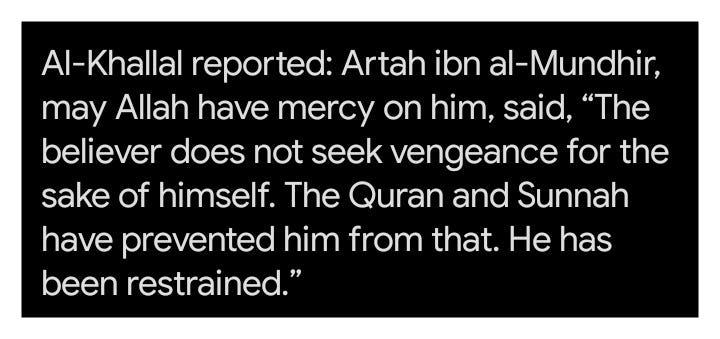
Messenger Of Allah (saw) Never Took Revenge For Himself:
“The Messenger of Allah (saw) was never given the choice between two things but he chose the easier of them, so long as it was not a sin — But if it was a sin he would be the Furthest of the people From it. And the Messenger of Allah (saw) never took revenge For himself, unless the sacred limits of Allah were transgressed, then he would take revenge for the sake of Allah.”
(Narrated by al-Bukhaari, 3367; Muslim, 2327)
It is permissible for a Muslim to refrain from taking revenge on a non-believer if the Muslim is in a weak position and is not strong. If he is weak then it is permissible For him not to Fight. Allah Forbade the Muslims to Fight at the beginning of Islam when they were weak and oppressed.
Allah says:“Truly, Allah defends those who believe. Verily, Allaah likes not any treacherous ingrate to Allaah [those who disobey Allah but obey Shaytaan (Satan)]”.(Al-Hajj 22:38)
Abu Huraira reported: The tribe of Al-Harith ibn ‘Amir had purchased Khubayb, may Allah be pleased with him, as a slave since he had killed Al-Harith during the battle of Badr. They took him prisoner until they agreed they would execute him.Khubayb wanted to borrow a razor from the daughter of Harith so he could shave and she allowed it. A small boy of hers drew close to Khubayb while she was unaware, then she came to him and found Khubayb with the boy in his lap and the razor in his hand. She became terrified and he noticed her fear. Khubayb said, “Are you afraid that I would kill him? I would never do that.” She said, “By Allah, I have never seen a prisoner behave better than Khubayb.”
(Source: Ṣaḥīḥ al-Bukhārī 3767)
The Recompense For an evil is an evil like thereof, but whoever Forgives and makes Reconciliation, his reward is with Allah.
Verily, He likes not the Zâlimûn (oppressors, polytheists, and wrong-doers)- And indeed whosoever takes revenge after he has suffered wrong, for such there is no way (of blame) against them -The way (of blame) is only against those who oppress men and rebel in the earth, without justification for such there will be a painful torment- And verily, whosoever shows patience and Forgives that would truly be From the things recommended by Allâh. (Surah Shura: verses 40 -43)
The above verses speak of Revenge and its extent, Pardon and its Reward.
The study of the Prophet’s character is not only meant to gain knowledge about him but also to adopt these noble characteristics in one’s own life.
The Qur’anic instruction to the Prophet (saw) about Akhlaq or improving one’s character is not only limited to the Prophet (saw) but extends to all those who believe in him and his message till the day of Qiyamah.
In other words, the Prophet (saw) is instructed not only to adopt such distinguished traits himself but also to teach the same to his companions and his Ummah.These distinguished traits should be adopted by all of his followers.
Success is not in gaining knowledge of Akhlaq or goodness as a part of research or syllabus but it also involves adopting and implementing the sought knowledge in our daily lives.
The Prophet (saw) made it very clear that — We are sent to this world to accomplish good Akhlaq (character) and to spread the Goodness to benefit all.
Retaliating against evil is allowed but…The recompense for an evil is an evil like thereof, but whoever forgives and makes reconciliation, his reward is with Allah.
One is allowed to take Revenge but it should not exceed the extent of evil done onto him. The person who is being punished, has to go through the same pain that he caused, but not any more.
Even The Closest Companions Feared To Take Revenge:
Abu Masud (May Allah be pleased with him) was a Badri companion- One who participated in the battle of Badr. This was a very important war because only around 300 unprepared Muslims were suddenly pitched against a well-equipped army of more than 1500 pagans of Makkah, and they won It was a great victory. Allah was very pleased with the participants of Badr.
“Allah looked at the participants of the battle of Badr (with mercy) and said : Do whatever you wish ; I have forgiven you.” (Sunan Abi Dawood).
Abu Mas'ud al-Badri reported:
I was beating my slave with a whip when I heard a voice behind me: Understand, Abu Masud; but I did not recognise the voice due to intense anger. He (Abu Mas'ud) reported: As he came near me (I found) that he was the Messenger of Allah (saw) and he was saying:
Bear in mind, Abu Mas’ud; bear in mind. Abu Mas’ud. He said: The whip fell down from my hand. Thereupon he (the Holy Prophet) said: Bear in mind, Abu Mas’ud; verily Allah has more dominance upon you than you have upon your slave. I said: Allah’s Messenger, I set him Free for the sake of Allah. Thereupon he said: Had you not done that, (the gates of) Hell would have opened For you, or the fire would have burnt you. I (then) said: I would never beat my servant in Future.(Sahih Muslim).
“Bear in mind," is a reminder here; that if the retaliation was equal to the discomfort or disobedience they (servants) caused, then it would not cause any consequences. If the retaliation was less, then Allah would have rewarded him. But if the retaliation was greater, even slightly more, then he would have been punished by Allah(swt).
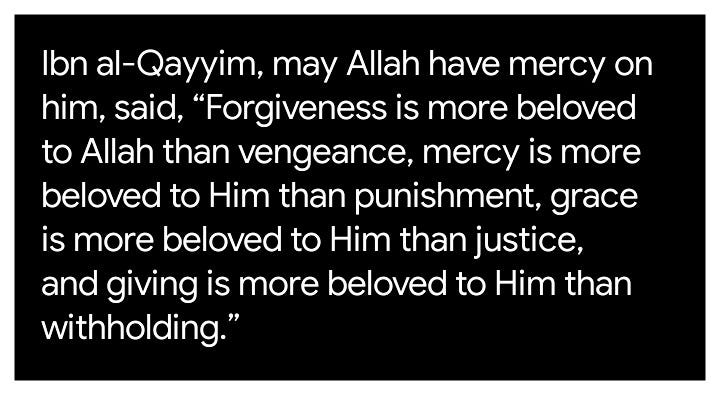
Ibn Taymiyyah, May Allah have mercy on him, said, “Verily, the matter of benevolence and Forgiveness towards people takes precedence over the matter of vengeance and revenge.” (Source: Minhāj al-Sunnah 4/327).
Taking Revenge is allowed only if it does not exceed the harm/pain inflicted upon the person. Pardon is still the better and safer option.
Dua for Protection from your Enemies, Haters and Evil people · “O Allah, we ask You to restrain them by their necks and we seek refuge in You from their evil.”.
JazakAllah (May Allah reward you with goodness)for reading.
Kindly Follow & subscribe to receive latest insightful stories by email.