
Revenge and Class Retaliation in PARASITE
An essay exploring themes in the Best Picture winning film from director Bong Joon Ho
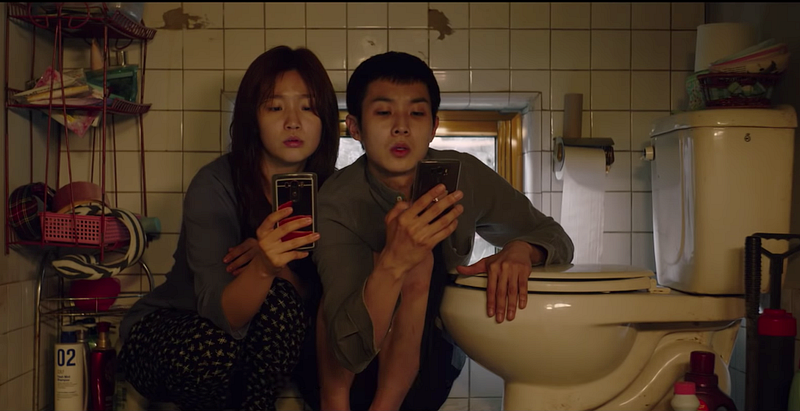
I had no idea what Parasite was before I walked into the Ritz 5 in Philadelphia. The journey that led me to this particular theater was mostly instigated by my desire to see the Delaware River, and then the Internet told me the film was playing nearby. This was my first time in Philly, so my state of mind was already primed to be cognizant to the difference of culture. This coincidentally appropriate reality helped me connect with Bong Joon Ho’s Oscar-sweeping picture on a level I hope to articulate in this essay. Obviously, there will be many spoilers ahead and my best advice is to watch this film dead cold. The trailer is safe, and I believe it was directed by Bong himself to avoid giving the movie away. As such, the trailer is here below to act as a buffer between this introduction and the spoiler-prone zone.
I enjoy talking about movies with my friends, like any normal American. It’s not unusual for people to go out of their way to bring up specific movies with me because there is a trust in the chain of recommendations that I’ve built up with other cinephiles. To see a film so carefully and naturally portray a story about manipulating that same kind of trust, I thought myself lucky. Blessed with material wealth. Since my viewing of it at the beginning of the year, I had been rooting for a Best Picture win and perhaps was a bit obnoxious in some bar conversations about why 1917 and Joker deserved the nominations but not the award. That the film would sweep the 4 major Oscars was not something I ever predicted.
The richness of Parasite’s emotional range is wonderfully immersive as much as it is subversive. From beginning to end, the viewer understands each character’s basic motivations and believes the choices they make. This is not a trivial feat in ensemble casts. Yet more clever is the finely-tuned political line drawn in the frames of the film in all its stunning humanity. South Korea is on full display, Bong Joon Ho does not hide it. This is why he expresses encouragement to those who enjoy good stories via cinema:
Once you overcome the 1-inch-tall barrier of subtitles, you will be introduced to so many more amazing films.
– Bong Joon Ho, LA Times
The narrative is well-woven from the start, with tight timing between the laughs and the surprises. And a brief moment of heartbreak.
Bong’s film opens with an introduction to a family living in a semi-basement: the alley outside is visible from the windows, the family lives underneath the street. Getting to know the casual nature of the family intimates a closeness between them. They rely on each other. They help one another. They all lie to others.
What sets them apart from any other family? In this story, it is a literal gift. Woo-sik Choi plays Kim Ki-woo, who lives at home after apparently failing out of military school. Ki-woo’s friend Min pops in for a visit and invites himself into the Kim household to bestow upon them a gift: a scholar stone from his grandfather’s collection, thought to bring material wealth to families. Ki-woo, delightedly, holds the stone up for examination and reverently admires it.
This is so metaphorical.
– Ki-woo
Ki-woo is later offered Min’s recommendation as a private tutor for the rich Park family’s daughter, Da-hye. Considering the luck of such a proposition he decides to work with his sister, Kim Ki-jung (played by So-dam Park) to manufacture university credentials. The documents, knowingly meaningless upon Min’s expert reputation, will not matter if there is ample opportunity to deceive a reputably gullible matron. Yeo-jeong Jo is adorably daft as Park Yeon-kyo, the unwitting player in the game of dark socioeconomics within her very household.
Ki-jung quickly finds herself ringing the doorbell, thanks to Ki-woo’s success ingratiating himself into the Park family. He managed to convince his student and her temporarily-involved mother that he was there to help her. Then, he raised the stakes by asking Yeon-kyo to extend his own goodwill so that he might recommend a vaguely-described woman to host her own art therapy sessions for the Park family’s youngest, Da Song. The woman, he said, was a classmate of his cousin Jessica and went to college in Chicago, Illinois. His sister, who showed up to play this woman, was thus welcomed into the Park home.
At this point, viewers get the game Parasite is playing. The whole Kim family is on their way into that house, somehow, and the audience is now co-conspirator to the misdeeds.
Kim Ki-taek, superbly performed by Kang-ho Song, does not take too long to find his own role within the Park ecosystem, thanks to the efforts of his daughter. Ki-jung takes the generous offer of a ride from the Park family driver and plants her underwear underneath the passenger seat for the father, Dong-ik (Sun-kyun Lee) to find later on. The suspicion germinates quickly, resulting in a swift and quiet dismissal of the driver and a judiciously timed recommendation of an “older, mature” driver from Ki-jung. Yeon-kyo uses this moment to promptly satisfy her husband’s need for a driver. Curious, how different the timing is when the housekeeper suddenly needs to be replaced in the same, unexpected manner.
Enter Chong-sook. The Kim family mother is expertly inserted into the household in one of the most impressive montages in cinema. Bong Joon Ho managed to stitch over 60 different shots into 5 minutes of storytelling that has become my favorite montage scene. It set up elements and paid off on them quickly, then continued to branch out into other storylines until it became obvious: the con was going to work. The housekeeper who managed to stay on between owners would not be able to keep her job if she might embarrass the Park honor by bringing tuberculosis into the house. The resting easy comes when Ki-taek is assured his role in alerting Mrs. Park of Moon-gwang’s apparent health crisis would not be viewed as untoward.
A viewer might feel the sense of satisfaction, having been given a triumphal sequence of orchestral accompaniment rising just before the decrescendo. Yet, the gentle Moon-gwang is summarily removed from the household and the audience’s reward is a lingering view of a lonely woman out on the streets in the dark. With no arrangements to accommodate the sudden departure, the Park household goes for more than a week without a housekeeper. Ki-taek slips Mr. Park a fancy business card to set up the final stage of the infiltration: Chong-sook accepts assignment to the Park household.
When all of the Kims have reached their conclusory clauses, the film is at a meditative moment. After the exciting buildup and the heartbreaking consequences, the audience will get to investigate the family dynamics’ growth from what’s happened to them so far. The Park family continues on, undeterred by the upset staffing record which plagues them recently. The English tutoring lessons create a hormonal stew between Ki-woo as Romeo with Da-hye his Juliet. The art therapy from Ms. “Jessica” is uninterestingly endearing to Da Song. Chong-sook maintains the house in proper order. And Ki-taek keeps Mr. Park happy on the road, despite his criticism of his driver for having an unpleasant smell wafting through the car.
In Parasite, disaffecting aroma is often included as a part of a scene. The opening credits include the Kim family’s semi-basement being doused in pest control chemicals. The multiple scenes involving food are superlative in invoking an aroma, especially as the family moves on from griddle-cooked steak to a driver’s cafeteria, even up to the living room of the Park household.
The stench of alcohol clouds the Park family home the moment they’re gone for a camping trip, and the Kims are having a fun time enjoying the abundance. Not too long into their evening, they’re interrupted by a ghost that haunts the house. Moon-gwang rings the doorbell, pleading to her replacement that she left something in the basement. Reluctantly allowing her in, Chong-sook follows her downstairs.
In these moments, the audience knows they’re missing something. Chong-sook finds Moon-gwang struggling to move a cabinet along the back wall. She is horizontal between the wall and the obstacle, so it is undeniably a hilarious, confusing sight for Chong-sook to encounter when she descends the stairs. The two manage to move the shelves over and a second, heavier door opens to a deeper level of the house.
The heartbreak viewers might have felt for the housekeeper before doesn’t help them process what they’re about to to learn.
There is more to the Park house than anyone really knew. Moon-gwang’s presence and embodiment as the spirit of the house now stands in stark contrast to a grim reality: she was so well-acquainted with the house because she knew its secrets. She so intimately trusted the house that she hid her own secrets within: her husband has lived for years in the underground bunker of the house.
The next act of the film pits out the multiple descents of varying characters, some falling harder than others. But what’s undeniable is how this shift in the narrative not only fundamentally alters the stakes of the Kim family getting caught, but it dramatically draws (not entirely undue) consternation on Moon-gwang and her leech husband.
Filmgoers might remember a couple of the little hints that led to this moment, examples being: the subtle mystery of the housekeeper’s knowledge of the architect and Mr. Park’s comment that Moon-gwang eats enough for two. The pleasures a storyteller includes are a language of love for the audience. Bong Joon Ho has managed to tell a story that has only human characters, and that humanity shines in the details he leaves behind.
“… a comedy without any clowns and a tragedy without any villains.”
– Bong Joon Ho
This monumental moment in film history will be remembered because of how perfectly it executes a comedy transforming into a tragedy without losing itself. It is undeniable how the tone of the movie is completely darkened by Moon-gwang’s revelation. Everything the characters have done up to this point in the film remains intact, but the stage upon which they play has been completely upended and gutted.
The remaining acts of the film play out a tense claustrophobic nightmare as the Parks return home from their camping trip early and decide to throw an impromptu birthday party the next morning. The Kim family manages to hide their insane number of problems in a matter of 8 minutes, ‘according to GPS.’ Yeon-kyo calls in the middle of a dramatic scene. The Kims fix everything up just in time while fighting the housekeeper and her husband, the secret inhabitants who live in the basement of the house. Though taut with some suspenseful moments, it it ultimately the dialogue which signals the coming conflicts. The character motivation dynamic shifting here is how the Kim family’s luck has run foul.
The growing narrative tension angles out the disparity between the two families: Ki-woo and his father and sister make it a safe distance away from the Park house in the rain before he’s able to ask his dad about a plan. Granted they’re having this conversation in the middle of the street during a monsoon, I think it’s additionally safe to assume there’s no plan after the insane situation this family is in. Chong-sook could clean once the family was asleep, and their sub-level guests were stuck safely out of sight. Unfortunately for the other three, their semi-basement house is terribly flooded, leading to them joining a large number of residents sleeping in a local shelter.
Ki-woo and his father have a moment to reflect on their fortune, as Ki-woo clutches the scholar stone he rescued from the flood. This is the moment that Ki-taek breaks as a man. With his son looking to him for consolation, the elder Kim has come to a grim conclusion about the world and how it works.
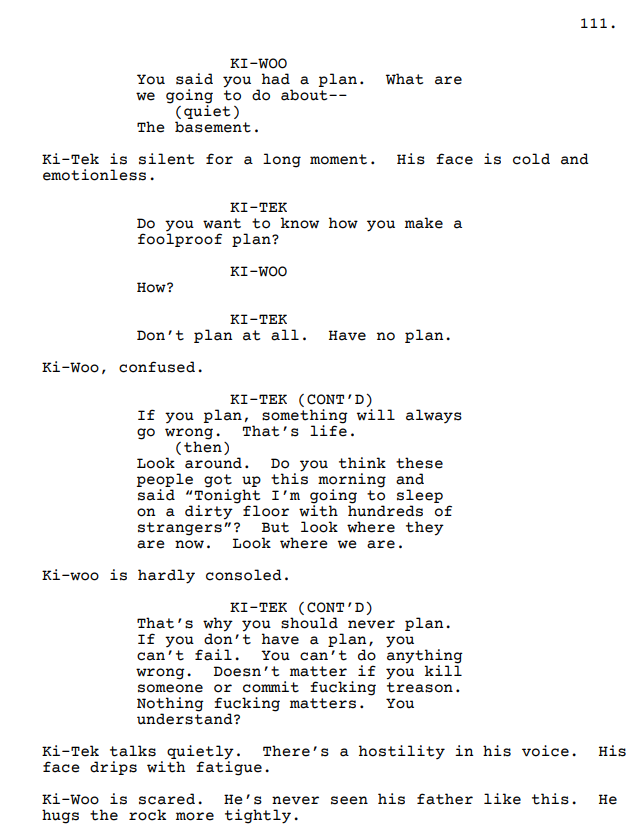
Ki-woo is not like his father. Ki-taek has become convinced of a certain level of cynicism for his own outcome after considering the fates of Moon-gwang and her husband. His son, instead, is clinging to a fantasy that there is more to life. It’s possible Ki-taek understands this, and is why he is so angry about it: the promise that life makes sense one day is false, but how do you kill it without years and years wasted? Nothing matters.
Yet, there is obviously something which matters.
Most American audiences were surprised by the revenge-filled ending of Parasite. Korean cinema features themes of revenge as a part of their film language. The ideas Korean movies get to explore feel very human because of the unfiltered expression of a desire that is so rarely fulfilled. This is (to my amateur knowledge) expressed in Korean by the word “han” which cannot be easily translated. Check out this video from SCREENED to hear more about Korean film and revenge.
The revenge plot that plays out in Parasite is a twisted surprise.
The tension has been built up carefully to bring about an explosion of violence that cannot be decoupled from its political messages rooted in class warfare — or class vengeance.
The hastily-planned birthday party for Da Song brings the Parks to call on the entire Kim family to work. The Parks remain happily ignorant of the hellish night their staff has had. Ki-woo mournfully leaves his student-girlfriend to use the scholar stone to kill Moon-gwang’s husband Geun-se and end the crisis of being discovered. In true thriller form, Geun-se used the time since his wife died to piece together a strategy for flipping the script on his now-captors.
The sequence of events starts in the basement and works its way into the afternoon daylight. Ki-woo and Geun-se struggle against each other until the older man finally knocks the younger down and hits him over the head with the scholar stone, a few times for good measure. In dramatically manic form, Geun-se walks out behind the crowd as everyone is gathered to watch Ki-jung / Jessica carry the birthday cake to Da Song. His sudden appearance through the throng causes a disturbance, the frames become filled with the sounds of hysteria. Ki-taek watches as his daughter takes a fatal stab wound to the heart.
Even in the slowed frame rate, there’s an overwhelming amount of information to process onscreen. Ki-woo, somehow fortunate enough to be alive, is carried out on Da-hye’s back amidst the chaos of people fleeing the yard. Chong-sook fights off Geun-se and counters with a barbecue pick she inserts into his gut. Mr. Park is concerned for Da Song, who started seizing at the trauma. He urgently calls to his driver for the keys. Ki-taek, lost and helpless with his daughter bleeding out in front of him, fumbles the keys. They land on the ground underneath Geun-se as he goes limp from Chong-sook’s retaliatory injury. Later on, her actions would be deemed in self-defense.
Ki-taek’s next moves could not be justified so easily. As Mr. Park leans down to get the keys, he draws attention to the stench of the man. What rage coursed through the elder man. His daughter was dying. His son was in questionable condition. There is a dead woman below everyone. But something in the way the upper class man reacted to Geun-se’s odor triggered Ki-taek to fight. He took the blade used against his daughter and murdered his boss.
Geun-se’s attack on Ki-jung was a desperate man striking back at the family who was responsible for his wife’s death. Chong-sook’s role in Geun-se’s death is displayed as legally rational through court proceedings, but she and Ki-woo are able to continue on after his recovery. Ki-taek’s was the most violent crime, as the story was told in the newsreels following the aftermath. His fate, certain and sad, would leave him to hide in the secret bunker of the famous murder house. There, he would survive as long as he was undetected.
The release of tension Bong Joon Ho gives his audience uses naïve optimism to bring the narrative to a close. He shows us what he meant when he described this film as a tragicomedy.
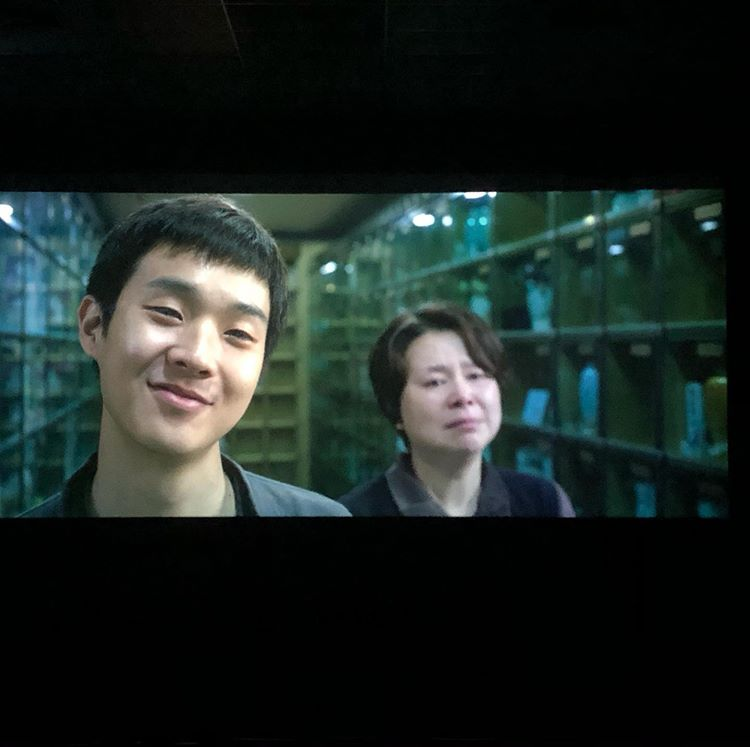
Ki-woo and Chong-sook make visual a metaphor, summoning the image of the masks from Greek history of a gleeful smile and a pained frown. Chong-sook’s thoughts do not close out the film. Instead, it is the youthful view of young Ki-woo who plots out the future that will make everything better.
But why should he hope to acquire something so obviously out of his reach? The human component is easily explained by his love for his father: he wants to fix his hopes on restoring his relationship in a way that would be satisfying and meaningful. It is a tragic realization as the final shot tracks the winter falling outside in the alley down into the semi-basement and fixes on Ki-woo’s face: as he is writing this letter to his father, it is impossible to send it to him. He will never know it. So, even with all the hope he mustered penning the words, the film closes with a son saying goodbye to his father forever.


