
The Authentic Eclectic
Environmentally Speaking, Much Can Happen In Nine Years
The clear evidence of extinction of particular species scared us to death. Nobody seemed concerned or aware. This was an ecosystem in crisis.
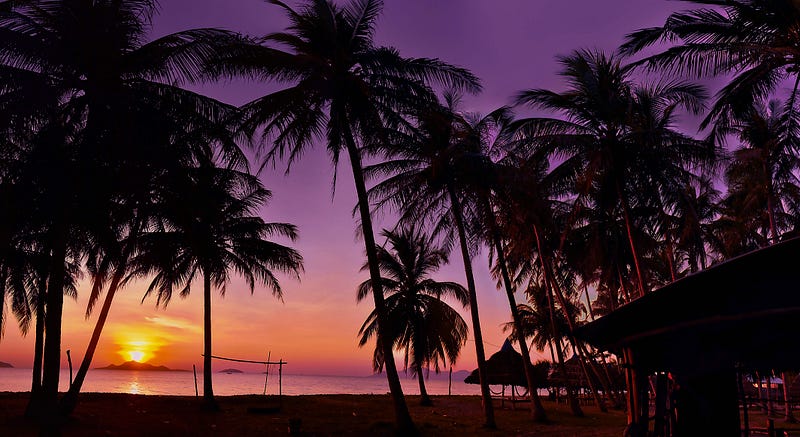
Yes, we returned to Bougainville some nine years after we left, this time with our daughter.
There were people there who had become a big part of our lives, and we wanted them to be in her life too.
Besides, we had so many things to teach her about this island living.
First, let’s flash back to our first year on the island
It’s hard to forget our initial walk along the beach, where the sand seemed to be moving, ever so slightly, but moving nonetheless. On closer inspection we found we were looking at thousands of tiny hermit crabs.
Hermit crabs love to live where the land and ocean meet. That first meeting is still etched in my mind, as there were so many of them. Seems they like to hide amongst the rocks when the tide ebbs.
No matter how often we went to the beach thereafter, we’d stop, and gaze, and be in awe of these omnivorous creatures.
“Hermit crabs lay thousands of eggs at a time. The hatchlings roam the sea as zooplankton. A microscope is the only way to see them. Hermit crab habitat.”
The next species we noticed in plentiful supply, were snails. We learned to tread carefully so as not to crush them underfoot. They were everywhere, so much so, that the local rag, posted a recipe to feed your collection, if you had any. From memory it was a flour and additives concoction. Feed for two weeks, after which you could set up your very own French escargot kitchen.
“Escargot s’il vous plait.”
Some people did try the idea out, but generally speaking, not too many.
And then there were the frogs…shameless creatures who had no problem with copulating on our lawn as we ate dinner on the balcony each night. They seemed to be everywhere, and certainly not intimidated by a human audience!
So nine years later
Nine years and a little wiser, we returned to the island for a one-year stay. So many things we wanted to show our daughter, but that in itself caused us to realize that things had changed a lot!
The baby hermit crabs were no longer there.
The snails had disappeared.
And the croak of the frogs, conspicuous by its absence.
Still we didn’t make the connections that, with hindsight, we should have.
It wasn’t until my husband was offered a flight on the mine’s helicopter, just to see how it all looked from above, that he realized the impact and the devastation the mining had caused.
Bougainville is rich in both copper and gold, much of it spread throughout the island. My husband’s job was to do short-term mine-planning (an IT-based system) that produced a metallurgical assay of the ground. This allowed for a much more accurate assessment of where to mine.
What shocked him, apart from the horrible gouging of the landscape, and more worrying, was the significant spewing of tailings into the Pacific Ocean.
I use the term spewing deliberately. It was a wide and constant discharge into the ocean, with little thought about its effect.
The effect on villages
Bear in mind that the Papuan people had built their homes along the beach. It’s where they lived, socialized, caught their fish, where they swam and had fun, where they earned their living.
Now their water was tainted, which pretty much meant, everything was tainted.
A song from the past
For some reason the words of the Joni Mitchell song, Big Yellow Taxi keeps pestering me for a place in this tale, because over the years it has “become an iconic protest song for environmentalists that choose to ‘fight the destruction of the Earth’s ecosystems by human industrialization.’”
‘They paved paradise And put up a parking lot With a pink hotel, a boutique And a swinging hot spot
“Don’t it always seem to go That you don’t know what you’ve got til its gone They paved paradise And put up a parking lot
‘They took all the trees And put ’em in a tree museum And they charged the people A dollar and a half to seem ‘em
“No no no Don’t it always seem to go, That you don’t know what you’ve got Til its gone They paved paradise And put up a parking lot
“Hey farmer farmer Put away the DDT I don’t care about spots on my apples Leave me the birds and the bees Please!”
Enough! We were in shock. We had to leave.
And so, with heavy hearts, we said goodbye to these beautiful people, wondering why it is that some agencies continue to rob from poor, but mineral-rich countries, so that a few can be wealthy.
We had a whole new take on why the villagers resented all we seemed to have, compared to them.
As it happened, we left just in time
It wasn’t long after our leaving that an uprising began. One of our very good friends, was shot. Shot, but thankfully not killed.
The islanders had had enough.
There was certainly an outrage that they had been abused, and pillaged on their own turf. It was time to take back.
What mining companies are called to do
“When a large-scale mining project reaches the end of its commercial life, a comprehensive mine closure and rehabilitation plan is usually put in place.
‘But Bougainville Copper simply abandoned the site in the face of a landowner rebellion. This was largely triggered by the mine’s environmental and social impacts, including disputes over the sharing of its economic benefits and the impacts of those benefits on predominantly cashless societies.
‘Following PNG security forces’ heavy-handed intervention — allegedly under strong political pressure from Bougainville Copper — the rebellion quickly escalated into a full-blown separatist conflict that eventually engulfed all parts of the province.
‘By the time the hostilities ended in 1997, thousands of Bougainvilleans had lost their lives, including from an air and sea blockade the PNG military had imposed, which prevented essential medical supplies reaching the island.’
including from an air and sea blockade the PNG military had imposed, which prevented essential medical supplies reaching the island.’
Whose side was the military on?
The sad reality…
One mining company was totally responsible for the destruction of a whole island. Around twenty thousand people lost their lives.
Yet, justice, to this day, still has not been done.
Two years ago, ‘156 people from the Autonomous Region of Bougainville, in Papua New Guinea, petitioned the Australian government to investigate Rio Tinto over a copper mine that devastated their homeland.’
Will there ever be justice for the people of Bougainville?
All those years ago, we noted just three species that had all but died out, because of mining. Undoubtedly there will be many more…many, many more, not to mention the effect the mining had on the health of the islanders.
It does pose the question though. Does any one giant corporation have the right to take over a mineral-rich island, and make egregious profits, at the expense of the native people and the land they lived on, and fed from?
Bougainvilleans have long striven to be independent of mainland PNG. The reason for this is that they are, in fact, part of the Solomon Island archipelago.
But it could get worse
Now there are plans afoot to reopen this mine. I dare not think about what will happen.
Sure, they may broker a better deal for the island people. But how much better could it be?
The deal will always come at inordinate cost, loss of identity, loss of peace, loss of biodiversity, and loss of health.
Once again, there will be people like us, visitors working and adventuring, young and blinkered, coming and going, not actually committed to improving a culture…more ignorant of a culture, truth be known.
I have no answers. I have no clout to put the mockers on businesses who could not care less about people’s lifestyle and health.
Instead I will leave you with this thought.
“If you think the economy is more important than the environment, try holding your breath while counting your money.”
More on Bougainville living…


