
ONLY THE NAMES ARE CHANGED
Returning From The Korean War With PTSD
Memoirs 7 — It’s the children who suffer
I want to step outside the story for a moment to get some perspective. When a child feels powerless, the child often learns to be pleasing, to be responsive to the needs of those who have power over her or him.
One of the responses to the wounding of being abandoned in my case, was to attempt to make those around me to become more dependent upon me. If others come to depend upon an abandoned child, the chances of being abandoned again should cease to exist — at least this is the magical thinking that fills the head of a child.
Of course, a single event would soon pass leaving a very small wound in the soul of a child. However, the wounding takes on depth when it is experienced repeatedly. Abandonment is not just the experience of having others leave physically. More often, it is a psychological abandonment which wounds the deepest.
The first four years of my life had seen abandonment take a number of forms. With my mother’s retreat into depression, I was left to the care of my aunts and grandmother. It was a more profound abandonment than if she had left the house never to return.
One feels the care and attention being withdrawn as though one wasn’t worth keeping when the mother is physically present but removed in all other ways.
With my father’s disappearances for extended periods of time, only returning to break down the walls of protective distance before leaving again I was blissfully unaware on how his repeated leaving was wounding me.
I unconsciously learned I wasn’t worth being his son. Both of my parents were unaware of the effects of their total obsession with their own wounds, thus unable to see how they were wounding their children.
I remember living in a small place near the Ottawa River, a place not much more than a cheap tenement in a district of the city called Tunney’s Pasture, when my sister was born. It was my parents’ first home separate from my father’s parents.
In comparison to my French grandparents home bustling with life, where my grandmother took charge of everything, where my Dad’s siblings were constantly massaging his ego; this new home was too quiet and too demanding for both of my parents.
Mom was suddenly expected to do everything to make the mean shack a home, while making sure that Dad continued to stay interested in her. With a third small child in the house, a baby that seemed to always be crying, a toddler fathered by another man, another baby was almost too much to handle.
As well, my mother was unsure that my father wouldn’t once again take flight leaving her alone with these three children. With no one to help her, my mother struggled. And, as she struggled, a dark anger began to surface in my father.
It was an eruption of Dad’s anger that created another traumatic memory within me. The scene that emerged happened in the shack, where we were all crammed into the only bedroom.
My baby sister’s crib was against the wall near the bed and my brother and I were on a small mattress placed on the floor at the foot of our parents’ bed. My sister had woken in the night, crying. My mother wasn’t able to get B to stop crying and it woke my father who had been having trouble sleeping since his return from Korea even though it was almost two years since he had returned.
Dad began to yell at my mother to get the baby to stop crying. His anger-filled voice woke D and me from our sleep. As my father’s voice rose in a fury, D huddled close to me as if I could somehow protect him.
Dad grabbed the baby and shook her as he screamed at her. I could see and feel his rage as he shook her, and I could hear my mother begging him to stop, to put the baby down saying, “Please, Lou. She’s just a baby. Please, Lou.” As D clung to me, I told him “Sh!” as I didn’t want to have Dad turn his anger upon us once he was finished with the baby.
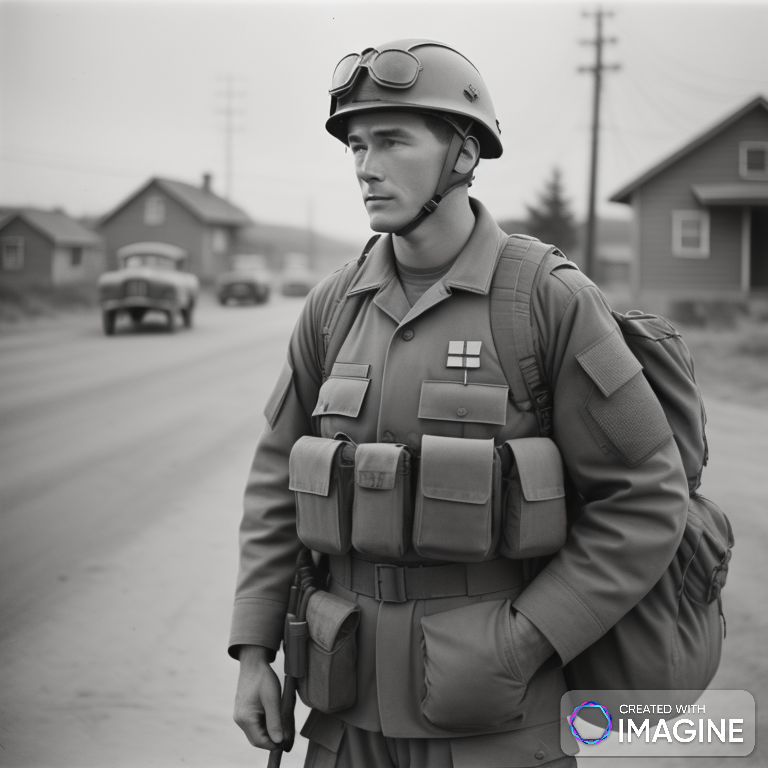
Volatile anger would erupt without any notice. The anger was expressed verbally or physically. It was always sitting on the sidelines. Post-Traumatic Stress Disorder [PTSD] didn’t exist as a condition understood by medicine or by the public at that time.
People went to war and often returned home changed, even damaged psychologically. However, for most, like my father, it was something that lurked beneath, hidden from the world. Occasionally something would trigger an irrational response such as rage leaving everyone shocked, even frightened as the rage erupted and then wore itself out.
I have seen this same rage in other veterans who were in the Korean War, and how that rage caused their families to suffer collateral damage.
It was safest for both my brother and I to be quiet, or to rush to give my father an ashtray, or some other thing that he wanted. D wasn’t as quick to catch on being just three years old. D was always getting on my father’s nerves.
He called D my mother’s little bastard and rejected my brother as his son. With my father’s return from Korea, there was no way to continue the pretense of him being my brother’s true father.
It wasn’t just the war in Korea that had created an immense anger in him. Believing that my mother had cheated on him and had foisted her bastard child on him, pretending that it was his son was too much for him to swallow.
It was only through continued pressure from my grandmother that my father grudgingly agreed to protect the family’s honour, to bury his shame and go on as if everything was as it should be. Our home was a dark place for a child to grow up in with my father’s rage always simmering just below the surface.
Of course, I took ownership of all the bad things that happened. A child doesn’t have the mind of an adult and so can’t look at the evidence in order to judge properly any cause and effect and ownership of words, moods and actions by others.
My father’s deteriorating relationship with his family was taken in by myself and magically transformed into somehow all being my fault.
‘If I was better, he wouldn’t yell at my mother. If I was quieter he wouldn’t yell at us. If I somehow did the right things, he would smile more.’
Like any other child in the same circumstances, these things went on below the surface of my awared, creating patterns of beliefs about myself that would eventually serve as an unquestioning foundation for my later life.
Not long after that, I got sick.
Next
Previously
Thanks to the following for following along with the story this far:
Carrie, Benighted, Patrick OConnell, Adrian CDTPPW, JB The Talker, Maddy Mirza, Block Wife, and katoshi