
Retrofitting Our Buildings, Stabilizing Our Own Lives
How to use emotional alchemy to navigate the little earthquakes.
- Things Change Architecturally
The flyers appeared on Saturday morning, taped to our front doors.
“Holy shit” I gasped when I saw the notices flapping in the breeze. “I’ll bet the owners sold the apartment complex. They’re probably going to evict us all just so they can make multiple millions selling the buildings to new owners. Plus, we’ll have to move and we won’t be able to afford the higher new rents. We’ll be forced to take a second or third floor flat above a dry cleaner or a Seven-Eleven. We’re doomed!” I despairingly said to Linda.
In a few nanoseconds I pictured the drudgery of having to find another apartment and our relegation to a life of poverty. If our landlords had sold the property, there would also be the moving expense. There would be all the time required to find another apartment. The new rent would likely be higher. We already pay 55% of our social security income on rent alone. Then there is the astronomical price of food. Did I mention you shouldn’t think of retiring to LA without hundreds of thousands in savings or investments? Think again!
When we moved out to California to be in proximity with our daughter and her family, the expense and the opulence of the LA lifestyle floored us. Around here, there are more Mercedes, Teslas and Audis than you can shake a stick at. And the real-estate. We used to own a home back in Buffalo, NY but here? Forget it.
There are benefits to driving around in an old Toyota Corolla. The crooks who saw off the catalytic converters from the exhaust pipes seem only to go after the newer and pricier cars. On our walk, we spoke with a AAA repair person who was installing a new battery in a parked car. He said, “I go over to Venice on a weekend and have to put in ten or twelve car batteries. The thieves come along with special tools to open the locked hoods and toss the batteries in a shopping cart full of them to sell for the money.
“Read the notice!” Linda calmly (but assertively) said as she interrupted my panic attack. “They are just retrofitting the garage. They are temporarily working in all the garages behind the building. We only have to park on the street for a couple of months. We don’t have to move.”
“Whew!” I said in relief. “That landlord notice must have triggered some of my phobias and maladaptive schemas. So they are doing some construction work on the garage end of our buildings in case of potential earthquakes. A reality check for me!”
2. Spotting Structural Architectural Weaknesses
Earthquakes. When we first visited Los Angeles in 2010, our daughter mentioned earthquakes. “It isn’t a big deal, just some occasional shaking” she assured us.
During our early visits, we would stay in a motel near our daughter’s residence. In one visit, we were gently awakened in the middle of the night by the rocking of our bed. Turns out that Los Angeles experiences an average of five earthquakes a year with magnitudes around 3 and 4 on the Richter scale . The Richter scale defines the significance of a quake. For example, a 5.3 is a “moderate” where a 6.3 is a “strong” earthquake. What you experience also depends on how far away the disturbance is from where you are standing.¹

¹ The Richter scale is a logarithmic calculation where each whole number represents a tenfold increase in measurement on a seismogram. Magnitude is expressed in whole numbers and decimal fractions. source
They didn’t have this information in the travel brochures we saw before moving to LA. There are an average of 59 smaller earthquakes each year with magnitudes between 2.0 and 3.0. The hotel sightseeing pamphlets also didn’t mention that in 1994, the Northridge earthquake was a magnitude 6.7. It bubbled up twenty miles west-northwest of downtown Los Angeles. The shock lasted about 20 seconds, killed 57 people and caused billions in property damage. The Northridge quake is remembered as one of costliest natural disasters in U.S. history. It destroyed or damaged thousands of single-family homes, apartments and mobile homes, displacing about 22,000 people and caused more than $20 billion in residential damage — the equivalent of nearly $35 billion today.²
² “How likely is ‘the Big One’ earthquake to hit west coast after recent LA tremors?’’
“Northridge earthquake remembered as one of costliest natural disasters in U.S. history”
California is said to be about 80 years overdue for “The Big One.” This is the kind of massive earthquake that periodically rocks California as tectonic plates slide past each other along the 800-mile long San Andreas fault. Scientists say that a Northridge-magnitude earthquake is a near certainty somewhere in California again in the next 30 years.³
³ “UCERF3: A New Earthquake Forecast for California’s Complex Fault System”
“How likely is ‘Big One’ earthquake to hit California after recent LA tremors?”
“25 Years Later — What If the M6.7 Northridge Earthquake Were to Strike Again?”
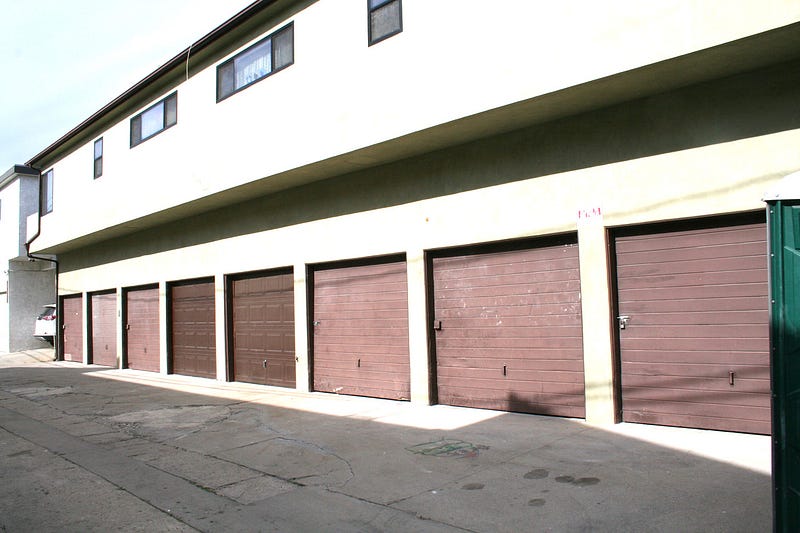
Because of previous earthquakes, the City of Los Angeles passed a mandatory ordinance about building structures. The regulation dictates that multiple story wood frame buildings built before 1978, with wide unsupported 1st floor or brittle concrete beams or walls, need to be retrofitted. These structures could not withstand the stress of earthquake movement and would tend to collapse. It has been determined that the structural vulnerability of this building type is typically due to “soft,” weak or open front walls. In 1978, the building codes were changed to require concrete steel reinforcement and steel vertical strengthening. They wanted the construction industry to create the most economical and feasible method to shore up these buildings subject to structural failures.⁴
⁴ On October 2015, LA passed ordinance 183893 regarding wood frame buildings. Under Ordinance 183893 and Ordinance 184081, the new building codes pertain to “soft story” structures or “non-ductile concrete structures” (that contain brittle concrete elements like columns, beams, walls, and connections). These structures tend to perform poorly during earthquakes.
- https://www.ladbs.org/services/core-services/plan-check-permit/plan-check-permit-special-assistance/mandatory-retrofit-programs
- https://www.ladbs.org/services/core-services/plan-check-permit/plan-check-permit-special-assistance/mandatory-retrofit-programs/soft-story-retrofit-program
3. Shoring Up Architectural Weaknesses
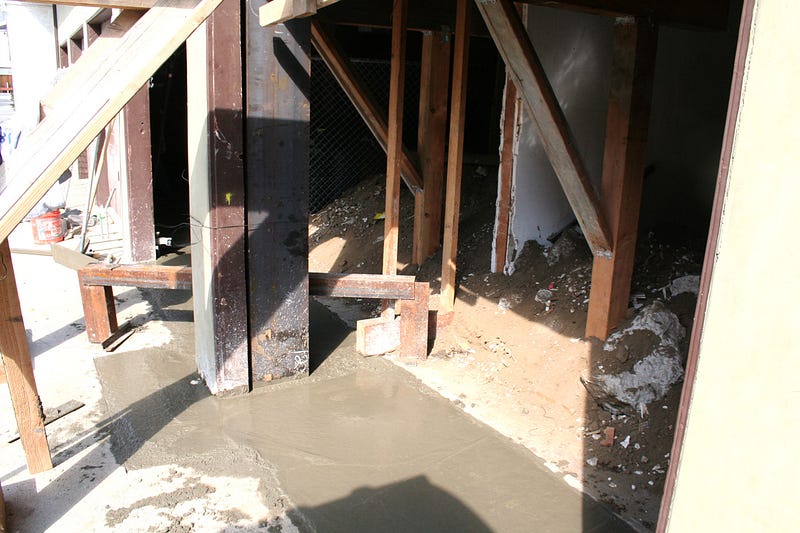
In the base of our garage complex, they dug down six or more feet into the garage floor. Then they placed a new vertical steel column to support the second floor above it. This steel pillar rests on a steel-reinforced concrete footer to support the new column. Across the width of the building, only one new steel beam is added to support the structure. The new steel column doesn’t prevent earthquakes, the occasional tremors nor the accompanying structural issues. It just adds stability. It can save lives. It’s like the cane I use because of my multiple sclerosis. It doesn’t prevent me from having MS nor my occasional leg buckling and overall awkwardness. It just helps with my stability. My cane is like having another leg on which to stand.
- Things Change For Us Personally
Oh these little earthquakes Here we go again These little earthquakes Doesn’t take much to rip us into pieces”⁵
⁵ Chorus to Tory Amos’ “Little Earthquakes” by Tori Ellen Amos, Little Earthquakes lyrics © Downtown Music Publishing, Kobalt Music Publishing Ltd.
Impermanence is one of the central teachings of Buddhism. Mindfulness of how much and how frequently things change in our lives seems to run counter to our affluent lifestyle. Think of the atrocities occurring in Ukraine.
· We don’t want any pain or inconvenience.
· We went more than we have.
· We want the best.
· We want it now.
· We want what we have to last forever.
· We want everything to stay the same
· We want it all and we deserve it.
But life is not like that but we earnestly believe it is and should be so. Since we ‘can’t take it with us,’ we don’t want to go anywhere that won’t let us keep forever those possessions which we’ve worked so hard to accumulate. Why not stay here in the Villages and take our golf cart to the corner commissary and get a snack?
The problem with living in this change-adverse sort of house of cards is that things fall apart. Like the LA buildings which cannot adequately remain stable, we humans can become stressed when things change. How we respond to life’s changes can turn out to be somewhat predictable. Sometimes we distort and overreact in certain predictable patterns.
Fortunately, the changes in our personal lives are not as earthshattering (I had to use that adjective) as the Northridge LA quake in 1994. But some things set us off. What often causes us imbalance are some predictable patterns of our poor responses to stressors. If we have learned from past architectural research about structures that don’t hold up during earthquakes, can we learn personal skills which support us in times of stress?
2. Spotting Structural Personal Weaknesses
Life is impermanent — like the changeable Southern California landscape. Life for all of us is changeable. Life doesn’t always work out as we planned or hoped. Star athletes eventually lose physical function. We fall in love but tragically, we get divorced. We gain and then lose careers. Our health comes and goes. While life is not totally unpredictable, change happens enough that we can’t insure any kind of permanence. Life doesn’t stay the same. Life changes. We change.
How we navigate through life’s changes is directly affected by our own psychic structure. Just as the seismic scientists have learned from architectural structures that don’t fare well in earthquakes, social scientists have found patterns we may have in our temperament that will hinder our resiliency in times of stress.

Social scientists have gained knowledge of vulnerabilities in our personalities that are less suitable for enduring times of emotional turbulence. One of the benchmarks of research on emotional wellbeing is Tara Bennett-Goleman’s Emotional Alchemy, How The Mind Can Heal The Heart.⁶ Just as the city of Los Angeles has newly formed building codes guiding building structures, you may find Emotional Alchemy to be a helpful first resource to become mindful of areas needing emotional strengthening.
⁶ Harmony Books, New York 2001.
In Emotional Alchemy, Bennett-Golemen describes the “schemas,” the mental states, that can become our habits which cause us to behave in certain ways. Like certain kinds of buildings that don’t hold up in the earthquake tremors, a schema is a mental state that has become a habit that leads us to behave in maladaptive ways in response to threatening changes.
Every schema can be seen as an attempt gone awry to fulfill the basic needs of life: safety, connection to others, autonomy, competence, and so on.⁷
⁷ Emotional Alchemy , p.66.
Our schemas can inhibit our own stability when we struggle with change. To keep from becoming trapped in negative thoughts and feelings, awareness of these patterns in ourselves and our tribe around us can bring us to a more settled sense of wellbeing. Emotional Alchemy helps us learn strategies to remain stable when we suffer schema attacks when we feel we are threatened.
Bennett-Golemen describes two areas of schemas: Personal Relationship Schemas and Career or Community Life Schemas. I only list the schemas to note that she covers the waterfront of our human weaknesses. Depending on the day and the circumstance, we could be subject to any of these personal and communal weaknesses.
She helpfully describes each of schemas noting:
(1) The core thinking and emotion
(2) The fixation which binds us
(3) The maladaptive coping which causes our social and psychological failures plaguing us.
(4) Specific tasks that will help us out of these problematic mental and emotional patterns
Just to give you an overview of the scope of her book, here is a simple listing of the types of schemas her work describes.
Personal Relationship Schemas
Abandonment –triggers anxiety and fear, causing us to think people will abandon me. Emotionally we are fearful. We can develop anxious attachment, or we put up with a bad relationship. We can stay stuck as we await signs that someone will leave us.
Deprivation — triggers sadness and hopelessness. Emotionally we feel that our needs won’t be met, that we cannot be understood, known or be one who is cared for by others.
Subjugation — triggers shame and humiliation. We think our needs never take priority.
Mistrust — triggers rage, causing us to feel people can’t be trusted.
Unlovability — causes us to feel we are somehow flawed so that we feel shame and humiliation.
Career or Community Life Schemas
Exclusion — triggers anxiety and inadequacy as we feel that we don’t belong.
Vulnerability — gives rise to a general anxiety about possible catastrophes. We feel that the world is a dangerous place. [Perhaps when I overreacted to the property owner’s notices on our doors, I was plagued by this schema.]
Failure — causes deep self-doubt and an anxious sadness.
Perfectionism — triggers sadness and a sense of failure no matter the extent that we try.
Entitlement — triggers a lack of empathy for those who potentially may take advantage of you.
Carefully reading through Tara Bennett-Golemen’s Emotional Alchemy will be like reading the guidelines of the geological survey’s identification of our building’s structure that needed retrofitting. Similar to how certain building configurations require added support, each of us have our own patterns of responding that may need shoring up. This is true when life brings surprises and hardships. Consider Emotional Alchemy to be a primer about retrofitting your personal building codes.
3. Shoring Up Personal Weaknesses
“It’s typical that I would react that way” we tell ourselves after reading through Tara Bennett-Golemen book. But how do we install the steel-reinforced concrete based struts that ground our sometimes-flimsy psyches? “Life sometimes dishes out some surprises that are really stressful, no matter how neurotic I am” we proclaim in our harder times.
Life is always in the process of change.
The new steel column doesn’t prevent earthquakes, the occasional tremors nor the accompanying structural issues. It just adds stability. It can save lives.
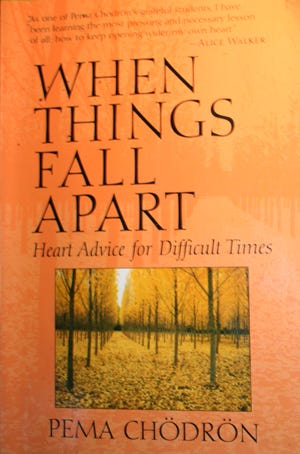
Finding our grounding, our personal stability in life, is a lifelong task. That process is a journey of gaining wisdom, maturity, and the complex work of compassionately accepting, forgiving and celebrating ourselves and those around us. This process of gathering tools for stability motivated me to write this article. As halting and as incomplete as any attempt like this may be, I suggest a second book for you to read once you’ve enjoyed taking in Emotional Alchamy. To take yourself up to the next level, read Pema Chodron’s When Things Fall Apart, Heart Advice for Difficult Times.⁸
⁸ Shambhala, Boston & London 1997.
When Things Fall Apart — 20th Edition By Pema Chodron (paperback) : Target
Things falling apart is a kind of testing and also a kind of healing. We think that the point is to pass the test or to overcome the problem, but the truth is that things don’t really get solved. They come together and they fall apart. Then they come together and fall apart again. It’s just like that. The healing comes from letting there be room for all of this to happen: room for grief, for relief, for misery, for joy.⁹
⁹ When Things Fall Apart, p.8.
Things like disappointment and anxiety are messengers telling us that we’re about to go into unknown territory.¹⁰
¹⁰ When Things Fall Apart, p14.
Grounded Personal Stability
Chodron’s book, When Things Fall Apart is a brilliant summary, in my opinion, of the wisest of Buddhist teachings. Pema masterfully shows us how to approach our difficulties. She practically outlines what we can be doing with ourselves when we feel lost or unable to find our way through the uncertainties that plague us all. She writes clearly in understandable prose and has pertinent examples and metaphors. Her work encompasses classic Buddhism and describes what we need to maintain a healthier balance in life.
To be faithful to scholars who are familiar with Tibetan Buddhism, she will occasionally mention a Tibetan word or two. In each case, though, she quickly moves on to explain the concept in our own language and culture.
When Things Fall Apart has provided a grounding for my life. My hope is that her work may do the same for you.
Conclusion
Emotional Alchemy gives us an introduction to understanding our maladaptive responses to change. When Things Fall Apart helps us enact the retrofitting. Pema Chodron provides practical tactics for us in the face of change. We gain greater stability and strength as we practice living fully in the present. She encourages us to avoid living in the past and escape from the ‘what ifs’ of the future. These teachings free us from the tendency to run away from problems and stressors. Instead, Chodron teaches us how to find greater stability amidst the ever-changing world around us.
The take home for this article is my recommendation for you to read both Bennett-Goleman’s and Chodron’s books. I’ve read them many times and find their works to be life changing. Ironically, after you’ve digested When Things Fall Apart, you will come to see that your life is more together than it ever was. Its wisdom will be powerfully healing.
Isn’t that why we long for structural integrity?


