
Retiree Climate Investments that Could Yield 30% Returns or More
How to profitably help clean up the mess we made

If you are retired and working with a financial advisor to manage your 401k or Roth IRA, chances are no one has talked with you about the substantial returns you could be getting through individual-level carbon mitigation investments. To be clear, I am not talking about ESG stocks or green investing. Rather, I am talking about the huge returns offered by eliminating your own carbon emissions.
While there are many good reasons to eliminate carbon emissions that have to do with climate change, it turns out that some actions also offer outsized financial returns. There’s a limit to how much you can invest and still get these returns, but utilizing them to optimize a retirement portfolio is smart money for anyone who can invest. (I’ll review the investments below, but remember to consult your own financial advisors before making any financial decisions.)
Quick Overview of the Environmental Benefit
For this article, climate investments are those that can produce a substantial reduction in one’s personal carbon output. By “personal carbon output” I am not talking about the common notion of carbon footprint, which purports to account for all the upstream carbon our individual choices entail. Rather, I want to address those emissions that you can control, or what are known as direct emissions. Direct emissions are what you cause directly by your actions — driving a gasoline-burning vehicle, for example, or operating your natural gas-burning furnace. Indirect emissions, on the other hand, are those that result from an activity “upstream,” away from the actual usage or choices the consumer makes. Indirect emissions are usually cited in estimations of the carbon footprint of beef or air travel, for example. The difference is that direct emissions can be managed by your own behavioral choices and investments, whereas indirect emissions are affected by many factors, your choices of which are only a small part. If an investment can have a substantial impact on one’s direct emissions, it is worth looking at whether or not the investment is financially worthwhile for retirees to consider. But there are two good options every retiree should consider from an investment perspective.
Investment #1: A 30% Rate of Return by Choosing an EV over a Gas Burning Car
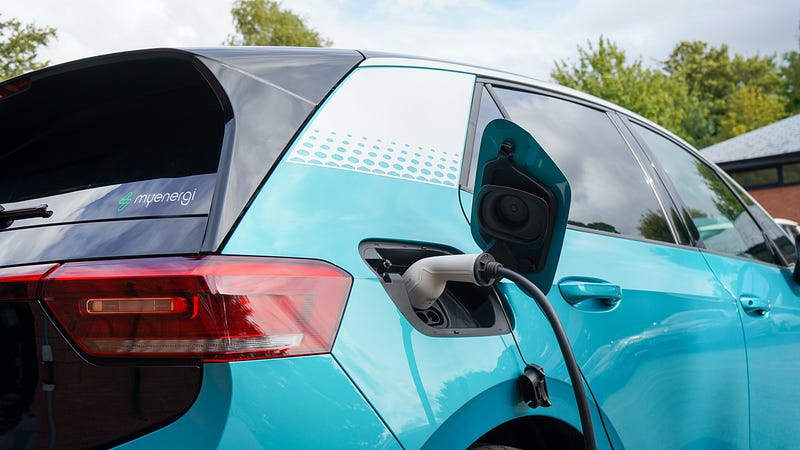
Most retirees living in the US have grown dependent on automobile transportation. We need cars to move around, obtain groceries, visit friends and family, and maintain our independence. As long as a retiree can drive, he or she will have a car. By converting from a gas-burning car to an electric vehicle, carbon emissions from the tailpipe are eliminated, even though the net reduction depends on other factors as well, especially the source of electricity. As I illustrated in another article, going to an EV will almost always reduce emissions. But can it also be a good investment?
As with the carbon benefits, the investment outcome of switching to an EV also depends on many factors.
- Price of gasoline
- Price of electricity
- How much you drive
- Price of the vehicle
- MPG efficiency of the car you drive now
- Kwh/mile efficiency of the EV
These factors vary quite widely, so it is important to consider and compare one to the other. For example, the price of gasoline has recently been as low as $2.00 a gallon, as high as $6.00 a gallon in some places, Today, as I write, it floats around $4.00 per gallon. Likewise, electricity typically ranges from around $0.07/kwh to as high as $0.25/kwh. We also know that the efficiency of gas-burning cars ranges from about 8 MPG to 50 MPG, while EV efficiencies range from 0.15 kwh/mile to 0.87 kwh/mi. With ranges that are this wide, any given situation needs to be analyzed carefully. But such analysis is warranted because even in average conditions, returns can reach 30% per year or more.
To see how this works, let’s look at a case. You are retired and you need a new car. The gas-burning SUV is $30,000 and the EV SUV is $40,000. You are going to purchase one or the other because you need a vehicle, but you are thinking to yourself: “Gee, that EV looks nice but it is so much more expensive!” And you are right — $10,000 is a lot more money.
But let’s think about this. Let’s assume you drive 1,000 miles per month, gas costs $4.00 a gallon, and your mileage is 25 mpg (the average). In this case, the gas-burning vehicle will cost you $157 in gasoline plus an average of $20 per month in oil changes (assuming one every 3 months or 3,000 miles) for a total monthly operating cost of $177. If you drive the same 1,000 miles per month in your EV with the cost of electricity at $0.15 per kwh and the vehicle you want to buy rated at 0.35 kwh per mile (the average), you can calculate your estimated monthly cost as $50.90. The EV costs $126 a month less to operate. Over the course of a year, you save $1,512.
Now, you may think, well, that’s not so much money. But consider this. You are going to buy one car or the other because you need a car, so $30,000 will be spent no matter what. The EV is, as we said, $10,000 more. That increment is the actual investment you are making to drive an EV instead of a gas-burning vehicle, and $1,512 of savings on a $10,000 investment is over 15% annual return. Chances are you are not getting that in your stock portfolio.
Here’s the kicker: For many people, 1,000 miles per month of driving isn’t very much. Many would say that 2,000 miles per month is more realistic. If that’s you, the savings every month double to over $3,000 per year, but the incremental investment is still $10,000. Now that investment is paying you a 30% return, and it goes on year after year.
Now, here’s the double kicker: If you buy a qualifying EV, you also qualify for the EV tax credit, which can be up to $7,500 on a new vehicle. Whatever your new EV may qualify for, that effectively reduces the incremental investment even further, and the returns on the incremental investment begin to calculate at ridiculous looking numbers.
Purchasing an EV gets even better if you also undertake the second good retirement investment because it could reduce the cost of electricity substantially, maybe even to zero. Each increment in cost savings improves the return. So let’s look at that investment next.
How to Get Steady, Long-term, Growing Returns on Rooftop Solar
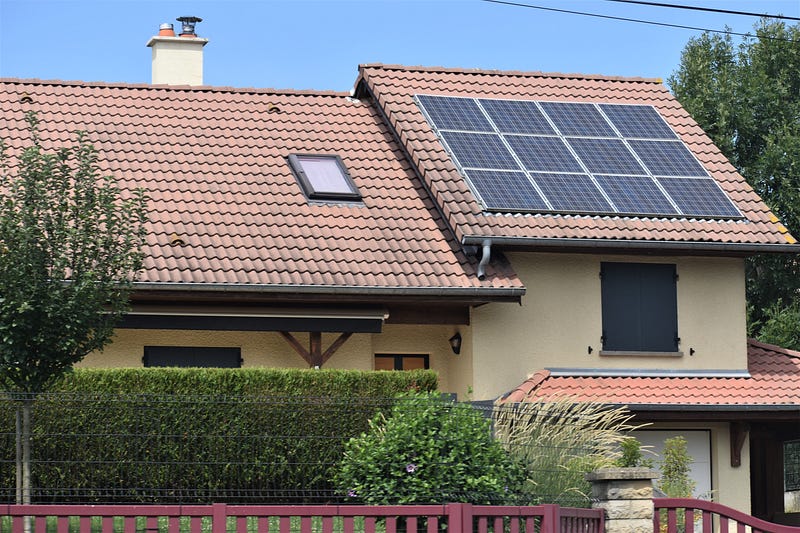
Whether you are building a new home, buying a retirement home, or setting up your family home for a term in retirement, the installation of renewable rooftop or backyard electricity is a worthy investment to consider financially. Your returns will depend on many factors including your local cost of electricity, your available sunshine or wind energy, construction costs, and more. In most cases, people are achieving returns of 10–25% in the first ten years, and once they achieve payback, their electricity from the system is essentially free — usually for up to 30 or 40 years.
Here are some of the factors that determine the ultimate rate of return in a given situation.
- Tax incentives, including the 30% federal tax credit.
- Other federal, state, and local incentives.
- Local cost of electricity.
- Cost of building and installing the array.
- Amount of electricity produced by an array or wind system.
- The utility rate credit offered for excess production.
- Increased home valuation without increased property taxes
These and other factors affect the key elements of the investment — the amount of capital invested and the return from operating the system built with that capital.
Solar Rooftop Return Example
Let me give an example. In my rural area, a modest-sized home might use 740 kwh of electricity per month on average, or 8,900 kwh per year. To reliably generate that much electricity, one could build an 8 kW solar array to cover all electricity used. The average cost for constructing an array is $2.60 per watt, in Wisconsin, or $20,800 total. While that’s a lot of money, it makes good investment sense for many people. Many retirees have used their 401k funds because of the returns available, as you will see.
The first reason to consider this is simple — there is a federal investment tax credit that allows the homeowner to receive 30% of the cost of the solar array in the form of tax credits. People who are approaching retirement but still working and have taxes withheld from their paychecks will probably see this as a refund. In this case, the refund would be $6,240. This 30% of the purchase price incentive is returned to the homeowner as a credit on one’s taxes, so the net investment is the purchase price minus the tax credit. (Anyone interested should check with their tax advisor to see what the impact would be in their specific situation.) Hence, the $20,800 sticker price gets reduced by 30% by using the tax credit, for a total investment of $14,560. If other incentives apply, the total investment is reduced further. For example, my state of Wisconsin has a $500 rebate for anyone who installs solar and an additional $500 rebate for those who install solar in a rural area. I would take that rebate and reduce my investment basis by another $1,000. The total investment would be $13,560.
The average electric rate in Wisconsin is $0.17 per kwh. We also have net metering (as most, but not all, states do). Think of net metering as a technical function that turns the utility into a virtual battery that will store your excess produced energy — for example in my area, the excess will be large in July, adding energy into the virtual battery, and my home will draw from that virtual battery in January and February when the panels are covered with snow. What determines the value is how many kwh the homeowner doesn’t have to buy from the utility and what the price is. Here, the price is $0.17 and the total kwh is the annual amount of kwh a home uses. In other words, the homeowner is replacing 100% of her electric bill.
The bill to the utility would have been $1,514 for the year at $0.17 per kwh for the 8,904 kwh used. That bill goes away because the electricity you use is coming from the array and the “virtual battery” on the grid. Hence, the first-year return on the investment is $1,514/$13,560 for an ROI of 11.16%. That is a decent return for any investment, but it gets better.
Although these first-year returns are at or above average for stock market returns, they differ in some important respects. First, they are paying back every month in the form of a non-existent electric bill. Second, utility electric rates keep rising. If the average rate of increase over ten years is 2–3%, for example, the homeowner saves 2–3% more money every year, which increases the return on investment. In this way, solar energy is a great long-term strategy to help fight inflation because every time electric rates go up, the retiree’s expenses from electricity remain zero. At the same time, the retiree’s income is going up based on cost of living adjustments, so the net effect is like getting a small raise every time the electric rates go up!
There is one other important aspect to this as well. Studies have shown that installing solar panels on your home increases the market value of the home by an average of 4.1%. If the average home in my example were valued at, say, $300,000, installing solar would increase the home’s value by $12,300 — that’s nearly dollar for dollar the investment I would have made in solar after the tax credit and state incentive. Those benefits brought the total down to $13,560. If the investment is covered by an increase in home value or $12,300, the net investment is only $1,260, which is less than my annual savings of $1,512 on electricity, yielding a 120% annualized return. I know, it looks ridiculous, but that’s the numbers. Your net investment is repaid in less than one year and you can save that amount on electricity for essentially the rest of your life.
For the skeptics out there, are there any caveats? Sure there are. Solar panel productivity degrades by about 0.5% per year, and that will work against your long-term savings increases based on the increasing rates utilities will inevitably charge. But it is only a reduction in gains.
Likewise, the skeptic will argue that property taxes will go up and offset the gains. That could happen in localities with property taxes, but in many US states, local assessors are barred by state law from increasing tax valuations based on the installation of rooftop solar energy. No matter where you are, you should look into the effect on taxes. Most people will find there isn’t one or it is minor enough to ignore.
The calculations on solar are fairly complex and the details in any given situation must be assessed carefully while taking into account all the local variances. This investment should be evaluated with cost estimates from a local contractor, your own tax and financial advisors, and a sophisticated, experienced solar financial advisor. While the benefits are substantial and in my view constitute a good investment, you have to make the cash available upfront to pay for the system. While 11–12% is a baseline minimum to expect, we’ve just seen that the total investment could provide returns substantially higher than that — even exceeding 100% annually.
A final note
Most retirees built whatever wealth they have on a fossil fuel economy because it was the only thing available to us during our lifetimes. As such, we each carry some of the responsibility for the mess the Earth is in regarding climate change, and many feel a responsibility to give back. Yet, we also did our work, contributed as we could, and need to protect our retirement years so we can live well. The good news of this article is that you can do both. EVs and rooftop solar will both make huge reductions in your direct emissions and with the way the world is structured today, they will also enhance your retirement financial security. As I said, however, consult your own tax and financial professionals before you make any investment.
Anthony Signorelli