
Astrophysics
Rethinking Dark Matter (#25)
The origin of the idea for dark matter comes from the observation that galaxy clusters rotate around each other faster than was predicted by Newton’s inverse square law (Fritz Zwicky in the 1930s). Astronomers hypothesized there must be some other hidden matter that explained the fast rotation.
In the 1970s, the astronomer, Vera Rubin, deduced that stars in many galaxies had velocities that exceeded their estimated escape velocities i.e. the stars should continue to move further and further away from the centre of a galaxy. Again, the proposed explanation was that there was some other hidden matter.
The existence of hidden matter in galaxies was confirmed by astronomers measuring how light from far away galaxies was bent when there were galaxies between the far away galaxy and Earth. The effect is known as gravitational lensing. The path taken by photons was measured to be longer than that predicted using the known mass of galaxies. The explanation for this divergence is the existence of dark matter.
Dark matter has now been incorporated into theories about how the universe has evolved. For example:
‘Structure in the universe formed on the smallest scales first. It is believed that dark matter condensed first to form a “scaffolding,” with normal matter in the form of galaxies and clusters following the dark matter concentrations’.
Despite the strong theoretical evidence in support of the existence of dark matter, no dark matter particles have been found.
Predicting the rotation curve of stars in a galaxy
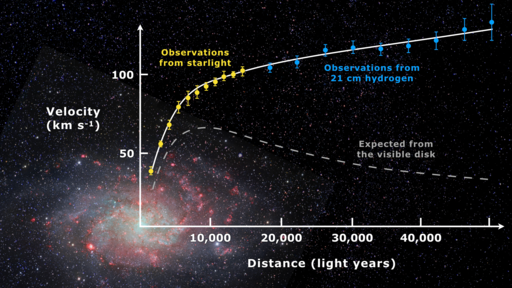
The rotation curve of the spiral galaxy Messier 33 provides an example of the difference between the observed and expected rotation curve of stars around a galaxy. The observed rotation curve varies among galaxies. Sometimes the line has a positive slope as for Messier 33, sometimes the line is flat, and in others, the line has a negative slope.
Not all scientists believe in the existence of dark matter. For example, some astrophysicists have proposed the MOND theory where Newton’s equation for gravity is modified over long distances.
There is a relatively simple statistical relationship involving dark matter that mainstream cosmologists do not seem to discuss publicly. This analysis raises significant challenges to current ideas about dark matter.
Using an excel spreadsheet containing public data from the SPARC database on the velocities of 3,360 stars in 175 galaxies, calculations can be made to determine the amount of dark matter required to explain the deviations between the expected velocities using Newton’s equation for gravity and the observed velocities. The SPARC data is based on a wide cross-section of different galaxies.
For stars that are 2 kiloparsecs (kpc) or further out from the centre of a galaxy (2,665 stars), the average discrepancy between predicted and observed velocities is -19% with a standard deviation of 28%. When Equation 2 (see below) is used to predict the velocities of the same stars, the average discrepancy is -2% with a standard deviation of 5%.
Calculation of the discrepancy is affected by the uncertainty associated with measuring the velocities of stars and estimating the radial distances of stars e.g. the uncertainty associated with the distances of 50 objects from the Tip of the Red Giant Branch (45), Cepheids (3), or supernovae (2) ranges from ∼5% to∼10%. This suggests that the discrepancies (standard deviation) associated with Equation 2 are within expected error margins.
The equation predicting the velocity of a star using Newton’s equation for gravity is:
Vᵣ ~ √(Mᵣ/r) ………………………………… (1)
Where Vᵣ = Velocity at radius r
Mᵣ = Mass of a galaxy within radius r
r = Radius of a galaxy
The revised equation is:
Vᵣ ~ √([Mᵣ — {dev(r-1)*M(r-1)}]/r) …………. (2)
Where dev(r-1) = Deviation in velocity using Newton’s equation for nearest inner star;
M(r-1) = Mass of the galaxy associated with the star closer to the centre of the galaxy
In brief, it appears that the observed velocities of stars can be reasonably accurately predicted with Newton’s equation for gravity after taking into account prediction deviations associated with a nearby inner star.
Superficially, this result may appear to be consistent with the dark matter hypothesis i.e. the amount of dark matter increases as the radius increases. However, according to particle physicist, Sabine Hossenfelder, Renzo’s rule suggests that dark matter should remove any correlation between the luminosity of baryonic matter and the galaxy rotation curve.
“For every feature in the curve for visible emission like a wiggle or a bump, there is also a feature in the rotation curve, that’s an observational fact but it makes absolutely no sense for dark matter if you think that most of the matter in galaxies is dark matter. The dark matter should remove any correlation between the luminosity and the rotation curves.” (time 6.21)
Problem with dark matter hypothesis
The theory behind dark matter does not explain how dark matter is distributed in a galaxy. Consequently, the observation that the velocity of a star depends on the amount of dark matter associated with a nearby star cannot easily be falsified.
This series of articles proposes a hypothesis that provides a scientific explanation for the observed statistical relationship; a potentially falsifiable explanation. In this proposal, no ‘prior’ distinction is made between different types of galaxies. All stars lying outside a galaxy radius of 1.95 kpc are included in the analysis; there are no assumptions about the distribution of dark matter in galaxies. The ‘explanation’ for dark matter is associated with each galaxy’s baryonic mass rather than an assumption that dark matter forms a scaffold for the structure of galaxies.
The question for this article is:
Are astrophysicists not acknowledging the dark matter hypothesis is not easily falsifiable?
To view the headings of all the articles to be published in this series please click on https://readmedium.com/orbiting-stars-and-origin-of-our-universe-338906930f51
To obtain a copy of the book ‘Orbiting Stars’ which contains the first drafts of all these articles, please visit https://www.amazon.com


.png)